Department of Microbiology, Immunology, and Pathology, Colorado State University, Fort Collins, Colorado 80523, USA.
Nat Commun. 2017 May 19;8:15412. doi: 10.1038/ncomms15412.
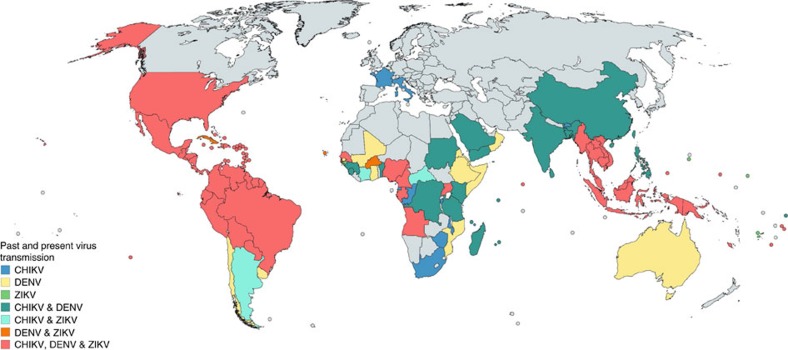
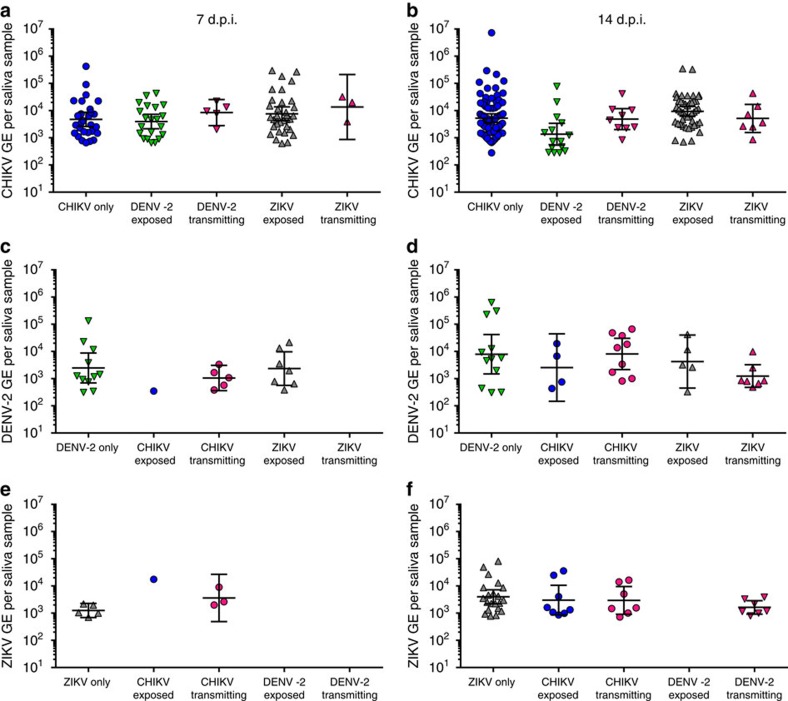
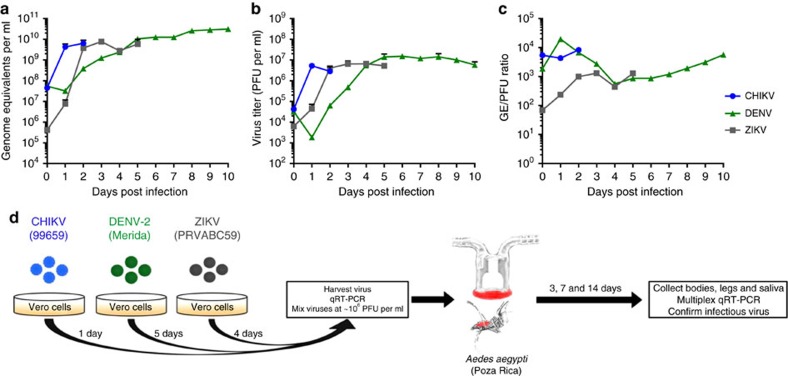
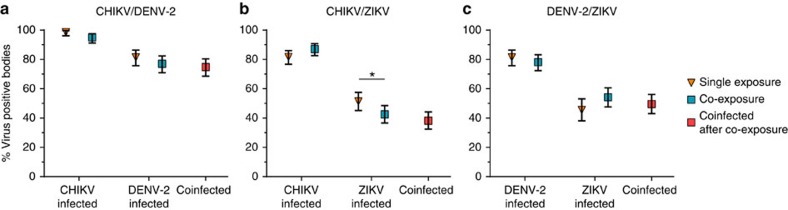
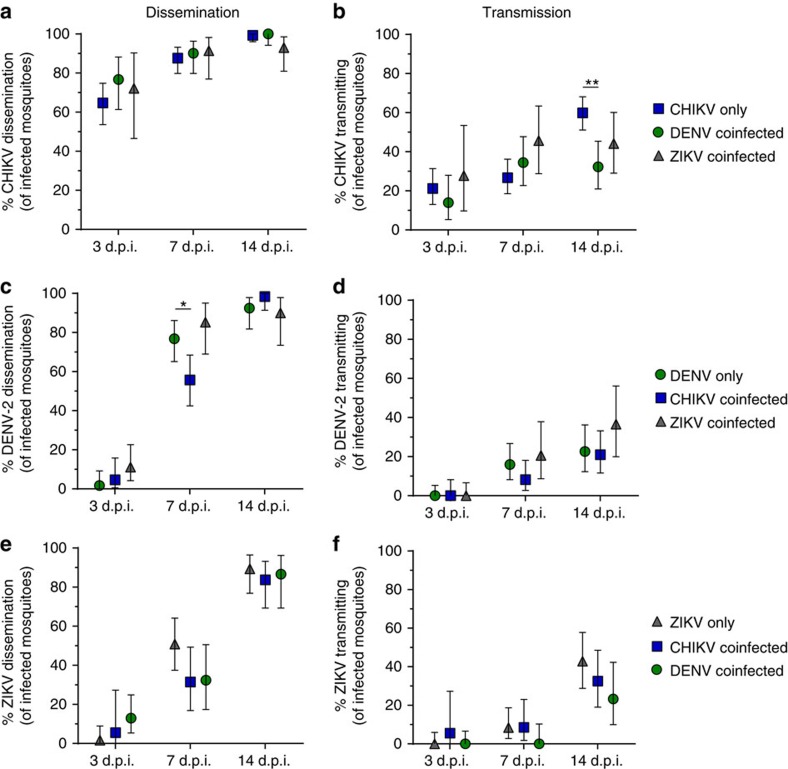
The recent emergence of both chikungunya and Zika viruses in the Americas has significantly expanded their distribution and has thus increased the possibility that individuals may become infected by more than one Aedes aegypti-borne virus at a time. Recent clinical data support an increase in the frequency of coinfection in human patients, raising the likelihood that mosquitoes could be exposed to multiple arboviruses during one feeding episode. The impact of coinfection on the ability of relevant vector species to transmit any of these viruses (that is, their vector competence) has not been determined. Thus, we here expose Ae. aegypti mosquitoes to chikungunya, dengue-2 or Zika viruses, both individually and as double and triple infections. Our results show that these mosquitoes can be infected with and can transmit all combinations of these viruses simultaneously. Importantly, infection, dissemination and transmission rates in mosquitoes are only mildly affected by coinfection.
近期,基孔肯雅热和寨卡病毒在美洲的出现,大大扩大了它们的分布范围,因此增加了一个人同时感染多种经埃及伊蚊传播病毒的可能性。最近的临床数据支持人类患者中合并感染频率的增加,这增加了蚊子在一次吸血过程中可能同时接触多种虫媒病毒的可能性。合并感染对相关媒介物种传播任何一种病毒的能力(即媒介效能)的影响尚未确定。因此,我们在这里单独以及双重和三重感染的方式,用基孔肯雅热、登革热 2 型和寨卡病毒感染埃及伊蚊。我们的结果表明,这些蚊子可以同时感染并传播所有这些病毒的组合。重要的是,蚊子的感染、传播和传播率受合并感染的影响很小。