Lessard Lysanne, Michalowski Wojtek, Fung-Kee-Fung Michael, Jones Lori, Grudniewicz Agnes
Telfer School of Management, University of Ottawa, 55 Ave. Laurier E, Ottawa, ON, K1N 6N5, Canada.
Institut du Savoir Montfort (ISM), 202-745A Montreal Road, Ottawa, ON, K1K 0T1, Canada.
Implement Sci. 2017 Jun 23;12(1):78. doi: 10.1186/s13012-017-0607-7.
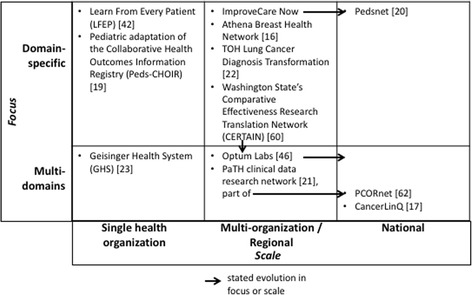
The vision of transforming health systems into learning health systems (LHSs) that rapidly and continuously transform knowledge into improved health outcomes at lower cost is generating increased interest in government agencies, health organizations, and health research communities. While existing initiatives demonstrate that different approaches can succeed in making the LHS vision a reality, they are too varied in their goals, focus, and scale to be reproduced without undue effort. Indeed, the structures necessary to effectively design and implement LHSs on a larger scale are lacking. In this paper, we propose the use of architectural frameworks to develop LHSs that adhere to a recognized vision while being adapted to their specific organizational context. Architectural frameworks are high-level descriptions of an organization as a system; they capture the structure of its main components at varied levels, the interrelationships among these components, and the principles that guide their evolution. Because these frameworks support the analysis of LHSs and allow their outcomes to be simulated, they act as pre-implementation decision-support tools that identify potential barriers and enablers of system development. They thus increase the chances of successful LHS deployment.
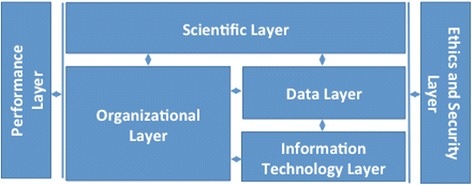
We present an architectural framework for LHSs that incorporates five dimensions-goals, scientific, social, technical, and ethical-commonly found in the LHS literature. The proposed architectural framework is comprised of six decision layers that model these dimensions. The performance layer models goals, the scientific layer models the scientific dimension, the organizational layer models the social dimension, the data layer and information technology layer model the technical dimension, and the ethics and security layer models the ethical dimension. We describe the types of decisions that must be made within each layer and identify methods to support decision-making.
In this paper, we outline a high-level architectural framework grounded in conceptual and empirical LHS literature. Applying this architectural framework can guide the development and implementation of new LHSs and the evolution of existing ones, as it allows for clear and critical understanding of the types of decisions that underlie LHS operations. Further research is required to assess and refine its generalizability and methods.
将卫生系统转变为学习型卫生系统(LHS)的愿景,即快速且持续地以更低成本将知识转化为改善的健康结果,正引发政府机构、卫生组织和卫生研究界越来越多的关注。虽然现有举措表明不同方法能够成功实现学习型卫生系统的愿景,但它们在目标、重点和规模上差异太大,难以不费周折地复制。事实上,缺乏有效在更大规模上设计和实施学习型卫生系统所需的结构。在本文中,我们提议使用架构框架来开发学习型卫生系统,使其在遵循公认愿景的同时适应其特定的组织背景。架构框架是对作为一个系统的组织的高层次描述;它们在不同层次上捕捉其主要组成部分的结构、这些组成部分之间的相互关系以及指导其演变的原则。由于这些框架支持对学习型卫生系统的分析并允许对其结果进行模拟,它们充当实施前的决策支持工具,识别系统开发的潜在障碍和促进因素。因此,它们增加了学习型卫生系统成功部署的机会。
我们提出了一个学习型卫生系统的架构框架,该框架纳入了学习型卫生系统文献中常见的五个维度——目标、科学、社会、技术和伦理。提议的架构框架由六个决策层组成,这些决策层对这些维度进行建模。绩效层对目标进行建模,科学层对科学维度进行建模,组织层对社会维度进行建模,数据层和信息技术层对技术维度进行建模,伦理与安全层对伦理维度进行建模。我们描述了每层内必须做出的决策类型,并确定支持决策的方法。
在本文中,我们概述了一个基于概念性和实证性学习型卫生系统文献的高层次架构框架。应用这个架构框架可以指导新学习型卫生系统的开发和实施以及现有系统的演变,因为它能够清晰且关键地理解构成学习型卫生系统运作基础的决策类型。需要进一步研究来评估和完善其通用性及方法。