Institut national d'excellence en santé et en services sociaux (INESSS), Quebec, Canada.
Centre de recherche sur les soins et les services de première ligne de l'Université Laval, Landry-Poulin Pavilion, 2525 chemin de la Canardière, Quebec, QC, G1J 0A4, Canada.
Health Res Policy Syst. 2019 Aug 9;17(1):79. doi: 10.1186/s12961-019-0477-3.
Interest in value-based healthcare, generally defined as providing better care at lower cost, has grown worldwide, and learning health systems (LHSs) have been proposed as a key strategy for improving value in healthcare. LHSs are emerging around the world and aim to leverage advancements in science, technology and practice to improve health system performance at lower cost. However, there remains much uncertainty around the implementation of LHSs and the distinctive features of these systems. This paper presents a conceptual framework that has been developed in Canada to support the implementation of value-creating LHSs.
The framework was developed by an interdisciplinary team at the Institut national d'excellence en santé et en services sociaux (INESSS). It was informed by a scoping review of the scientific and grey literature on LHSs, regular team discussions over a 14-month period, and consultations with Canadian and international experts.
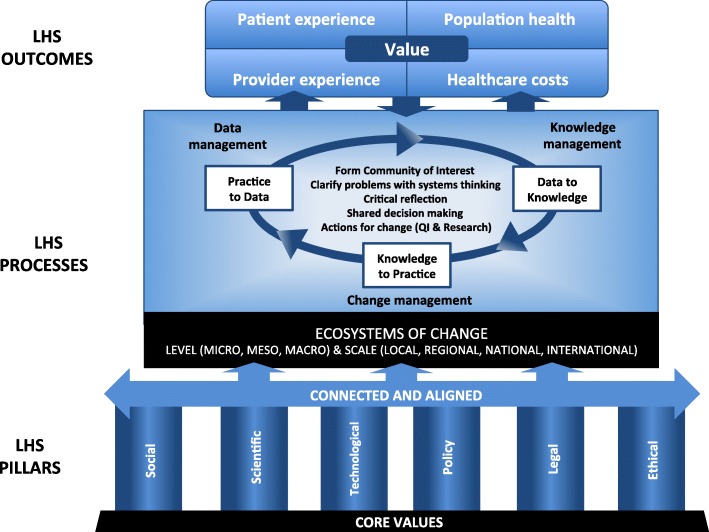
The framework describes four elements that characterise LHSs, namely (1) core values, (2) pillars and accelerators, (3) processes and (4) outcomes. LHSs embody certain core values, including an emphasis on participatory leadership, inclusiveness, scientific rigour and person-centredness. In addition, values such as equity and solidarity should also guide LHSs and are particularly relevant in countries like Canada. LHS pillars are the infrastructure and resources supporting the LHS, whereas accelerators are those specific structures that enable more rapid learning and improvement. For LHSs to create value, such infrastructures must not only exist within the ecosystem but also be connected and aligned with the LHSs' strategic goals. These pillars support the execution, routinisation and acceleration of learning cycles, which are the fundamental processes of LHSs. The main outcome sought by executing learning cycles is the creation of value, which we define as the striking of a more optimal balance of impacts on patient and provider experience, population health and health system costs.
Our framework illustrates how the distinctive structures, processes and outcomes of LHSs tie together with the aim of optimising health system performance and delivering greater value in health systems.
基于价值的医疗保健(通常定义为以更低的成本提供更好的医疗服务)在全球范围内受到关注,学习型卫生系统(LHSs)已被提议作为提高医疗保健价值的关键策略。LHSs 正在全球范围内兴起,旨在利用科学、技术和实践的进步,以更低的成本提高卫生系统的绩效。然而,LHSs 的实施以及这些系统的独特特征仍然存在许多不确定性。本文介绍了加拿大开发的一个概念框架,以支持创造价值的 LHSs 的实施。
该框架由 INESSS 的跨学科团队开发。它是通过对 LHSs 的科学和灰色文献进行范围界定审查、在 14 个月的时间内定期进行团队讨论以及与加拿大和国际专家进行磋商而形成的。
该框架描述了构成 LHSs 的四个要素,即(1)核心价值观、(2)支柱和加速器、(3)流程和(4)结果。LHSs 体现了某些核心价值观,包括强调参与式领导、包容性、科学严谨性和以患者为中心。此外,公平和团结等价值观也应指导 LHSs,在像加拿大这样的国家尤为相关。LHS 支柱是支持 LHS 的基础设施和资源,而加速器则是使学习和改进更迅速的特定结构。为了使 LHSs 创造价值,这种基础设施不仅必须存在于生态系统中,而且还必须与 LHSs 的战略目标相连接和一致。这些支柱支持学习循环的执行、常规化和加速,这是 LHSs 的基本过程。执行学习循环的主要目的是创造价值,我们将其定义为在患者和提供者体验、人口健康和卫生系统成本方面产生的影响之间实现更优平衡。
我们的框架说明了 LHSs 的独特结构、流程和结果如何联系在一起,旨在优化卫生系统的绩效,并在卫生系统中提供更大的价值。