Clifford Tom, Wood Matthew J, Stocks Philip, Howatson Glyn, Stevenson Emma J, Hilkens Catharien M U
School of Biomedical Sciences, Newcastle University, Newcastle upon Tyne, NE1 7RU, UK.
Musculoskeletal Research Group, Institute of Cellular Medicine, Newcastle University, Newcastle upon Tyne, UK.
Eur J Appl Physiol. 2017 Aug;117(8):1727-1737. doi: 10.1007/s00421-017-3667-0. Epub 2017 Jun 23.
T-regulatory cells (Tregs) are a sub-population of lymphocytes that act to suppress aberrant immune responses. We investigated changes in the numbers of naïve and terminally differentiated Tregs in the peripheral blood to establish their role in the immuno-suppressive response to prolonged exercise.
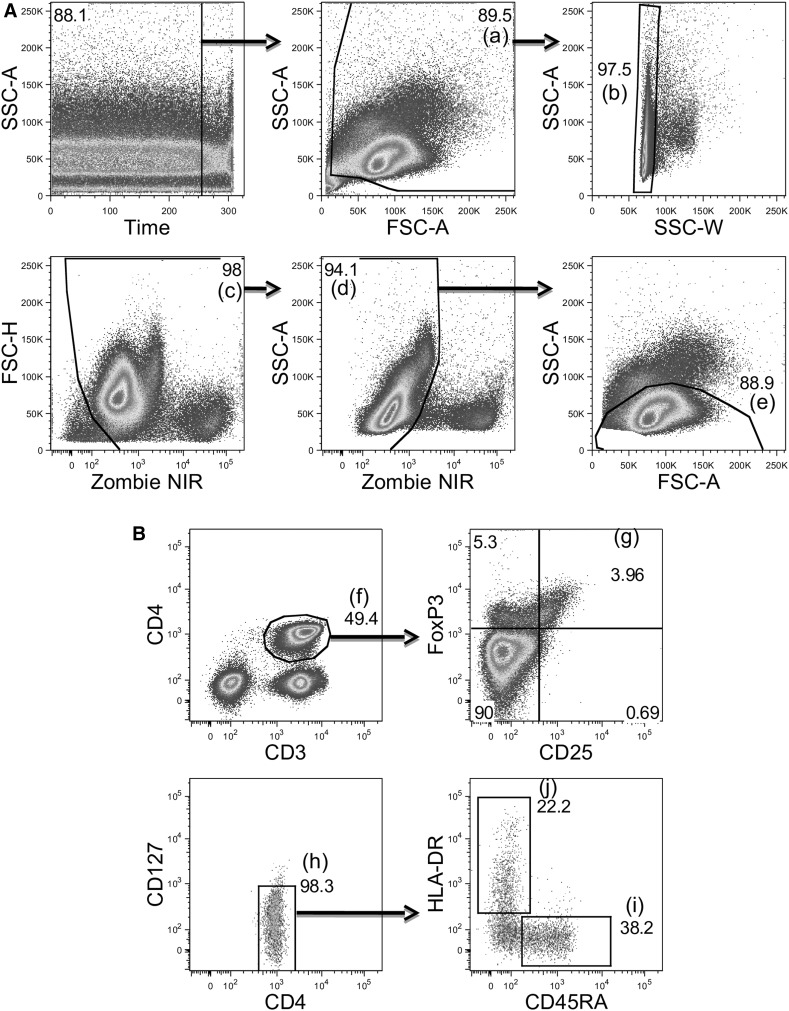
Blood was drawn from seventeen experienced runners (age 40 ± 12 years; height 1.75 ± 0.08 m; mass 71.4 ± 10.8 kg) before, ~1 h after (POST-1h), and on the day following the marathon (POST-1d). Tregs (CD3CD4Foxp3CD25CD127) were analysed in peripheral blood mononuclear cells using flow cytometry. The markers CD45RA and HLA-DR were included to define naïve and terminally differentiated Tregs, respectively.
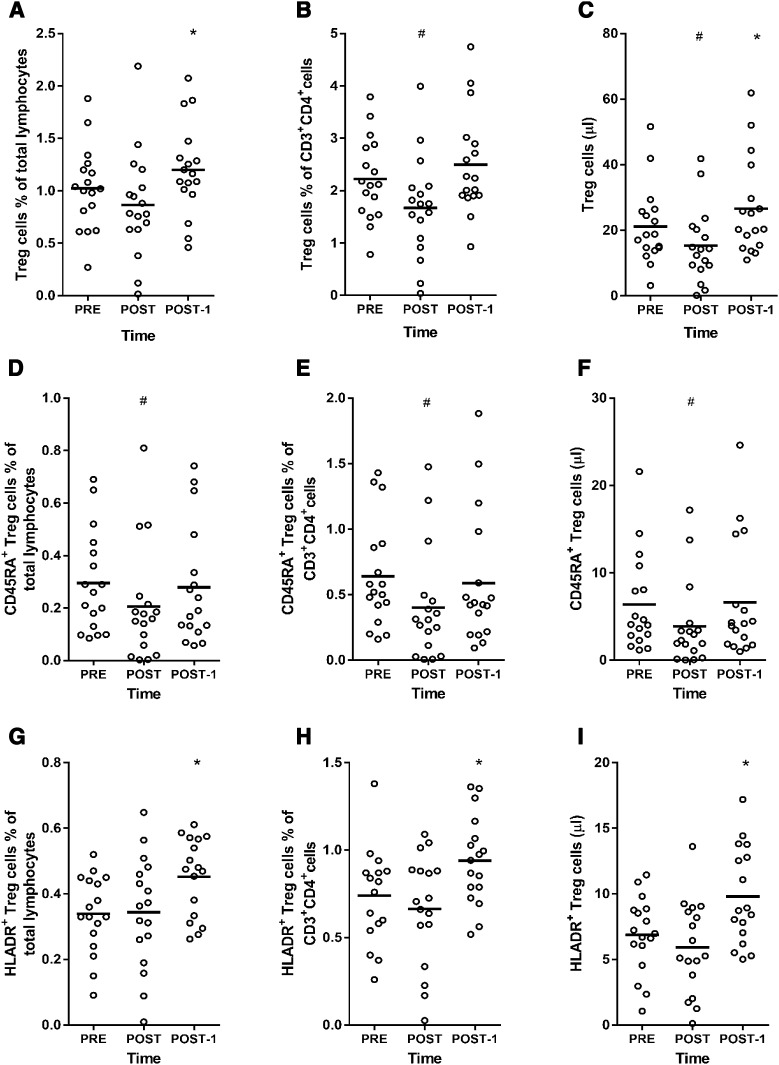
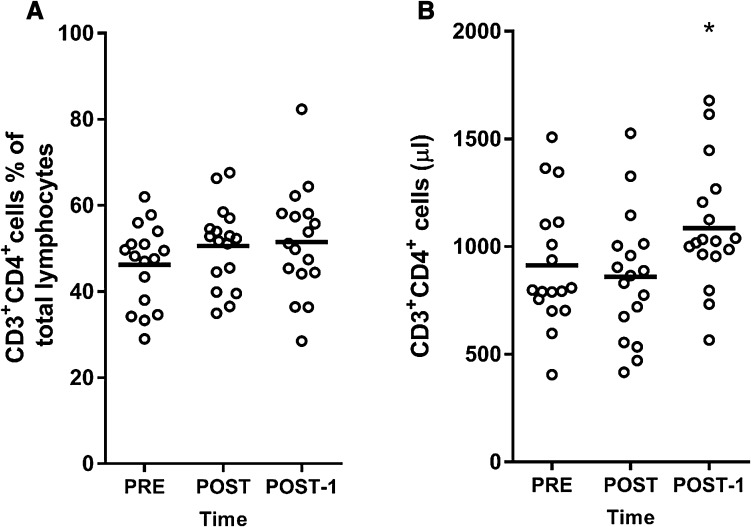
The absolute number of Tregs decreased (27%) POST-1h marathon (P < 0.001) but increased (21%) at POST-1d (P < 0.01). Naïve CD45RA Tregs fell by 39% POST-1h (P < 0.01) but were unaffected POST-1d (P > 0.05). In contrast, an increased number of Tregs expressing HLA-DR was observed at POST-1d (P < 0.01). Interleukin (IL)-1β, IL-6, IL-8 and IL-10 levels in the serum all increased POST-1h (P > 0.05) but returned to pre-exercise levels POST-1d. The suppressive cytokine, transforming growth factor-beta, was unaffected by the marathon (P > 0.05).
These results suggest that Tregs do not play a major role in immune suppression in the early hours of recovery from a marathon. However, terminally differentiated HLA-DR Tregs are mobilized the following day, which could represent a compensatory attempt by the host to restore immune homeostasis and limit excessive cell damage.
调节性T细胞(Tregs)是一类淋巴细胞亚群,其作用是抑制异常免疫反应。我们研究了外周血中初始Tregs和终末分化Tregs数量的变化,以确定它们在长时间运动免疫抑制反应中的作用。
采集17名经验丰富的跑步者(年龄40±12岁;身高1.75±0.08米;体重71.4±10.8千克)在马拉松比赛前、赛后约1小时(POST-1h)以及马拉松赛后第1天(POST-1d)的血液。使用流式细胞术分析外周血单个核细胞中的Tregs(CD3CD4Foxp3CD25CD127)。分别纳入CD45RA和HLA-DR标志物来定义初始Tregs和终末分化Tregs。
马拉松赛后1小时,Tregs的绝对数量减少(27%)(P<0.001),但在赛后第1天增加(21%)(P<0.01)。初始CD45RA Tregs在赛后1小时下降了39%(P<0.01),但在赛后第1天未受影响(P>0.05)。相比之下,在赛后第1天观察到表达HLA-DR的Tregs数量增加(P<0.01)。血清中的白细胞介素(IL)-1β、IL-6、IL-8和IL-10水平在赛后1小时均升高(P>0.05),但在赛后第1天恢复到运动前水平。抑制性细胞因子转化生长因子-β不受马拉松比赛影响(P>0.05)。
这些结果表明,Tregs在马拉松赛后早期恢复阶段的免疫抑制中不发挥主要作用。然而,终末分化的HLA-DR Tregs在第二天被动员起来,这可能代表宿主为恢复免疫稳态和限制过度细胞损伤而进行的一种代偿性尝试。