Patrick Samantha C, Pinaud David, Weimerskirch Henri
School of Environmental Sciences, University of Liverpool, Liverpool, UK.
Centre d'Etudes Biologiques de Chizé, UMR 7372, CNRS-Université La Rochelle, Villiers-en-Bois, France.
J Anim Ecol. 2017 Sep;86(5):1257-1268. doi: 10.1111/1365-2656.12724. Epub 2017 Jul 24.
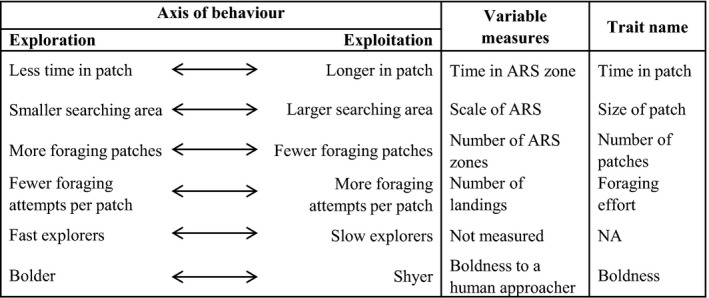
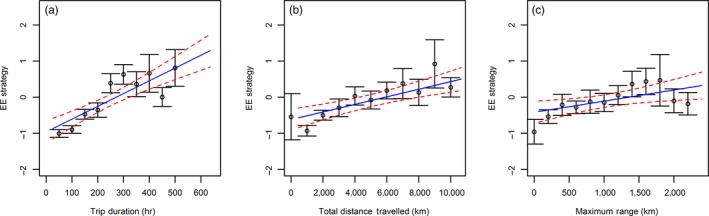
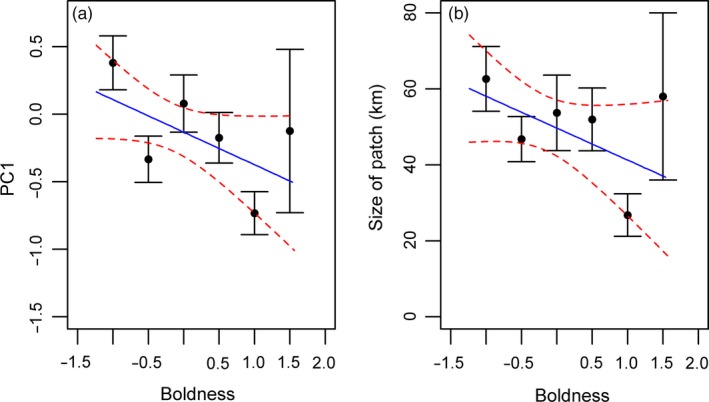
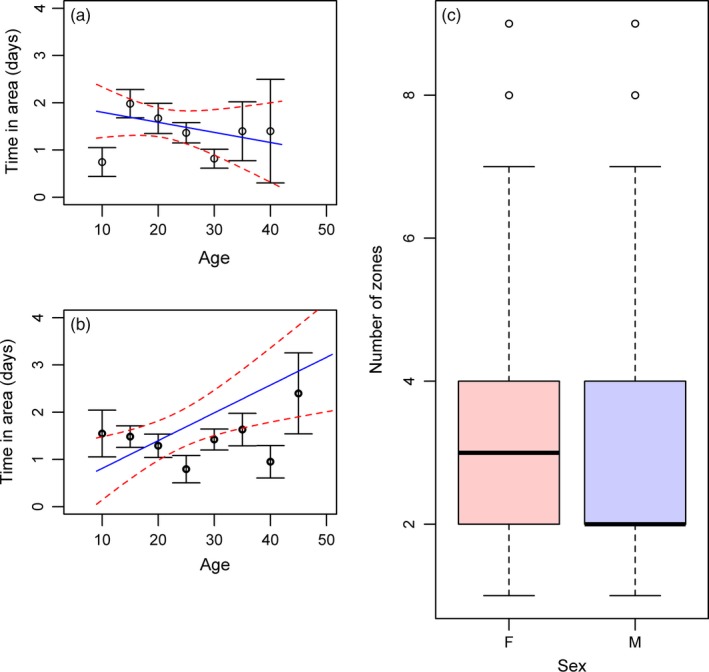
Individuals do not have complete information about the environment and therefore they face a trade-off between gathering information (exploration) and gathering resources (exploitation). Studies have shown individual differences in components of this trade-off but how stable these strategies are in a population and the intrinsic drivers of these differences is not well understood. Top marine predators are expected to experience a particularly strong trade-off as many species have large foraging ranges and their prey often have a patchy distribution. This environment leads these species to exhibit pronounced exploration and exploitation phases but differences between individuals are poorly resolved. Personality differences are known to be important in foraging behaviour but also in the trade-off between exploration and exploitation. Here we test whether personality predicts an individual exploration-exploitation strategy using wide ranging wandering albatrosses (Diomedea exulans) as a model system. Using GPS tracking data from 276 wandering albatrosses, we extract foraging parameters indicative of exploration (searching) and exploitation (foraging) and show that foraging effort, time in patch and size of patch are strongly correlated, demonstrating these are indicative of an exploration-exploitation (EE) strategy. Furthermore, we show these are consistent within individuals and appear stable in the population, with no reproductive advantage. The searching and foraging behaviour of bolder birds placed them towards the exploration end of the trade-off, whereas shy birds showed greater exploitation. This result provides a mechanism through which individual foraging strategies may emerge. Age and sex affected components of the trade-off, but not the trade-off itself, suggesting these factors may drive behavioural compensation to maintain resource acquisition and this was supported by the evidence that there were no fitness consequence of any EE trait nor the trade-off itself. These results demonstrate a clear trade-off between information gathering and exploitation of prey patches, and reveals for the first time that boldness may drive these differences. This provides a mechanism through which widely reported links between personality and foraging may emerge.
个体对环境没有完整的信息,因此他们面临着在收集信息(探索)和收集资源(利用)之间的权衡。研究表明,在这种权衡的各个组成部分中存在个体差异,但这些策略在种群中的稳定性如何以及这些差异的内在驱动因素尚未得到很好的理解。顶级海洋捕食者预计会经历特别强烈的权衡,因为许多物种的觅食范围很大,而且它们的猎物分布往往很分散。这种环境导致这些物种表现出明显的探索和利用阶段,但个体之间的差异却难以分辨。已知个性差异不仅在觅食行为中很重要,在探索和利用之间的权衡中也很重要。在这里,我们以广泛游荡的信天翁(漂泊信天翁)为模型系统,测试个性是否能预测个体的探索-利用策略。利用来自276只漂泊信天翁的GPS跟踪数据,我们提取了指示探索(搜索)和利用(觅食)的觅食参数,并表明觅食努力、在斑块中的时间和斑块大小密切相关,这表明这些参数指示了一种探索-利用(EE)策略。此外,我们表明这些参数在个体内部是一致的,并且在种群中似乎是稳定的,没有繁殖优势。更大胆的鸟类的搜索和觅食行为使它们处于权衡的探索端,而胆小的鸟类则表现出更多的利用行为。这一结果提供了一种个体觅食策略可能出现的机制。年龄和性别影响了权衡的组成部分,但没有影响权衡本身,这表明这些因素可能驱动行为补偿以维持资源获取,并且有证据支持这一点,即任何EE特征或权衡本身都没有适应性后果。这些结果表明在收集信息和利用猎物斑块之间存在明显的权衡,并首次揭示大胆可能驱动这些差异。这提供了一种机制,通过这种机制,广泛报道的个性与觅食之间的联系可能会出现。