Hiraki Hideaki, Kagoshima Hiroshi, Kraus Christopher, Schiffer Philipp H, Ueta Yumiko, Kroiher Michael, Schierenberg Einhard, Kohara Yuji
Genome Biology Laboratory, National Institute of Genetics, Mishima, Japan.
Transdisciplinary Research Integration Center, Research Organization of Information and Systems, Tokyo, Japan.
BMC Genomics. 2017 Jun 24;18(1):478. doi: 10.1186/s12864-017-3860-x.
Sexual reproduction involving the fusion of egg and sperm is prevailing among eukaryotes. In contrast, the nematode Diploscapter coronatus, a close relative of the model Caenorhabditis elegans, reproduces parthenogenetically. Neither males nor sperm have been observed and some steps of meiosis are apparently skipped in this species. To uncover the genomic changes associated with the evolution of parthenogenesis in this nematode, we carried out a genome analysis.
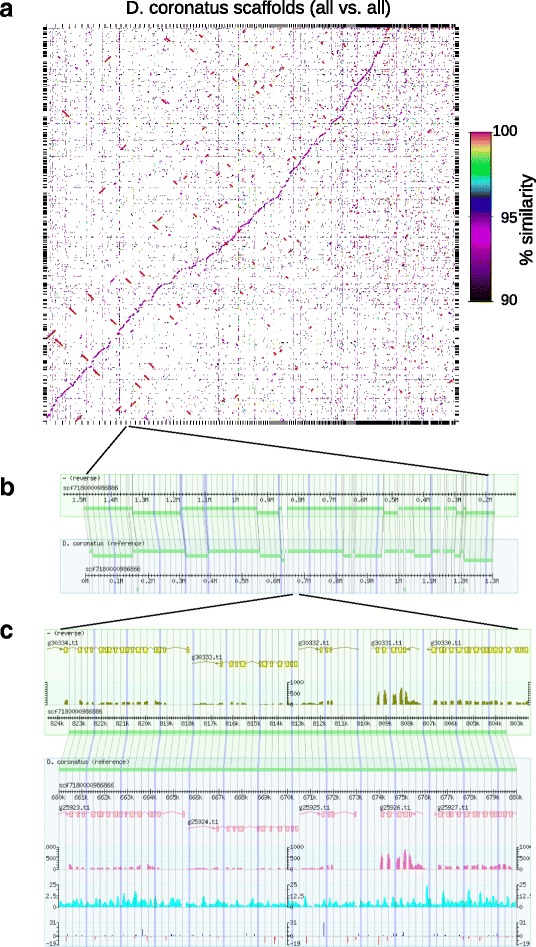
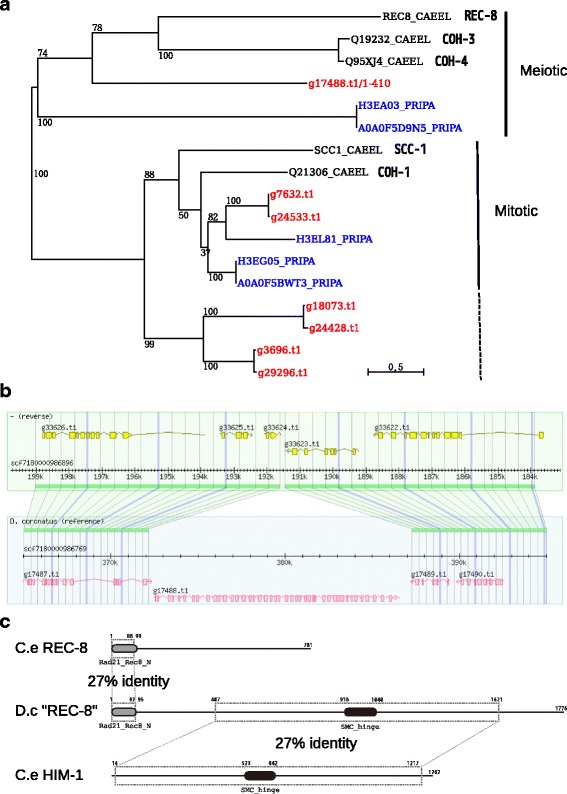
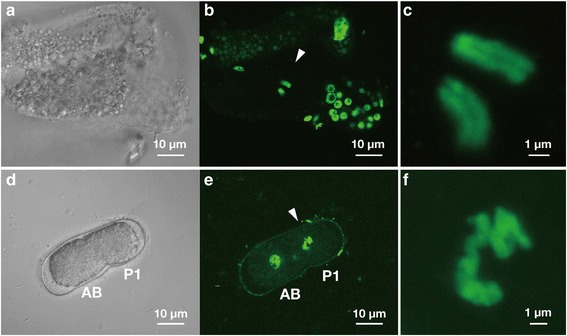
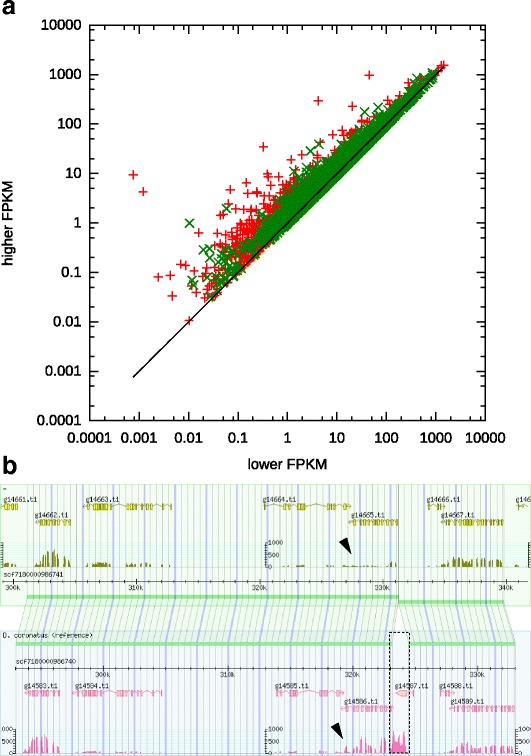
We obtained a 170 Mbp draft genome in only 511 scaffolds with a N length of 1 Mbp. Nearly 90% of these scaffolds constitute homologous pairs with a 5.7% heterozygosity on average and inversions and translocations, meaning that the 170 Mbp sequences correspond to the diploid genome. Fluorescent staining shows that the D. coronatus genome consists of two chromosomes (2n = 2). In our genome annotation, we found orthologs of 59% of the C. elegans genes. However, a number of genes were missing or very divergent. These include genes involved in sex determination (e.g. xol-1, tra-2) and meiosis (e.g. the kleisins rec-8 and coh-3/4) giving a possible explanation for the absence of males and the second meiotic division. The high degree of heterozygosity allowed us to analyze the expression level of individual alleles. Most of the homologous pairs show very similar expression levels but others exhibit a 2-5-fold difference.
Our high-quality draft genome of D. coronatus reveals the peculiarities of the genome of parthenogenesis and provides some clues to the genetic basis for parthenogenetic reproduction. This draft genome should be the basis to elucidate fundamental questions related to parthenogenesis such as its origin and mechanisms through comparative analyses with other nematodes. Furthermore, being the closest outgroup to the genus Caenorhabditis, the draft genome will help to disclose many idiosyncrasies of the model C. elegans and its congeners in future studies.
涉及卵子和精子融合的有性生殖在真核生物中普遍存在。相比之下,秀丽隐杆线虫的近亲冠双盘线虫进行孤雌生殖。在该物种中未观察到雄性和精子,并且减数分裂的某些步骤显然被跳过。为了揭示与这种线虫孤雌生殖进化相关的基因组变化,我们进行了基因组分析。
我们仅在511个支架中获得了一个170 Mbp的基因组草图,N长度为1 Mbp。这些支架中近90%构成同源对,平均杂合度为5.7%,存在倒位和易位,这意味着170 Mbp的序列对应于二倍体基因组。荧光染色显示冠双盘线虫基因组由两条染色体组成(2n = 2)。在我们的基因组注释中,我们发现了秀丽隐杆线虫59%基因的直系同源物。然而,许多基因缺失或差异很大。这些基因包括参与性别决定的基因(如xol-1、tra-2)和减数分裂的基因(如kleisins rec-8和coh-3/4),这可能解释了雄性的缺失和第二次减数分裂。高度的杂合度使我们能够分析单个等位基因的表达水平。大多数同源对显示出非常相似的表达水平,但其他同源对则表现出2至5倍的差异。
我们高质量的冠双盘线虫基因组草图揭示了孤雌生殖基因组的特性,并为孤雌生殖的遗传基础提供了一些线索。这个基因组草图应该成为通过与其他线虫进行比较分析来阐明与孤雌生殖相关的基本问题(如起源和机制)的基础。此外,作为秀丽隐杆线虫属最接近的外类群,该基因组草图将有助于在未来的研究中揭示模式生物秀丽隐杆线虫及其同属物种的许多特性。