Fernandes Carla F C, Pereira Soraya Dos S, Luiz Marcos B, Zuliani Juliana P, Furtado Gilvan P, Stabeli Rodrigo G
Fundação Oswaldo Cruz, Fiocruz Rondônia, Porto Velho, Rondônia, Brazil.
Departamento de Medicina da Universidade Federal de Rondônia, UNIR, Porto Velho, Rondônia, Brazil.
Front Immunol. 2017 Jun 9;8:653. doi: 10.3389/fimmu.2017.00653. eCollection 2017.
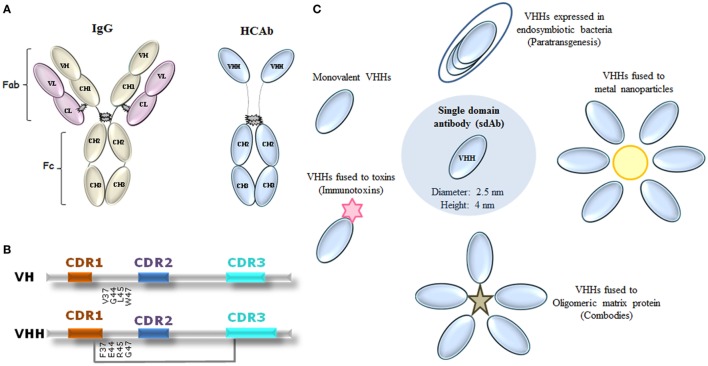
Due mainly to properties such as high affinity and antigen specificity, antibodies have become important tools for biomedical research, diagnosis, and treatment of several human diseases. When the objective is to administer them for therapy, strategies are used to reduce the heterologous protein immunogenicity and to improve pharmacokinetic and pharmacodynamic characteristics. Size minimization contributes to ameliorate these characteristics, while preserving the antigen-antibody interaction site. Since the discovery that camelids produce functional antibodies devoid of light chains, studies have proposed the use of single domains for biosensors, monitoring and treatment of tumors, therapies for inflammatory and neurodegenerative diseases, drug delivery, or passive immunotherapy. Despite an expected increase in antibody and related products in the pharmaceutical market over the next years, few research initiatives are related to the development of alternatives for helping to manage neglected tropical diseases (NTDs). In this review, we summarize developments of camelid single-domain antibodies (VHH) in the field of NTDs. Particular attention is given to VHH-derived products, i.e., VHHs fused to nanoparticles, constructed for the development of rapid diagnostic kits; fused to oligomeric matrix proteins for viral neutralization; and conjugated with proteins for the treatment of human parasites. Moreover, paratransgenesis technology using VHHs is an interesting approach to control parasite development in vectors. With enormous biotechnological versatility, facility and low cost for heterologous production, and greater ability to recognize different epitopes, VHHs have appeared as an opportunity to overcome challenges related to the prevention, detection, and control of human diseases, especially NTDs.
主要由于高亲和力和抗原特异性等特性,抗体已成为生物医学研究、诊断以及多种人类疾病治疗的重要工具。当目标是将其用于治疗时,会采用一些策略来降低异源蛋白的免疫原性,并改善药代动力学和药效学特性。减小尺寸有助于改善这些特性,同时保留抗原 - 抗体相互作用位点。自从发现骆驼科动物能产生无轻链的功能性抗体以来,已有研究提出将单域抗体用于生物传感器、肿瘤监测与治疗、炎症和神经退行性疾病治疗、药物递送或被动免疫治疗。尽管预计未来几年制药市场中抗体及相关产品会有所增加,但很少有研究举措涉及开发有助于应对被忽视热带病(NTDs)的替代方案。在本综述中,我们总结了骆驼科动物单域抗体(VHH)在被忽视热带病领域的发展情况。特别关注了源自VHH的产品,即与纳米颗粒融合用于开发快速诊断试剂盒的VHH;与寡聚基质蛋白融合用于病毒中和的VHH;以及与蛋白质偶联用于治疗人体寄生虫的VHH。此外,利用VHH的共生转基因技术是控制病媒中寄生虫发育的一种有趣方法。凭借巨大的生物技术通用性、异源生产的便利性和低成本,以及识别不同表位的更强能力,VHH已成为克服与人类疾病尤其是被忽视热带病的预防、检测和控制相关挑战的一个契机。