Karim Shahid, Budachetri Khemraj, Mukherjee Nabanita, Williams Jaclyn, Kausar Asma, Hassan Muhammad Jawadul, Adamson Steven, Dowd Scot E, Apanskevich Dmitry, Arijo Abdullah, Sindhu Zia Uddin, Kakar Muhammad Azam, Khan Raja Muhammad Dilpazir, Ullah Shafiq, Sajid Muhammad Sohail, Ali Abid, Iqbal Zafar
Department of Biological Sciences, University of Southern Mississippi, Hattiesburg, MS, United States of America.
Department of Parasitology, University of Agriculture, Faisalabad, Pakistan.
PLoS Negl Trop Dis. 2017 Jun 26;11(6):e0005681. doi: 10.1371/journal.pntd.0005681. eCollection 2017 Jun.
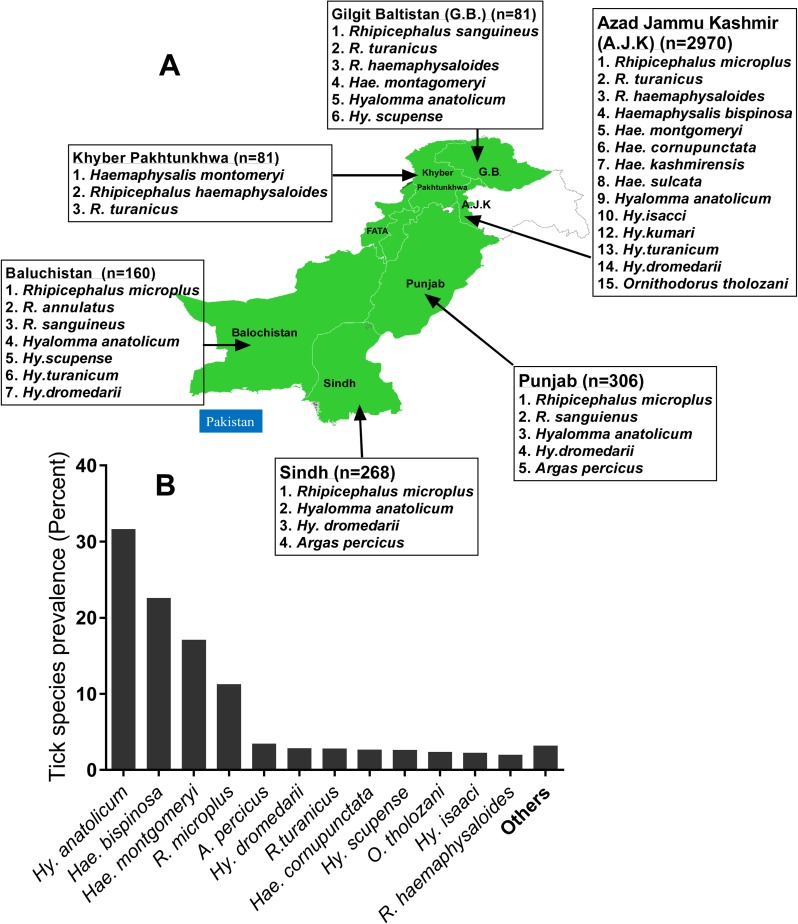
As obligate blood-feeding arthropods, ticks transmit pathogens to humans and domestic animals more often than other arthropod vectors. Livestock farming plays a vital role in the rural economy of Pakistan, and tick infestation causes serious problems with it. However, research on tick species diversity and tick-borne pathogens has rarely been conducted in Pakistan. In this study, a systematic investigation of the tick species infesting livestock in different ecological regions of Pakistan was conducted to determine the microbiome and pathobiome diversity in the indigenous ticks.
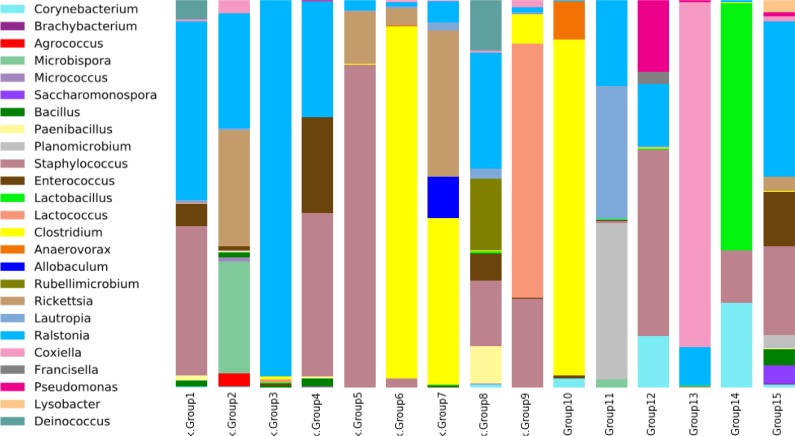
METHODOLOGY/PRINCIPAL FINDINGS: A total of 3,866 tick specimens were morphologically identified as 19 different tick species representing three important hard ticks, Rhipicephalus, Haemaphysalis and Hyalomma, and two soft ticks, Ornithodorus and Argas. The bacterial diversity across these tick species was assessed by bacterial 16S rRNA gene sequencing using a 454-sequencing platform on 10 of the different tick species infesting livestock. The notable genera detected include Ralstonia, Clostridium, Staphylococcus, Rickettsia, Lactococcus, Lactobacillus, Corynebacterium, Enterobacter, and Enterococcus. A survey of Spotted fever group rickettsia from 514 samples from the 13 different tick species generated rickettsial-specific amplicons in 10% (54) of total ticks tested. Only three tick species Rhipicephalus microplus, Hyalomma anatolicum, and H. dromedarii had evidence of infection with "Candidatus Rickettsia amblyommii" a result further verified using a rompB gene-specific quantitative PCR (qPCR) assay. The Hyalomma ticks also tested positive for the piroplasm, Theileria annulata, using a qPCR assay.
CONCLUSIONS/SIGNIFICANCE: This study provides information about tick diversity in Pakistan, and pathogenic bacteria in different tick species. Our results showed evidence for Candidatus R. amblyommii infection in Rhipicephalus microplus, H. anatolicum, and H. dromedarii ticks, which also carried T. annulata.
作为专性吸血节肢动物,蜱比其他节肢动物媒介更常将病原体传播给人类和家畜。畜牧业在巴基斯坦农村经济中起着至关重要的作用,而蜱虫侵袭给其带来了严重问题。然而,巴基斯坦很少开展关于蜱种多样性和蜱传病原体的研究。在本研究中,对巴基斯坦不同生态区域侵袭家畜的蜱种进行了系统调查,以确定本土蜱虫的微生物组和病理生物组多样性。
方法/主要发现:共3866只蜱标本经形态学鉴定为19种不同的蜱种,代表三种重要的硬蜱属(璃眼蜱属、血蜱属和硬蜱属)以及两种软蜱属(钝缘蜱属和argas蜱属)。使用454测序平台对10种侵袭家畜的不同蜱种进行细菌16S rRNA基因测序,评估这些蜱种的细菌多样性。检测到的显著菌属包括罗尔斯通氏菌属、梭菌属、葡萄球菌属、立克次氏体属、乳球菌属、乳杆菌属、棒状杆菌属、肠杆菌属和肠球菌属。对来自13种不同蜱种的514个样本进行斑点热群立克次氏体调查,在10%(54只)受试蜱虫中产生了立克次氏体特异性扩增子。只有微小牛蜱、小亚璃眼蜱和单峰驼璃眼蜱这三种蜱虫有感染“嗜吞噬细胞无形体(Candidatus Rickettsia amblyommii)”的证据,使用rompB基因特异性定量PCR(qPCR)检测进一步证实了这一结果。使用qPCR检测,璃眼蜱属蜱虫还检测到环形泰勒虫梨形虫呈阳性。
结论/意义:本研究提供了有关巴基斯坦蜱多样性以及不同蜱种中致病细菌的信息。我们的结果显示微小牛蜱、小亚璃眼蜱和单峰驼璃眼蜱感染嗜吞噬细胞无形体的证据,这些蜱也携带环形泰勒虫。