Dragan Wojciech Łukasz, Czerski Piotr M, Dragan Małgorzata
The Interdisciplinary Center for Behavior Genetic Research, Faculty of Psychology, University of Warsaw, Warsaw.
Laboratory of Psychiatric Genetics, Poznan University of Medical Sciences, Poznan.
Neuropsychiatr Dis Treat. 2017 Jun 8;13:1483-1489. doi: 10.2147/NDT.S137331. eCollection 2017.
Recent studies revealed the role of the () gene variability in vulnerability to posttraumatic stress disorder in women. Due to the relatively high comorbidity of posttraumatic stress disorder and substance use disorder, we hypothesized about possible associations between gene and problematic alcohol use.
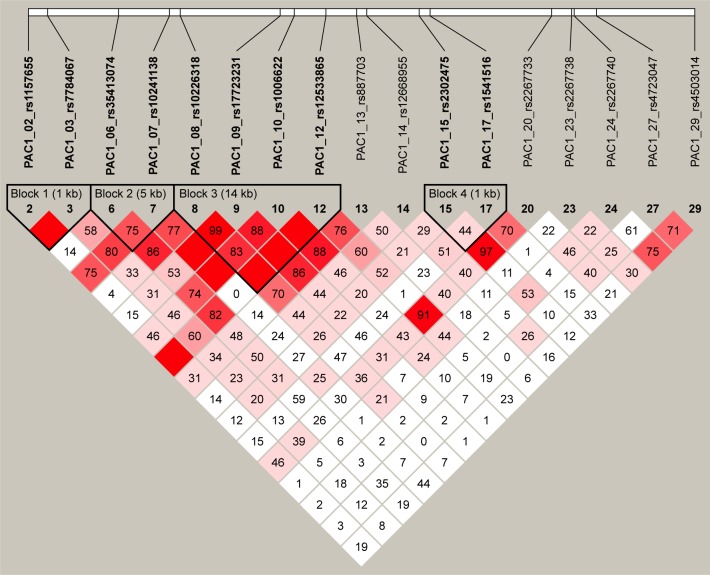
The sample studied consisted of 491 women aged 18-28 years (mean age =21.76 years; SD =1.83) and the Alcohol Use Disorders Identification Test was used to assess drinking problems. We successfully genotyped 17 single-nucleotide polymorphisms in the gene.
Single locus analysis revealed a significant (after correction for multiple testing) association between intronic polymorphism rs2302475 and problematic alcohol use (=0.00048; recessive model). This result was strengthened by the haplotype analysis (=0.00379).
Our results suggest that the PACAP/PAC1 signaling system is implicated in the development of problematic alcohol use in women.
近期研究揭示了()基因变异性在女性创伤后应激障碍易感性中的作用。由于创伤后应激障碍与物质使用障碍的共病率相对较高,我们推测该基因与酒精使用问题之间可能存在关联。
研究样本包括491名年龄在18 - 28岁之间的女性(平均年龄 = 21.76岁;标准差 = 1.83),并使用酒精使用障碍识别测试来评估饮酒问题。我们成功对该基因中的17个单核苷酸多态性进行了基因分型。
单基因座分析显示内含子多态性rs2302475与酒精使用问题之间存在显著关联(多重检验校正后)(P = 0.00048;隐性模型)。单倍型分析进一步证实了这一结果(P = 0.00379)。
我们的数据表明,垂体腺苷酸环化酶激活肽/垂体腺苷酸环化酶激活肽1信号系统与女性酒精使用问题的发生有关。