Kocot Joanna, Luchowska-Kocot Dorota, Kiełczykowska Małgorzata, Musik Irena, Kurzepa Jacek
Chair and Department of Medical Chemistry, Medical University of Lublin, 4A Chodźki Street, 20-093 Lublin, Poland.
Nutrients. 2017 Jun 27;9(7):659. doi: 10.3390/nu9070659.
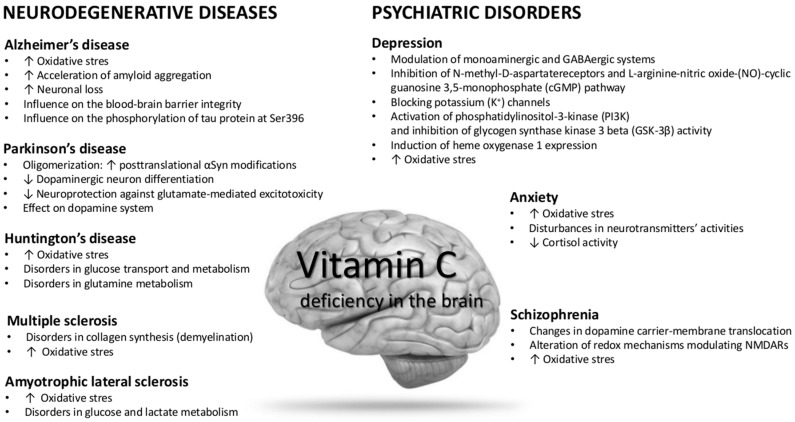
Vitamin C (Vit C) is considered to be a vital antioxidant molecule in the brain. Intracellular Vit C helps maintain integrity and function of several processes in the central nervous system (CNS), including neuronal maturation and differentiation, myelin formation, synthesis of catecholamine, modulation of neurotransmission and antioxidant protection. The importance of Vit C for CNS function has been proven by the fact that targeted deletion of the sodium-vitamin C co-transporter in mice results in widespread cerebral hemorrhage and death on post-natal day one. Since neurological diseases are characterized by increased free radical generation and the highest concentrations of Vit C in the body are found in the brain and neuroendocrine tissues, it is suggested that Vit C may change the course of neurological diseases and display potential therapeutic roles. The aim of this review is to update the current state of knowledge of the role of vitamin C on neurodegenerative diseases including Alzheimer's disease, Parkinson's disease, Huntington's disease, multiple sclerosis and amyotrophic sclerosis, as well as psychiatric disorders including depression, anxiety and schizophrenia. The particular attention is attributed to understanding of the mechanisms underlying possible therapeutic properties of ascorbic acid in the presented disorders.
维生素C(Vit C)被认为是大脑中一种至关重要的抗氧化分子。细胞内的Vit C有助于维持中枢神经系统(CNS)中多个过程的完整性和功能,包括神经元的成熟与分化、髓鞘形成、儿茶酚胺的合成、神经传递的调节以及抗氧化保护。小鼠体内钠 - 维生素C共转运体的靶向缺失会导致出生后第一天出现广泛的脑出血和死亡,这一事实证明了Vit C对CNS功能的重要性。由于神经疾病的特征是自由基生成增加,且体内Vit C的最高浓度存在于大脑和神经内分泌组织中,因此有人提出Vit C可能会改变神经疾病的病程并发挥潜在的治疗作用。本综述的目的是更新关于维生素C在神经退行性疾病(包括阿尔茨海默病、帕金森病、亨廷顿病、多发性硬化症和肌萎缩侧索硬化症)以及精神疾病(包括抑郁症、焦虑症和精神分裂症)中作用的当前知识状态。特别关注的是理解抗坏血酸在上述疾病中可能具有治疗特性的潜在机制。