Martinez Ana Flávia Canovas, de Almeida Luís Gustavo, Moraes Luiz Alberto Beraldo, Cônsoli Fernando Luís
Laboratório de Interações em Insetos, Departamento de Entomologia e Acarologia, Escola Superior de Agricultura "Luiz de Queiroz", Universidade de São Paulo, Av Pádua Dias 11, 13418-900, Piracicaba, SP, Brazil.
Laboratório de Espectrometria de Massas Aplicada a Produtos Naturais, Departamento de Química, Faculdade de Filosofia, Ciências e Letras de Ribeirão Preto, Universidade de São Paulo, Av Bandeirantes 3900, 14040-901, Ribeirão Preto, SP, Brazil.
BMC Microbiol. 2017 Jun 27;17(1):143. doi: 10.1186/s12866-017-1054-y.
The demand for sustainable agricultural practices and the limited progress toward newer and safer chemicals for use in pest control maintain the impetus for research and identification of new natural molecules. Natural molecules are preferable to synthetic organic molecules because they are biodegradable, have low toxicity, are often selective and can be applied at low concentrations. Microbes are one source of natural insecticides, and microbial insect symbionts have attracted attention as a source of new bioactive molecules because these microbes are exposed to various selection pressures in their association with insects. Analytical techniques must be used to isolate and characterize new compounds, and sensitive analytical tools such as mass spectrometry and high-resolution chromatography are required to identify the least-abundant molecules.
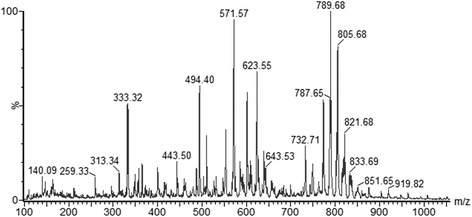
We used classical fermentation techniques combined with tandem mass spectrometry to prospect for insecticidal substances produced by the ant symbiont Streptomyces caniferus. Crude extracts from this bacterium showed low biological activity (less than 10% mortality) against the larval stage of the fall armyworm Spodoptera frugiperda. Because of the complexity of the crude extract, we used fractionation-guided bioassays to investigate if the low toxicity was related to the relative abundance of the active molecule, leading to the isolation of porphyrins as active molecules. Porphyrins are a class of photoactive molecules with a broad range of bioactivity, including insecticidal. The active fraction, containing a mixture of porphyrins, induced up to 100% larval mortality (LD = 37.7 μg.cm). Tandem mass-spectrometry analyses provided structural information for two new porphyrin structures. Data on the availability of porphyrins in 67 other crude extracts of ant ectosymbionts were also obtained with ion-monitoring experiments.
Insect-associated bacterial symbionts are a rich source of bioactive compounds. Exploring microbial diversity through mass-spectrometry analyses is a useful approach for isolating and identifying new compounds. Our results showed high insecticidal activity of porphyrin compounds. Applications of different experiments in mass spectrometry allowed the characterization of two new porphyrins.
对可持续农业实践的需求以及在开发用于害虫防治的更新、更安全化学品方面取得的有限进展,推动了对新天然分子的研究和鉴定。天然分子优于合成有机分子,因为它们可生物降解、毒性低、通常具有选择性且可在低浓度下使用。微生物是天然杀虫剂的一个来源,微生物昆虫共生体作为新生物活性分子的来源已引起关注,因为这些微生物在与昆虫的共生关系中面临各种选择压力。必须使用分析技术来分离和表征新化合物,并且需要诸如质谱和高分辨率色谱等灵敏的分析工具来鉴定含量最少的分子。
我们使用经典发酵技术结合串联质谱来探寻由蚂蚁共生菌食蟹链霉菌产生的杀虫物质。该细菌的粗提物对草地贪夜蛾幼虫期的生物活性较低(死亡率低于10%)。由于粗提物的复杂性,我们使用分级引导生物测定法来研究低毒性是否与活性分子的相对丰度有关,从而分离出卟啉作为活性分子。卟啉是一类具有广泛生物活性(包括杀虫活性)的光活性分子。含有卟啉混合物的活性级分可导致高达100%的幼虫死亡率(半数致死剂量=37.7μg/cm)。串联质谱分析提供了两种新卟啉结构的结构信息。通过离子监测实验还获得了关于67种其他蚂蚁外共生菌粗提物中卟啉可用性的数据。
与昆虫相关的细菌共生体是生物活性化合物的丰富来源。通过质谱分析探索微生物多样性是分离和鉴定新化合物的一种有用方法。我们的结果表明卟啉化合物具有很高的杀虫活性。质谱中不同实验的应用使得能够表征两种新的卟啉。