Umar Shifa, Clarke Kofi, Bilimoria Farshaad, Bilal Mohammad, Singh Shailendra, Silverman Jan
Department of Internal Medicine (Shifa Umar).
Division of Gastroenterology, Hepatology and Nutrition (Kofi Clarke, Shailendra Singh).
Ann Gastroenterol. 2017;30(4):429-432. doi: 10.20524/aog.2017.0153. Epub 2017 May 5.
Patients with inflammatory bowel disease (IBD) are often immunosuppressed and are at risk for reactivation of latent cytomegalovirus (CMV) infection. We examined the diagnostic yield from colon biopsies in IBD patients with suspected CMV infection.
Patients above 18 years of age who underwent testing for CMV on colon biopsies between January 1st, 2012, and December 31st, 2015, were identified from a pathology data base. A positive CMV result was included only if testing included both hematoxylin/eosin staining and immunohistochemistry from two or more biopsy samples.
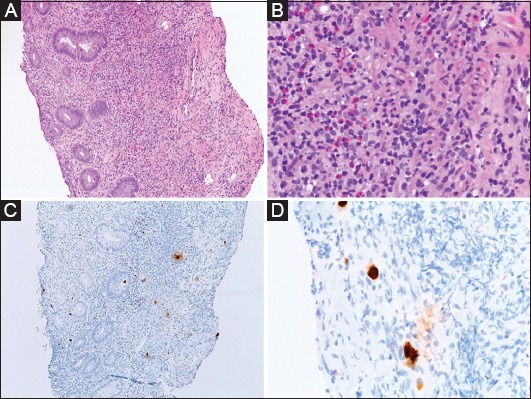
One hundred twenty-five patients met the inclusion criteria. Of these, 99 had a diagnosis of IBD: 30 with Crohn's disease, 63 with ulcerative colitis, and 6 with indeterminate colitis. As regards treatment, 21.2% of the patients had biologic therapy alone, 13.1% received immunomodulators, and 11.1% were treated with combined biologic and immunomodulator therapy within 3 months of the colon biopsy. In addition, 32.3% of the patients were on steroids. Of the 99 IBD patients, only 1 had biopsy-proven CMV colitis.
The yield from colon biopsies with hematoxylin/eosin staining and immunohistochemistry to test for CMV in IBD flare is very low. Further multicenter studies with large numbers of patients are needed to compare all testing modalities in the same cohort of patients. This may help identify which subgroup of IBD patients are likely to benefit from specific modalities of CMV testing, with potential cost-saving implications.
炎症性肠病(IBD)患者常处于免疫抑制状态,有潜伏性巨细胞病毒(CMV)感染再激活的风险。我们研究了疑似CMV感染的IBD患者结肠活检的诊断率。
从病理数据库中识别出2012年1月1日至2015年12月31日期间接受结肠活检CMV检测的18岁以上患者。仅当检测包括苏木精/伊红染色和来自两个或更多活检样本的免疫组织化学时,CMV检测结果为阳性才被纳入。
125名患者符合纳入标准。其中,99名诊断为IBD:30例克罗恩病,63例溃疡性结肠炎,6例不确定性结肠炎。关于治疗,21.2%的患者仅接受生物治疗,13.1%接受免疫调节剂治疗,11.1%在结肠活检后3个月内接受生物和免疫调节剂联合治疗。此外,32.3%的患者使用类固醇。在99名IBD患者中,只有1例经活检证实为CMV结肠炎。
在IBD发作期,通过苏木精/伊红染色和免疫组织化学进行结肠活检检测CMV的阳性率非常低。需要进一步开展多中心、大样本研究,在同一组患者中比较所有检测方式。这可能有助于确定哪些IBD患者亚组可能从特定的CMV检测方式中获益,并可能节省成本。