Junot Stephane, Keroak Stephanie, Del Castillo Jerome R E, Ayoub Jean-Yves, Paquet Christian, Bonnet-Garin Jeanne-Marie, Troncy Eric
VetAgro Sup - Veterinary Campus of Lyon - University of Lyon, APCSE unit, Marcy l'Etoile, France.
Faculty of Veterinary Medicine - University of Montreal, GREPAQ (Research group in animal pharmacology of Quebec) - Department of Veterinary Biomedicine, Saint-Hyacinthe, Québec, Canada.
PLoS One. 2017 Jun 28;12(6):e0179475. doi: 10.1371/journal.pone.0179475. eCollection 2017.
Inhaled nitric oxide (iNO) is commonly used as a treatment of pulmonary hypertension. Its action is purported to be specific to the lung, but extrapulmonary effects have been reported. The objective of this study was to evaluate if iNO could compensate the renal impairment induced by ketoprofen, a conventional non-steroidal anti-inflammatory drug (NSAID), during general anaesthesia.
Under pseudo-normovolaemic condition, thirty piglets were randomly assigned into 5 equal groups and equipped for renal and systemic parameters measurements. A first experiment was carried out to validate methods and reproduce the renal effects of iNO (40 ppm) in comparison with a placebo (100% oxygen). In a second experiment, iNO was inhaled for 120 minutes right after NSAID treatment (ketoprofen 2 mg×kg-1 IV, and 40 ppm iNO; group KiNO) and its effects were compared to ketoprofen alone (2 mg×kg-1 IV; group K) and placebo (saline; group C).
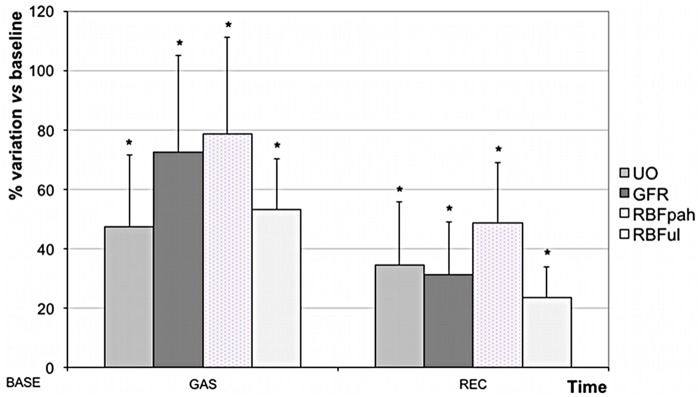
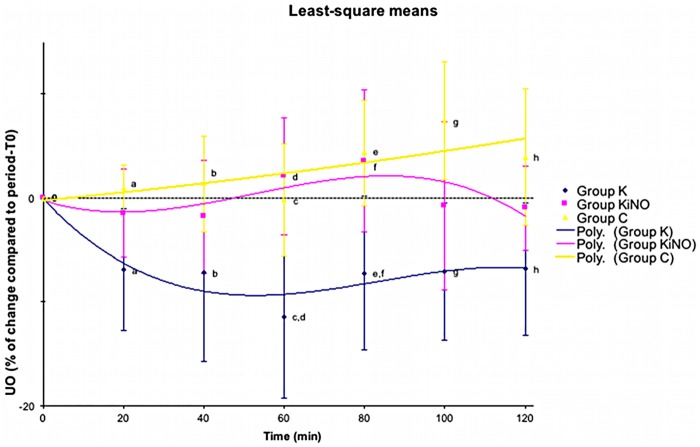
In this model, iNO increased significantly renal blood flow measured by ultrasonic (RBFUL: +53.2±17.2%; p = 0.008) and by PAH clearance (RBFPAH:+78.6±37.6%; p = 0.004) methods, glomerular filtration rate (GFR: +72.6±32.5%; p = 0.006) and urinary output (UO: +47.4±24.2%; p = 0.01). In the second experiment, no significant temporal variation was noted for renal parameters in groups KiNO and C, whereas a significant and constant decrease was observed in the group K for RBFUL (max -19.0±7.1%), GFR (max -26.6±10.4%) and UO (max -30.3±10.5%).
Our experiments show that iNO, released from its transport forms after its inhalation, can improve renal safety of NSAIDs. This result is promising regarding the use of NSAIDs in critical conditions, but needs to receive clinical confirmation.
吸入一氧化氮(iNO)常用于治疗肺动脉高压。其作用据称对肺具有特异性,但也有肺外效应的报道。本研究的目的是评估在全身麻醉期间,iNO是否能够补偿由传统非甾体抗炎药(NSAID)酮洛芬引起的肾功能损害。
在拟正常血容量状态下,将30只仔猪随机分为5组,每组数量相等,并配备用于测量肾脏和全身参数的设备。进行了第一个实验以验证方法,并与安慰剂(100%氧气)相比,重现iNO(40 ppm)对肾脏的影响。在第二个实验中,在NSAID治疗(酮洛芬2 mg×kg-1静脉注射,以及40 ppm iNO;KiNO组)后立即吸入iNO 120分钟,并将其效果与单独使用酮洛芬(2 mg×kg-1静脉注射;K组)和安慰剂(生理盐水;C组)进行比较。
在该模型中,通过超声测量(肾血流量超声法:+53.2±17.2%;p = 0.008)和对氨基马尿酸清除率测量(肾血流量对氨基马尿酸法:+78.6±37.6%;p = 0.004)、肾小球滤过率(GFR:+72.6±32.5%;p = 0.006)和尿量(UO:+47.4±24.2%;p = 0.01),iNO显著增加。在第二个实验中,KiNO组和C组的肾脏参数未观察到显著的时间变化,而K组的肾血流量超声法(最大-19.0±7.1%)、肾小球滤过率(最大-26.6±10.4%)和尿量(最大-30.3±10.5%)观察到显著且持续的下降。
我们的实验表明,iNO吸入后从其转运形式释放出来,可以提高NSAIDs的肾脏安全性。这一结果对于在危急情况下使用NSAIDs来说很有前景,但需要临床证实。