1 Department of Anaesthesiology and Intensive Therapy, Wrocław Medical University, Wrocław, Poland.
2 Department and Clinic of Surgery, Wrocław University of Environmental and Life Sciences, Wrocław, Poland.
Int J Immunopathol Pharmacol. 2018 Jan-Dec;32:394632017751486. doi: 10.1177/0394632017751486.
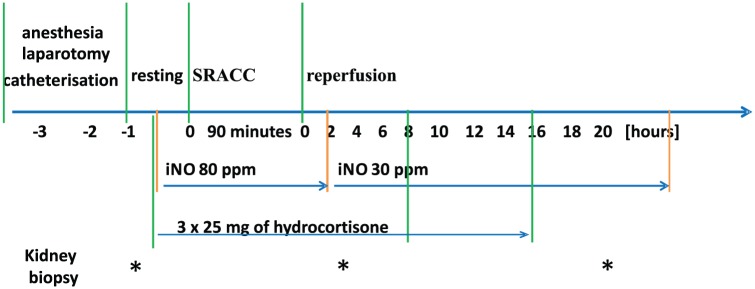
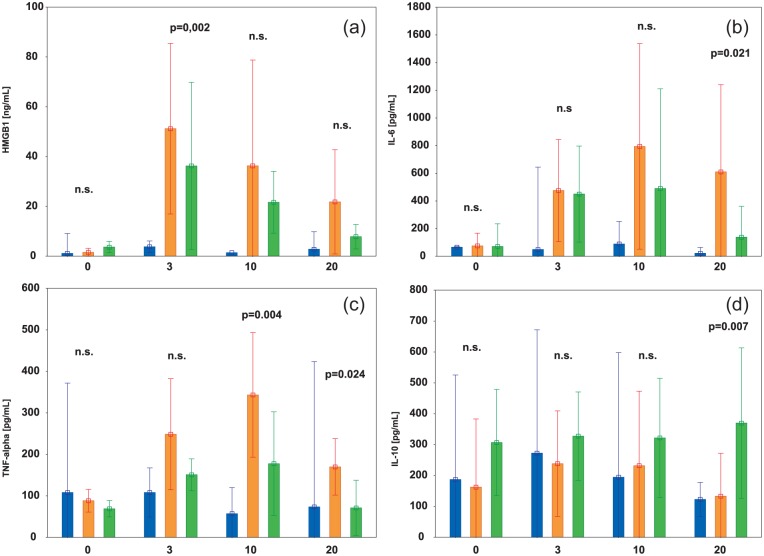
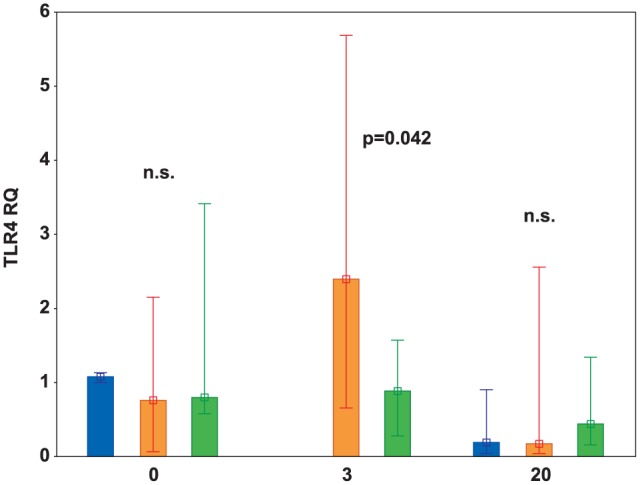
This study evaluated the effects of inhaled nitric oxide (iNO) therapy combined with intravenous (IV) corticosteroids on hemodynamics, selected cytokines, and kidney messenger RNA toll-like receptor 4 (mRNA TLR4) expression in ischemia-reperfusion injury animal model. The primary endpoint was the evaluation of circulatory, respiratory, and renal function over time. We also investigated the profile of selected cytokines and high-mobility group box 1 (HMGB1) protein, as well as renal mRNA TLR4 activation determined by quantitative real-time polymerase chain reaction analysis. Pigs (n = 19) under sevoflurane AnaConDa anesthesia/sedation were randomized and subjected to abdominal laparotomy and alternatively suprarenal aortic cross-clamping (SRACC) for 90 min or sham surgery: Group 1 (n = 8) iNO (80 ppm) + IV corticosteroids (25 mg ×3) started 30 min before SRACC and continued 2 h after SRACC release, followed with decreased iNO (30 ppm) until the end of observation, Group 2 (n = 8) 90 min SRACC, Group 3 (n = 3)-sham surgery. Renal biopsies were sampled 1 hr before SRACC and at 3 and 20 h after SRACC release. Aortic clamping increased TLR4 mRNA expression in ischemic kidneys, but significant changes were recorded only in the control group ( P = 0.016). Treatment with iNO and hydrocortisone reduced TLR4 mRNA expression to pre-ischemic conditions, and the difference observed in mRNA expression was significant between control and treatment group after 3 h ( P = 0.042). Moreover, animals subjected to treatment with iNO and hydrocortisone displayed an attenuated systemic inflammatory response and lowered pulmonary vascular resistance plus increased oxygen delivery. The results indicated that iNO therapy combined with IV corticosteroids improved central and systemic hemodynamics, oxygen delivery, and diminished the systemic inflammatory response and renal mRNA TLR4 expression.
本研究评估了吸入一氧化氮(iNO)治疗联合静脉(IV)皮质类固醇对缺血再灌注损伤动物模型的血流动力学、选定细胞因子和肾脏信使 RNA toll 样受体 4(mRNA TLR4)表达的影响。主要终点是随时间评估循环、呼吸和肾功能。我们还研究了选定细胞因子和高迁移率族蛋白 B1(HMGB1)蛋白的特征,以及通过定量实时聚合酶链反应分析确定的肾脏 mRNA TLR4 激活。在七氟醚 AnaConDa 麻醉/镇静下的猪(n=19)随机分为 3 组:组 1(n=8)在肾动脉夹闭前 30 分钟开始接受 iNO(80ppm)+IV 皮质类固醇(25mg×3),并在肾动脉夹闭释放后继续使用 2 小时,然后减少 iNO(30ppm)直到观察结束;组 2(n=8)接受 90 分钟的肾动脉夹闭;组 3(n=3)为假手术。在肾动脉夹闭前 1 小时和肾动脉夹闭释放后 3 小时和 20 小时采集肾活检样本。肾动脉夹闭增加了缺血肾脏的 TLR4 mRNA 表达,但仅在对照组中观察到显著变化(P=0.016)。iNO 和氢化可的松的治疗降低了 TLR4 mRNA 表达,使其恢复到缺血前的水平,并且在 3 小时后,在对照组和治疗组之间观察到的 mRNA 表达差异具有统计学意义(P=0.042)。此外,接受 iNO 和氢化可的松治疗的动物表现出减弱的全身炎症反应和降低的肺血管阻力,同时增加了氧输送。结果表明,iNO 治疗联合 IV 皮质类固醇可改善中心和全身血流动力学、氧输送,并减少全身炎症反应和肾脏 mRNA TLR4 表达。