Orosz Andrea, Baczkó István, Nyiraty Szabolcs, Körei Anna E, Putz Zsuzsanna, Takács Róbert, Nemes Attila, Várkonyi Tamás T, Balogh László, Ábrahám György, Kempler Péter, Papp Julius Gy, Varró András, Lengyel Csaba
Department of Pharmacology and Pharmacotherapy, University of Szeged, Szeged, Hungary.
First Department of Medicine, University of Szeged, Szeged, Hungary.
Front Endocrinol (Lausanne). 2017 Jun 13;8:129. doi: 10.3389/fendo.2017.00129. eCollection 2017.
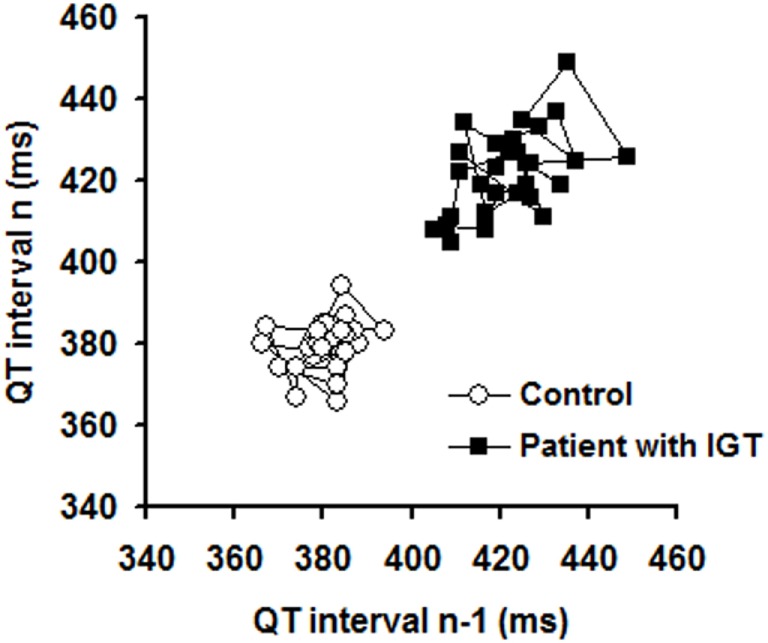
Prediabetic states and diabetes are important risk factors for cardiovascular morbidity and mortality. Determination of short-term QT interval variability (STV) is a non-invasive method for assessment of proarrhythmic risk. The aim of the study was to evaluate the STV in patients with impaired glucose tolerance (IGT). 18 IGT patients [age: 63 ± 11 years, body mass index (BMI): 31 ± 6 kg/m, fasting glucose: 6.0 ± 0.4 mmol/l, 120 min postload glucose: 9.0 ± 1.0 mmol/l, hemoglobin A1c (HbA1c): 5.9 ± 0.4%; mean ± SD] and 18 healthy controls (age: 56 ± 9 years, BMI: 27 ± 5 kg/m, fasting glucose: 5.2 ± 0.4 mmol/l, 120 min postload glucose: 5.5 ± 1.3 mmol/l, HbA1c: 5.4 ± 0.3%) were enrolled into the study. ECGs were recorded, processed, and analyzed off-line. The RR and QT intervals were expressed as the average of 30 consecutive beats, the temporal instability of beat-to-beat repolarization was characterized by calculating STV as follows: STV = Σ|QT - QT| (30x√2). Autonomic function was assessed by means of standard cardiovascular reflex tests. There were no differences between IGT and control groups in QT (411 ± 43 vs 402 ± 39 ms) and QTc (431 ± 25 vs 424 ± 19 ms) intervals or QT dispersion (44 ± 13 vs 42 ± 17 ms). However, STV was significantly higher in IGT patients (5.0 ± 0.7 vs 3.7 ± 0.7, < 0.0001). The elevated temporal STV in patients with IGT may be an early indicator of increased instability of cardiac repolarization during prediabetic conditions.
糖尿病前期状态和糖尿病是心血管疾病发病和死亡的重要危险因素。测定短期QT间期变异性(STV)是评估心律失常风险的一种非侵入性方法。本研究的目的是评估糖耐量受损(IGT)患者的STV。18例IGT患者[年龄:63±11岁,体重指数(BMI):31±6kg/m²,空腹血糖:6.0±0.4mmol/L,负荷后120分钟血糖:9.0±1.0mmol/L,糖化血红蛋白(HbA1c):5.9±0.4%;均值±标准差]和18例健康对照者(年龄:56±9岁,BMI:27±5kg/m²,空腹血糖:5.2±0.4mmol/L,负荷后120分钟血糖:5.5±1.3mmol/L,HbA1c:5.4±0.3%)纳入本研究。心电图记录后离线进行处理和分析。RR和QT间期表示为连续30个心动周期的平均值,逐搏复极的时间不稳定性通过计算STV来表征,计算方法如下:STV = Σ|QT - QT|(30×√2)。通过标准心血管反射试验评估自主神经功能。IGT组和对照组在QT(411±43 vs 402±39ms)、QTc(431±25 vs 424±19ms)间期或QT离散度(44±13 vs 42±17ms)方面无差异。然而,IGT患者的STV显著更高(5.0±0.7 vs 3.7±0.7,P<0.0001)。IGT患者升高的时间STV可能是糖尿病前期状态下心脏复极不稳定性增加的早期指标。