Department of Human Nutrition, Warsaw University of Life Sciences-SGGW, Warsaw, Poland.
Department of Dietetics, Warsaw University of Life Sciences-SGGW, Warsaw, Poland.
Aging Clin Exp Res. 2018 May;30(5):517-526. doi: 10.1007/s40520-017-0791-y. Epub 2017 Jun 29.
The effect of low and high concentration of some hematological parameters in the blood can have a negative impact on health.
Therefore, we investigated the associations between hematological parameters and all-cause mortality among older people living in Poland.
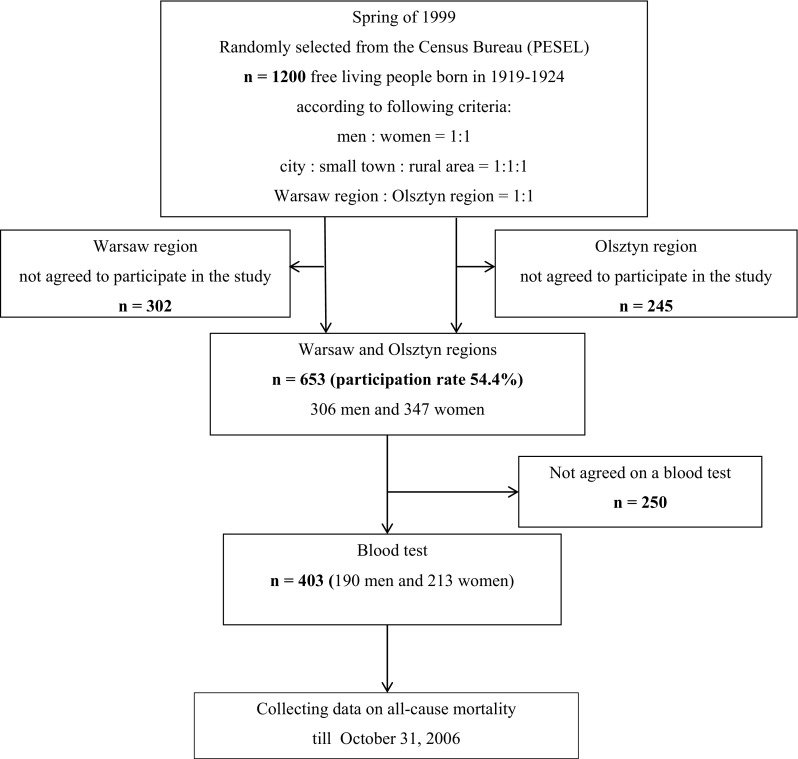
The study was carried out among 75-80-year-old participants (n = 403) from Warsaw and Olsztyn regions, Poland. Information on lifestyle factors and food consumption were obtained at baseline (June 1, 1999) using a self-administered questionnaire. Red blood cell, haemoglobin, hematocrit, mean corpuscular volume (MCV), mean corpuscular haemoglobin (MCH), and mean corpuscular haemoglobin concentration (MCHC) were determined. The data on deaths from all-causes were collected from the baseline until October 31, 2006. During an average of 7.4 years of follow-up, we ascertained 154 cases of death from all-causes.
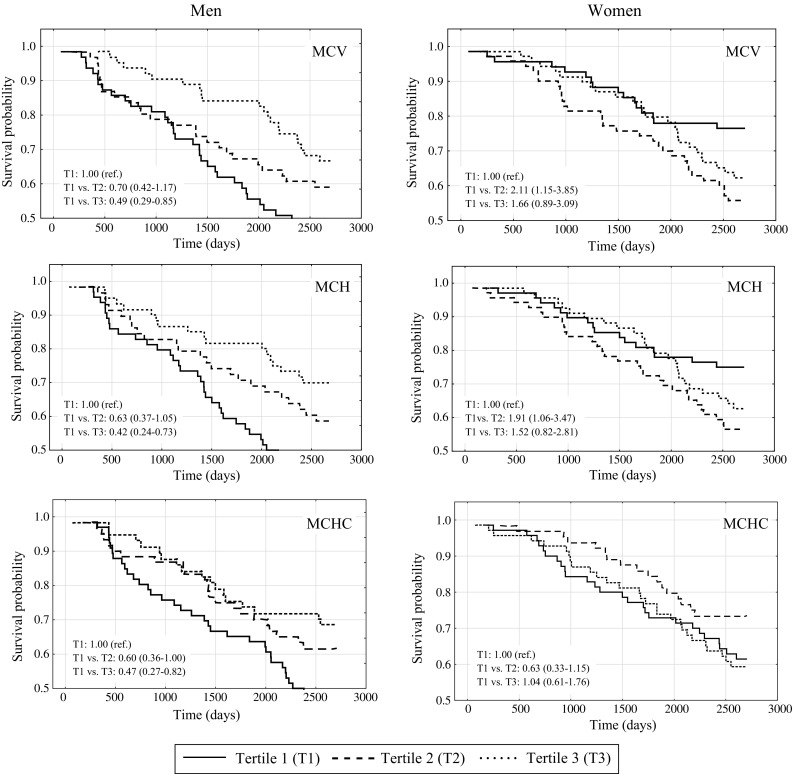
Compared with men in the lowest tertile of MCV, MCH, and MCHC, the multivariable hazard ratios (HRs) of all-cause mortality in those in the highest tertile were 0.35 (95% CI, 0.17-0.73), 0.32 (95% CI, 0.16-0.67), and 0.44 (95% CI, 0.22-0.88), respectively. In contrast, among women after combining the second and the third tertiles of MCV, MCH, and MCHC, the HRs were 2.01 (95% CI, 1.01-3.99), 1.71 (95% CI, 0.85-3.43), and 1.09 (95% CI, 0.62-1.94), respectively.
DISCUSSION/CONCLUSION: We observed inverse associations between some hematological parameters and all-cause mortality among men, but not among women. This may be explained by a difference in iron metabolism, iron status, hormone regulations, or the occurrence of some diseases.
血液中某些低浓度和高浓度的血液参数会对健康产生负面影响。
因此,我们调查了波兰老年人血液参数与全因死亡率之间的关系。
这项研究在波兰华沙和奥尔什丁地区的 75-80 岁参与者(n=403)中进行。在基线时(1999 年 6 月 1 日)使用自我管理问卷获得了生活方式因素和食物消耗的信息。测定了红细胞、血红蛋白、血细胞比容、平均红细胞体积(MCV)、平均红细胞血红蛋白(MCH)和平均红细胞血红蛋白浓度(MCHC)。从基线到 2006 年 10 月 31 日,收集了所有原因死亡的数据。在平均 7.4 年的随访期间,我们确定了 154 例全因死亡病例。
与 MCV、MCH 和 MCHC 最低三分位数的男性相比,MCV、MCH 和 MCHC 最高三分位数的男性全因死亡率的多变量风险比(HR)分别为 0.35(95%CI,0.17-0.73)、0.32(95%CI,0.16-0.67)和 0.44(95%CI,0.22-0.88)。相比之下,在女性中,MCV、MCH 和 MCHC 的第二和第三三分位组结合后,HR 分别为 2.01(95%CI,1.01-3.99)、1.71(95%CI,0.85-3.43)和 1.09(95%CI,0.62-1.94)。
讨论/结论:我们观察到男性血液参数与全因死亡率之间存在负相关,但女性中没有这种相关性。这可能是由于铁代谢、铁状态、激素调节或某些疾病的发生存在差异。