Persson Josefine, Aronsson Mattias, Holmegaard Lukas, Redfors Petra, Stenlöf Kaj, Jood Katarina, Jern Christina, Blomstrand Christian, Forsberg-Wärleby Gunilla, Levin Lars-Åke
Department of Clinical Neuroscience, Institute of Neuroscience and Physiology, Sahlgrenska Academy, University of Gothenburg, Gothenburg, Sweden.
Health Metrics, Sahlgrenska Academy, University of Gothenburg, Gothenburg, Sweden.
Qual Life Res. 2017 Nov;26(11):3059-3068. doi: 10.1007/s11136-017-1636-z. Epub 2017 Jun 29.
The aim of this study was to investigate whether the dependency of midlife stroke survivors had any long-term impact on their spouses' QALY-weights.
Data on stroke survivors, controls, and spouses were collected from the 7-year follow-up of the Sahlgrenska Academy Study on Ischemic Stroke. Health-related quality of life was assessed by the SF-36, and the preference-based health state values were assessed with the SF-6D. Spouses of dependent and independent stroke survivors were categorized according to their scores on the modified Rankin Scale. An ordinary least squares regression analysis was used to evaluate whether the dependency of the stroke survivors had any impact on the spouses' QALY-weights.
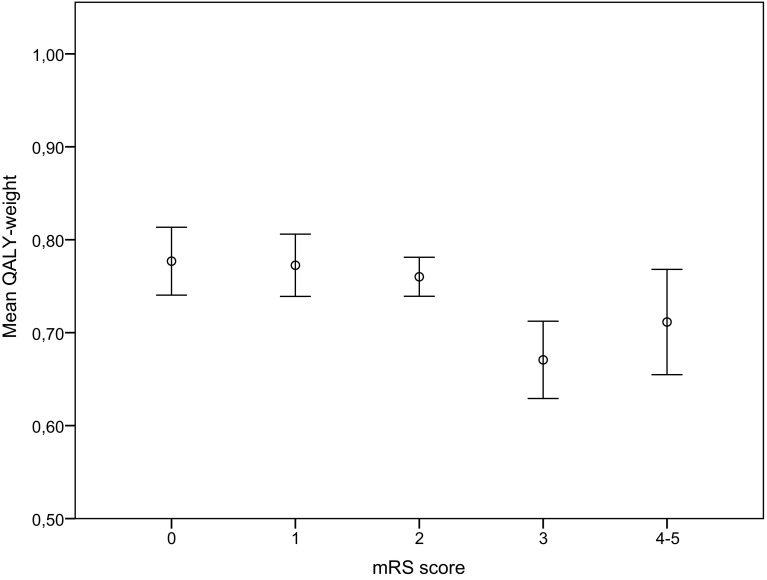
Cohabitant dyads of 247 stroke survivors aged <70 at stroke onset and 245 dyads of controls were included in the study. Spouses of dependent stroke survivors (n = 50) reported a significant lower mean QALY-weight of 0.69 in comparison to spouses of independent stroke survivors (n = 197) and spouses of controls, (n = 245) who both reported a mean QALY-weight of 0.77. The results from the regression analysis showed that higher age of the spouse and dependency of the stroke survivor had a negative association with the spouses' QALY-weights.
The QALY-weights for spouses of dependent midlife stroke survivors were significantly reduced compared to spouses of independent midlife stroke survivors. This indicates that the inclusion of spouses' QALYs in evaluations of early treatment and rehabilitation efforts to reduce stroke patients' dependency would capture more of the total effect in dyads of stroke survivors.
本研究旨在调查中年中风幸存者的依赖状况是否对其配偶的质量调整生命年权重有任何长期影响。
从哥德堡大学医学院缺血性中风研究的7年随访中收集中风幸存者、对照组和配偶的数据。使用SF-36评估与健康相关的生活质量,并用SF-6D评估基于偏好的健康状态值。根据改良Rankin量表的得分,对依赖和独立中风幸存者的配偶进行分类。采用普通最小二乘法回归分析来评估中风幸存者的依赖状况是否对其配偶的质量调整生命年权重有任何影响。
本研究纳入了247名中风发病时年龄<70岁的中风幸存者的同居二元组和245个对照组二元组。与独立中风幸存者的配偶(n = 197)和对照组的配偶(n = 245)相比,依赖中风幸存者的配偶(n = 50)报告的平均质量调整生命年权重显著较低,为0.69,而后两者报告的平均质量调整生命年权重均为0.77。回归分析结果表明,配偶年龄较大和中风幸存者的依赖状况与配偶的质量调整生命年权重呈负相关。
与独立中年中风幸存者的配偶相比,依赖中年中风幸存者的配偶的质量调整生命年权重显著降低。这表明,在评估旨在降低中风患者依赖性的早期治疗和康复努力时纳入配偶的质量调整生命年,将能更全面地体现中风幸存者二元组的总体效果。