Sarin Enisha, Lunsford Sarah Smith
University Research Co., LLC, B7, 1st floor, Suncity, sector 54, Gurgaon, Haryana, 122001, India.
EnCompass LLC, Rockville, United States of America.
Hum Resour Health. 2017 Jul 1;15(1):44. doi: 10.1186/s12960-017-0222-3.
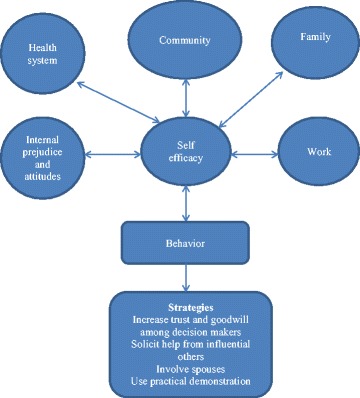
Accredited Social Health Activists (ASHAs) are community health workers tasked to deliver health prevention in communities and link them with the health care sector. This paper examines the social, cultural, and institutional influences that either facilitate or impede ASHAs' abilities to deliver services effectively through the lens of the reciprocal determinism framework of social cognitive theory.
We conducted 98 semi-structured, in-depth interviews with ASHAs (n = 49) and their family members (n = 49) in Gurdaspur and Mewat districts. Data were analyzed by comparing and contrasting codes leading to the identification of patterns which were explained with the help of a theoretical framework.
We found that while the work of ASHAs led to some positive health changes in the community, thus providing them with a sense of self-worth and motivation, community norms and beliefs as well as health system attitudes and practices limited their capacity as community health workers.
We outline potential mechanisms for improving ASHA capacity such as improved sensitization about religious, cultural, and gender norms; enhanced communication skills; and sensitization and advocating their work with health and state officials.
经认可的社会健康活动家(ASHAs)是社区卫生工作者,其任务是在社区开展健康预防工作,并将社区与医疗保健部门联系起来。本文从社会认知理论的相互决定论框架的角度,探讨了促进或阻碍ASHAs有效提供服务能力的社会、文化和制度影响因素。
我们在古尔达斯布尔和默瓦特地区对ASHAs(n = 49)及其家庭成员(n = 49)进行了98次半结构化深度访谈。通过对编码进行比较和对比来分析数据,从而识别出模式,并借助理论框架对其进行解释。
我们发现,虽然ASHAs的工作给社区带来了一些积极的健康变化,从而为他们提供了自我价值感和动力,但社区规范和信仰以及卫生系统的态度和做法限制了他们作为社区卫生工作者的能力。
我们概述了提高ASHAs能力的潜在机制,如提高对宗教、文化和性别规范的认识;增强沟通技巧;以及提高卫生和政府官员对他们工作的认识并为之宣传。