Ashenafi Wondimye, Eshetu Frehywot, Assefa Nega, Oljira Lemessa, Dedefo Melkamu, Zelalem Desalew, Baraki Negga, Demena Melake
Department of Public Health, Haramaya University, Harar, Ethiopia.
Kersa Health and Demographic Surveillance System (Kersa- HDSS), Haramaya University, Harar, Ethiopia.
Popul Health Metr. 2017 Jul 1;15(1):22. doi: 10.1186/s12963-017-0144-2.
The health problems of adults have been neglected in many developing countries, yet many studies in these countries show high rates of premature mortality in adults. Measuring adult mortality and its cause through verbal autopsy (VA) methods is becoming an important process for mortality estimates and is a good indicator of the overall mortality rates in resource-limited settings. The objective of this analysis is to describe the levels, distribution, and trends of adult mortality over time (2008-2013) and causes of adult deaths using VA in Kersa Health and Demographic Surveillance System (Kersa HDSS).
Kersa HDSS is a demographic and health surveillance and research center established in 2007 in the eastern part of Ethiopia. This is a community-based longitudinal study where VA methods were used to assign probable cause of death. Two or three physicians independently assigned cause of death based on the completed VA forms in accordance with the World Health Organization's International Classification of Diseases. In this analysis, the VA data considered were of all deaths of adults age 15 years and above, over a period of six years (2008-2013). The mortality fractions were determined and the causes of death analyzed. Analysis was done using STATA and graphs were designed using Microsoft Excel.
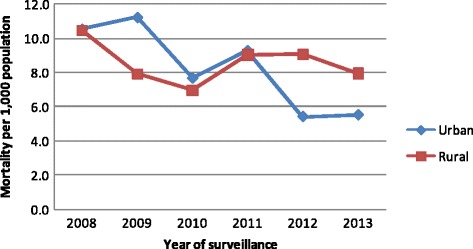
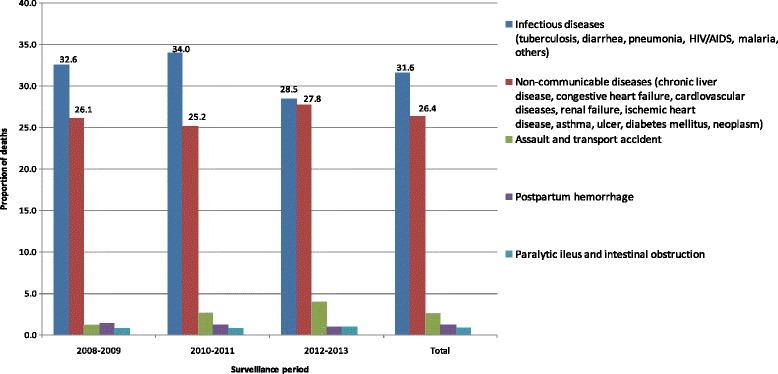
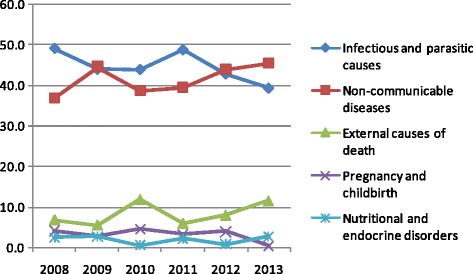
A total of 1535 adult deaths occurred in the surveillance site during the study period and VA was completed for all these deaths. In general, the adult mortality rate over the six-year period was 8.5 per 1000 adult population, higher for males (9.6) and rural residents (8.6) than females (7.5) and urban residents (8.2). There is a general decrease in the mortality rates over the study period from 9.4 in 2008-2009 to 8.1 in 2012-2013. Out of the total deaths, about one-third (32.4%) occurred due to infectious and parasitic causes, and the second leading cause of death was diseases of circulatory system (11.4%), followed by gastrointestinal disorders (9.2%). Tuberculosis (TB) showed an increasing trend over the years and has been the leading cause of death in 2012 and 2013 for all adult age categories (15-49, 50-64, and 65 years and over). Chronic liver disease (CLD) was indicated as leading cause of death among adults in the age group 15-49 years.
The increasing TB-related mortality in the study years as well as the relative high mortality due to CLD among adults of age 15-49 years should be further investigated and triangulated with health service data to understand the root cause of death.
在许多发展中国家,成人的健康问题一直被忽视,但这些国家的许多研究表明成人过早死亡率很高。通过死因推断(VA)方法来衡量成人死亡率及其原因,正成为死亡率估计的一个重要过程,并且是资源有限环境中总体死亡率的一个良好指标。本分析的目的是描述克尔萨卫生与人口监测系统(Kersa HDSS)中成人死亡率随时间(2008 - 2013年)的水平、分布和趋势以及使用VA得出的成人死亡原因。
Kersa HDSS是2007年在埃塞俄比亚东部建立的一个人口与健康监测及研究中心。这是一项基于社区的纵向研究,采用VA方法来确定可能的死亡原因。两到三名医生根据填写完整的VA表格,按照世界卫生组织的《国际疾病分类》独立确定死亡原因。在本分析中,所考虑的VA数据是15岁及以上成年人在六年期间(2008 - 2013年)的所有死亡情况。确定了死亡率并分析了死亡原因。使用STATA进行分析,使用Microsoft Excel设计图表。
在研究期间,监测点共发生1535例成人死亡,所有这些死亡均完成了VA调查。总体而言,六年期间成人死亡率为每1000名成年人口8.5例,男性(9.6)和农村居民(8.6)的死亡率高于女性(7.5)和城市居民(8.2)。在研究期间,死亡率总体呈下降趋势,从2008 - 2009年的9.4降至2012 - 2013年的8.1。在所有死亡中,约三分之一(32.4%)是由传染病和寄生虫病导致的,第二大死亡原因是循环系统疾病(11.4%),其次是胃肠道疾病(9.2%)。多年来,结核病(TB)呈上升趋势,并且在2012年和2013年一直是所有成人年龄组(15 - 49岁、50 - 64岁以及65岁及以上)的主要死亡原因。慢性肝病(CLD)被指出是15 - 49岁年龄组成年人的主要死亡原因。
研究期间与结核病相关的死亡率上升以及15 - 49岁成年人中因CLD导致的相对较高死亡率,应进一步调查并与卫生服务数据进行比对,以了解死亡的根本原因。