Winer E Samuel, Bryant Jessica, Bartoszek Gregory, Rojas Enrique, Nadorff Michael R, Kilgore Jenna
Department of Psychology, Mississippi State University, P.O. Box 6161, Mississippi State, MS 39762, USA.
Department of Psychology, University of Illinois at Chicago, 1007 W. Harrison St. (M/C 285), Chicago, IL 60607, USA.
J Affect Disord. 2017 Oct 15;221:289-296. doi: 10.1016/j.jad.2017.06.006. Epub 2017 Jun 13.
Anxiety and depression are often comorbid conditions, but there is uncertainty as to how this comorbidity develops. Thus, in three studies, we attempted to discern whether anhedonia may be a key linking factor between anxiety and depression.
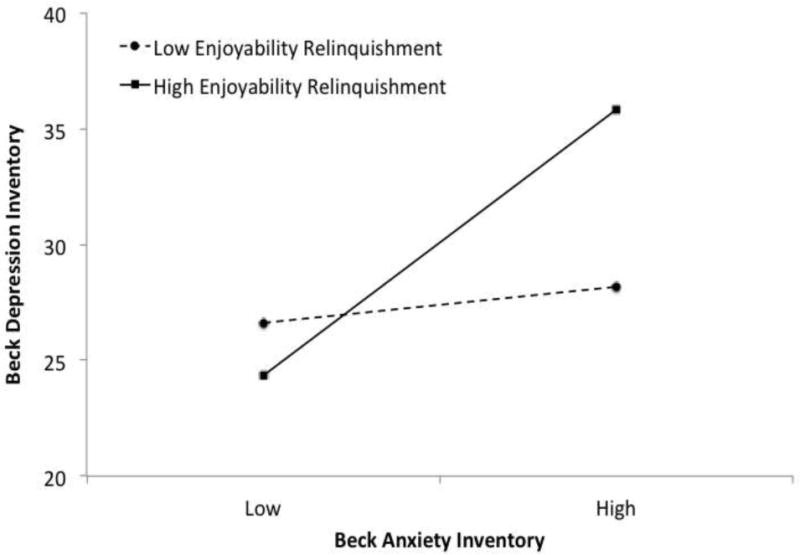
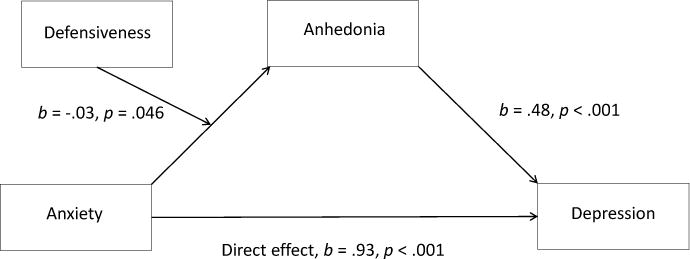
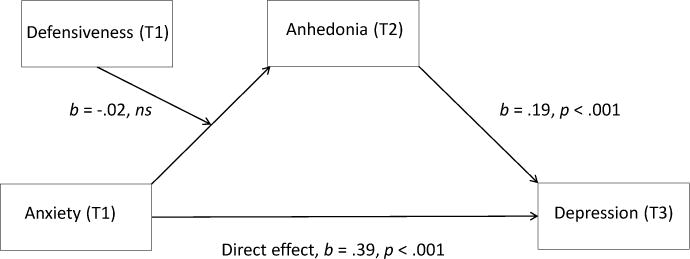
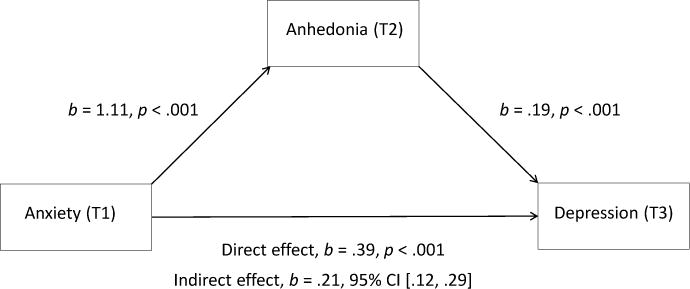
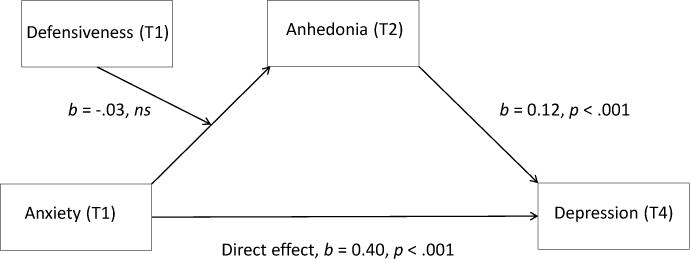
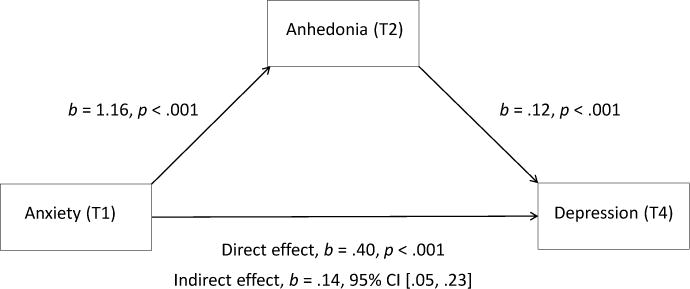
Three studies asked participants about their symptoms of anxiety and depression: in Study 1, 109 participants completed measures of anxiety, depression, activity avoidance, and perceived enjoyability and importance of avoided activities; in Study 2, 747 participants completed measures of anhedonia, anxiety, depression, and defensiveness; in Study 3, 216 participants completed measures assessing the same constructs as in Study 2 at four time-points (ranging 11 months in span).
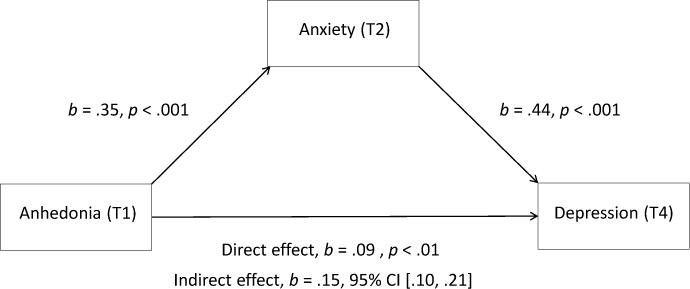
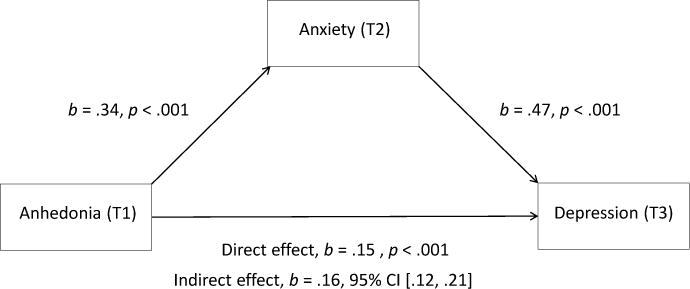
In Study 1, symptoms of anxiety and depression were positively related only in individuals who relinquished potential enjoyment due to their anxiety-related avoidance; in Study 2, the indirect effect of anhedonia helped explained how anxiety symptoms imparted risk onto depressive symptoms; and in Study 3, anxiety led to anhedonia and then depression over time and anhedonia led to anxiety and then depression at both 5 and 11 months.
The manuscript is limited by the use of a student sample in study 2, cross-sectional methods in studies 1 and 2, and reliance on self-ratings.
Anxiety may devolve into depression through anhedonia, such that anxious individuals begin to lose pleasure in anxiety-provoking activities, which results in the development of other depressive symptoms.
焦虑和抑郁常常是共病情况,但这种共病如何发展尚不确定。因此,在三项研究中,我们试图探究快感缺失是否可能是焦虑和抑郁之间的关键联系因素。
三项研究询问了参与者的焦虑和抑郁症状:在研究1中,109名参与者完成了焦虑、抑郁、活动回避以及对回避活动的感知愉悦度和重要性的测量;在研究2中,747名参与者完成了快感缺失、焦虑、抑郁和防御性的测量;在研究3中,216名参与者在四个时间点(跨度为11个月)完成了与研究2相同结构的测量。
在研究1中,焦虑和抑郁症状仅在那些因焦虑相关回避而放弃潜在愉悦感的个体中呈正相关;在研究2中,快感缺失的间接效应有助于解释焦虑症状如何将风险传递给抑郁症状;在研究3中,随着时间的推移,焦虑导致快感缺失进而导致抑郁,在5个月和11个月时,快感缺失均导致焦虑进而导致抑郁。
本手稿受到研究2中使用学生样本、研究1和2采用横断面方法以及依赖自我评定的限制。
焦虑可能通过快感缺失演变为抑郁,即焦虑个体开始在引发焦虑的活动中失去乐趣,进而导致其他抑郁症状的出现。