Popević Spasoje, Šumarac Zorica, Jovanović Dragana, Babić Dragan, Stjepanović Mihailo, Jovičić Snežana, Šobić-Šaranović Dragana, Filipović Snežana, Gvozdenović Branko, Omčikus Maja, Milovanović Anđela, Videnović-Ivanov Jelica, Radović Ana, Žugić Vladimir, Mihailović-Vučinić Violeta
Medical Faculty, University of Belgrade, Serbia.
Clinic of Pulmonary Diseases, Clinical Center of Serbia, Belgrade, Serbia.
J Med Biochem. 2016 Nov 2;35(4):390-400. doi: 10.1515/jomb-2016-0017. eCollection 2016 Oct.
Until now, a proper biomarker(s) to evaluate sarcoidosis activity has not been recognized. The aims of this study were to evaluate the sensitivity and specificity of the two biomarkers of sarcoidosis activity already in use (serum angiotensin converting enzyme - ACE and serum chitotriosidase) in a population of 430 sarcoidosis patients. The activities of these markers were also analyzed in a group of 264 healthy controls.
Four hundred and thirty biopsy positive sarcoidosis patients were divided into groups with active and inactive disease, and groups with acute or chronic disease. In a subgroup of 55 sarcoidosis patients, activity was also assessed by F-18 fluorodeoxyglucose positron emission tomography (F-FDG-PET) scanning. Both serum chitotriosidase and ACE levels showed non-normal distribution, so nonparametric tests were used in statistical analysis.
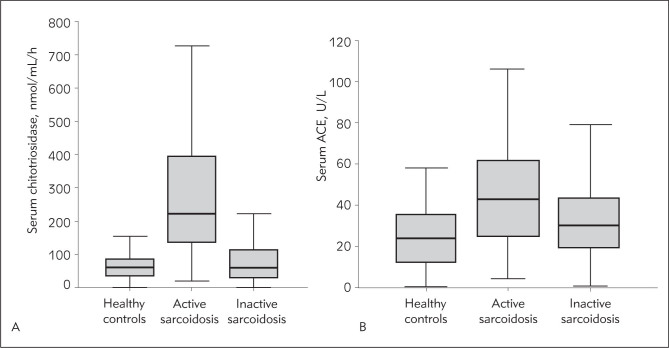
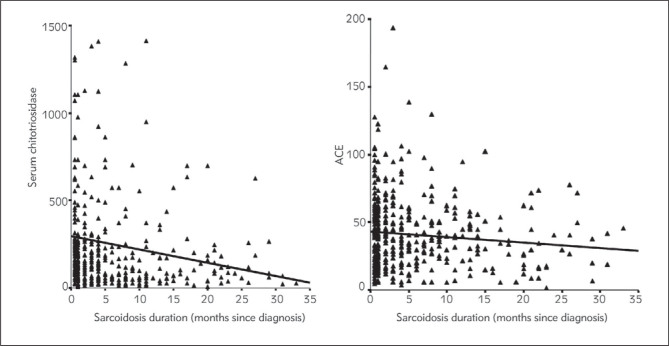
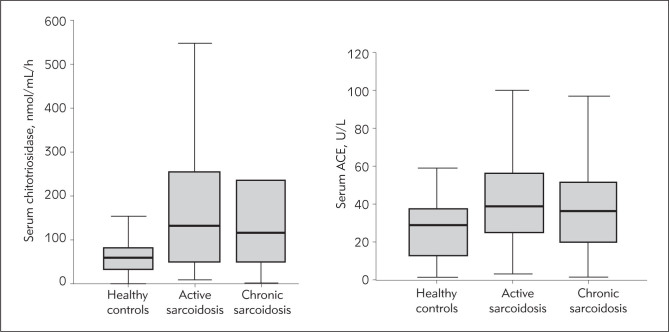
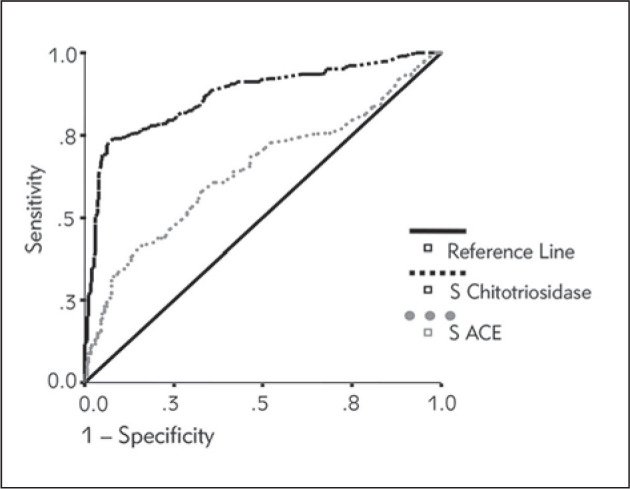
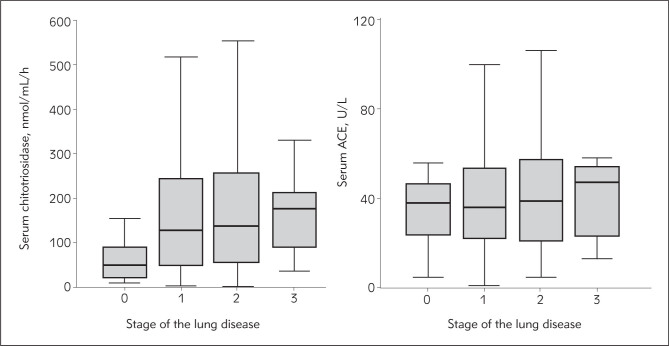
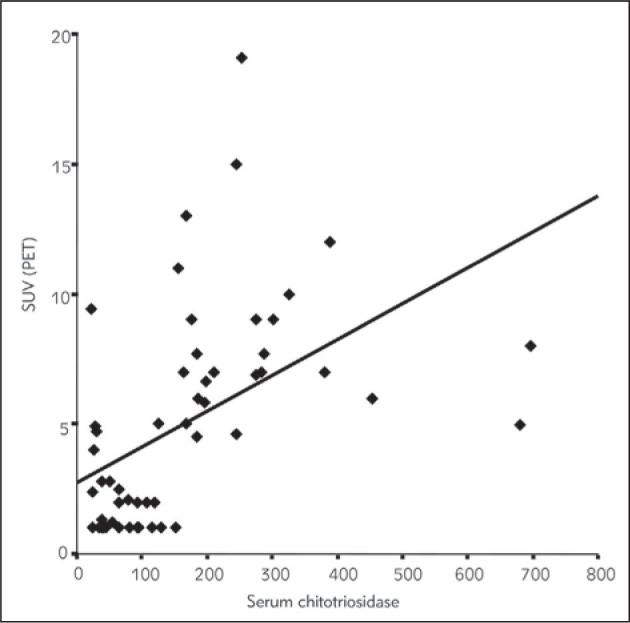
Serum chitotriosidase activities were almost 6 times higher in patients with active sarcoidosis than in healthy controls and inactive disease. A serum chitotriosidase value of 100 nmol/mL/h had the sensitivity of .5% and specificity of 70.0%. A serum ACE activity cutoff value of 32.0 U/L had the sensitivity of 66.0% and the specificity of 54%. A statistically significant correlation was obtained between the focal granulomatous activity detected on F-FDG PET/CT and serum chitotriosidase levels, but no such correlation was found with ACE. The levels of serum chitotriosidase activity significantly correlated with the disease duration ( < 0.0001). Also, serum chitotriosidase significantly correlated with clinical outcome status (COS) categories (ρ =0.272, =0.001).
Serum chitotriosidase proved to be a reliable biomarker of sarcoidosis activity and disease chronicity.
迄今为止,尚未发现用于评估结节病活动度的合适生物标志物。本研究旨在评估430例结节病患者中已使用的两种结节病活动度生物标志物(血清血管紧张素转换酶 - ACE和血清壳三糖苷酶)的敏感性和特异性。还在一组264名健康对照者中分析了这些标志物的活性。
430例活检阳性的结节病患者被分为疾病活动和非活动组,以及急性或慢性疾病组。在55例结节病患者的亚组中,还通过F-18氟脱氧葡萄糖正电子发射断层扫描(F-FDG-PET)扫描评估活动度。血清壳三糖苷酶和ACE水平均呈非正态分布,因此在统计分析中使用非参数检验。
活动期结节病患者的血清壳三糖苷酶活性几乎是健康对照者和非活动期疾病患者的6倍。血清壳三糖苷酶值为100 nmol/mL/h时,敏感性为5%,特异性为70.0%。血清ACE活性临界值为32.0 U/L时,敏感性为66.0%,特异性为54%。F-FDG PET/CT检测到的局灶性肉芽肿活性与血清壳三糖苷酶水平之间存在统计学显著相关性,但与ACE未发现此类相关性。血清壳三糖苷酶活性水平与疾病持续时间显著相关(<0.0001)。此外,血清壳三糖苷酶与临床结局状态(COS)类别也显著相关(ρ =0.272,=0.001)。
血清壳三糖苷酶被证明是结节病活动度和疾病慢性化的可靠生物标志物。