Robinson Colin, Connell Simon D
School of Dentistry, University of LeedsLeeds, United Kingdom.
Molecular and Nanoscale Physics Group, School of Physics and Astronomy, University of LeedsLeeds, United Kingdom.
Front Physiol. 2017 Jun 16;8:405. doi: 10.3389/fphys.2017.00405. eCollection 2017.
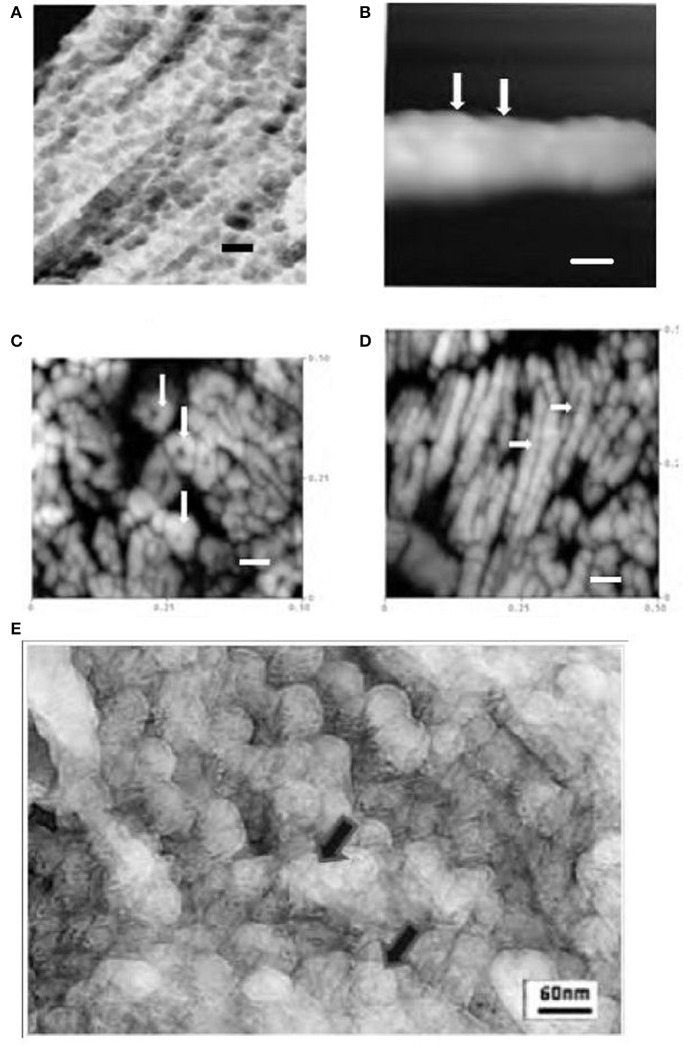
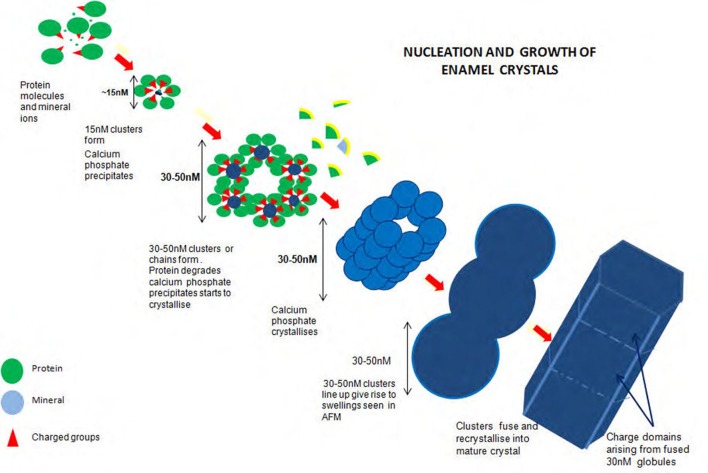
Investigations of developing enamel crystals using Atomic and Chemical Force Microscopy (AFM, CFM) have revealed a subunit structure. Subunits were seen in height images as collinear swellings about 30 nM in diameter on crystal surfaces. In friction mode they were visible as positive regions. These were similar in size (30-50 nM) to collinear spherical structures, presumably mineral matrix complexes, seen in developing enamel using a freeze fracturing/freeze etching procedure. More detailed AFM studies on mature enamel suggested that the 30-50 nM structures were composed of smaller units, ~10-15 nM in diameter. These were clustered in hexagonal or perhaps a spiral arrangement. It was suggested that these could be the imprints of initiation sites for mineral precipitation. The investigation aimed at examining original freeze etched images at high resolution to see if the smaller subunits observed using AFM in mature enamel were also present in developing enamel i.e., before loss of the organic matrix. The method used was freeze etching. Briefly samples of developing rat enamel were rapidly frozen, fractured under vacuum, and ice sublimed from the fractured surface. The fractured surface was shadowed with platinum or gold and the metal replica subjected to high resolution TEM. For AFM studies high-resolution tapping mode imaging of human mature enamel sections was performed in air under ambient conditions at a point midway between the cusp and the cervical margin. Both AFM and freeze etch studies showed structures 30-50 nM in diameter. AFM indicated that these may be clusters of somewhat smaller structures ~10-15 nM maybe hexagonally or spirally arranged. High resolution freeze etching images of very early enamel showed ~30-50 nM spherical structures in a disordered arrangement. No smaller units at 10-15 nM were clearly seen. However, when linear arrangements of 30-50 nM units were visible the picture was more complex but also smaller units including ~10-15 nM units could be observed. Structures ~10-15 nM in diameter were detected in developing enamel. While the appearance was complex, these were most evident when the 30-5 nM structures were in linear arrays. Formation of linear arrays of subunits may be associated with the development of mineral initiation sites and attendant processing of matrix proteins.
利用原子力显微镜和化学力显微镜(AFM、CFM)对发育中的釉质晶体进行的研究揭示了一种亚基结构。在高度图像中,亚基表现为晶体表面直径约30纳米的共线隆起。在摩擦模式下,它们表现为阳性区域。这些区域的大小(30 - 50纳米)与通过冷冻断裂/冷冻蚀刻程序在发育中的釉质中看到的共线球形结构(可能是矿物基质复合物)相似。对成熟釉质进行的更详细的AFM研究表明,30 - 50纳米的结构由直径约10 - 15纳米的较小单元组成。这些单元呈六边形或可能呈螺旋状排列。有人认为这些可能是矿物沉淀起始位点的印记。该研究旨在以高分辨率检查原始冷冻蚀刻图像,以确定在成熟釉质中使用AFM观察到的较小亚基在发育中的釉质(即有机基质消失之前)中是否也存在。使用的方法是冷冻蚀刻。简要来说,将发育中的大鼠釉质样本快速冷冻,在真空中断裂,然后从断裂表面升华冰。用铂或金对断裂表面进行阴影处理,并对金属复制品进行高分辨率透射电子显微镜检查。对于AFM研究,在环境条件下于空气中在牙尖和颈缘之间的中点对人类成熟釉质切片进行高分辨率轻敲模式成像。AFM和冷冻蚀刻研究均显示出直径为30 - 50纳米的结构。AFM表明这些可能是由直径约10 - 15纳米的稍小结构组成的簇,可能呈六边形或螺旋状排列。非常早期釉质的高分辨率冷冻蚀刻图像显示出直径约30 - 50纳米的球形结构呈无序排列。未清晰看到10 - 15纳米的较小单元。然而,当可见30 - 50纳米单元的线性排列时,情况更为复杂,但也能观察到包括约10 - 15纳米单元在内的较小单元。在发育中的釉质中检测到了直径约10 - 15纳米的结构。虽然其外观复杂,但当30 - 5纳米的结构呈线性阵列时最为明显。亚基线性阵列的形成可能与矿物起始位点的发育以及基质蛋白的伴随加工有关。