Zakikhan Kobra, Pournasr Behshad, Vosough Massoud, Nassiri-Asl Marjan
Cellular and Molecular Research Center, Department of Molecular Medicine, School of Medicine, Qazvin University of Medical Sciences, Qazvin, Iran.
Department of Stem Cells and Developmental Biology, Cell Science Research Center, Royan Institute for Stem Cell Biology and Technology, ACECR, Tehran, Iran.
Cell J. 2017 Jul-Sep;19(2):204-217. doi: 10.22074/cellj.2016.4362. Epub 2017 Feb 22.
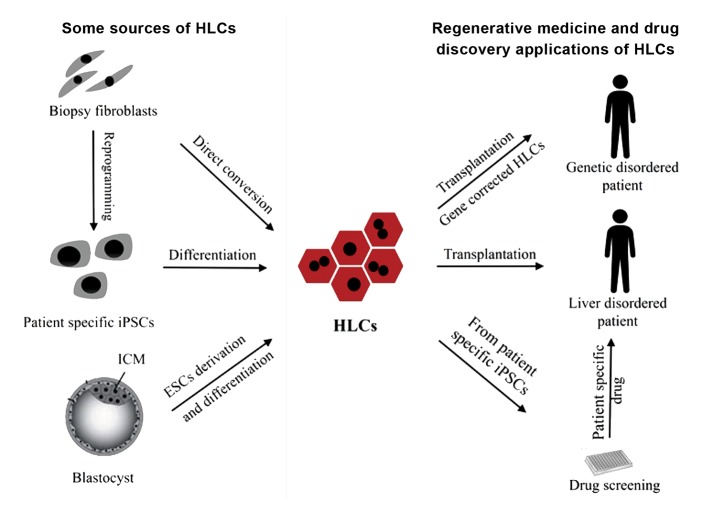
Hepatocyte-like cells (HLCs) are generated from either various human pluripotent stem cells (hPSCs) including induced pluripotent stem cells (iPSCs) and embryonic stem cells (ESCs), or direct cell conversion, mesenchymal stem cells as well as other stem cells like gestational tissues. They provide potential cell sources for biomedical applications. Liver transplantation is the gold standard treatment for the patients with end stage liver disease, but there are many obstacles limiting this process, like insufficient number of donated healthy livers. Meanwhile, the number of patients receiving a liver organ transplant for a better life is increasing. In this regard, HLCs may provide an adequate cell source to overcome these shortages. New molecular engineering approaches such as CRISPR/ Cas system applying in iPSCs technology provide the basic principles of gene correction for monogenic inherited metabolic liver diseases, as another application of HLCs. It has been shown that HLCs could replace primary human hepatocytes in drug discovery and hepatotoxicity tests. However, generation of fully functional HLCs is still a big challenge; several research groups have been trying to improve current differentiation protocols to achieve better HLCs according to morphology and function of cells. Large-scale generation of functional HLCs in bioreactors could make a new opportunity in producing enough hepatocytes for treating end-stage liver patients as well as other biomedical applications such as drug studies. In this review, regarding the biomedical value of HLCs, we focus on the current and efficient approaches for generating hepatocyte-like cells and discuss about their applications in regenerative medicine and drug discovery.
肝样细胞(HLCs)可从多种人类多能干细胞(hPSCs)中产生,包括诱导多能干细胞(iPSCs)和胚胎干细胞(ESCs),也可通过直接细胞转化、间充质干细胞以及其他干细胞(如妊娠组织来源的干细胞)获得。它们为生物医学应用提供了潜在的细胞来源。肝移植是终末期肝病患者的金标准治疗方法,但存在许多限制这一过程的障碍,如健康肝脏捐赠数量不足。与此同时,为了改善生活而接受肝脏器官移植的患者数量在不断增加。在这方面,HLCs可能提供充足的细胞来源来克服这些短缺。新的分子工程方法,如应用于iPSCs技术的CRISPR/Cas系统,为单基因遗传性代谢性肝病的基因校正提供了基本原则,这是HLCs的另一应用。研究表明,HLCs可在药物发现和肝毒性测试中替代原代人肝细胞。然而,生成功能完全的HLCs仍然是一个巨大的挑战;几个研究小组一直在尝试改进当前的分化方案,以根据细胞的形态和功能获得更好的HLCs。在生物反应器中大规模生成功能性HLCs可为生产足够的肝细胞用于治疗终末期肝病患者以及其他生物医学应用(如药物研究)带来新的机遇。在本综述中,鉴于HLCs的生物医学价值,我们重点关注当前生成肝样细胞的有效方法,并讨论它们在再生医学和药物发现中的应用。