College of Pharmacy, Southwest Minzu University, Chengdu 610225, China.
College of Life Science and Engineering, Southwest Jiaotong University, Chengdu 610032, China.
Int J Mol Sci. 2023 Jul 18;24(14):11592. doi: 10.3390/ijms241411592.
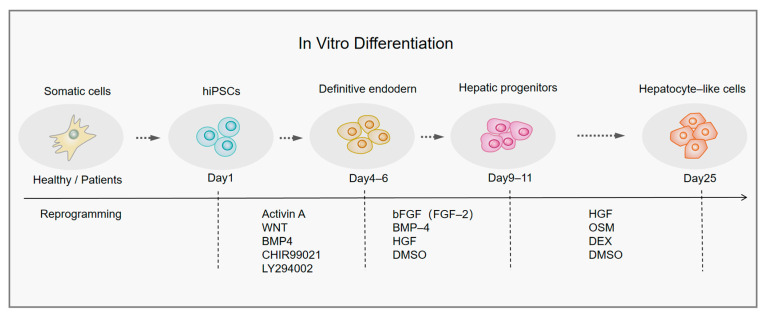
The development of regenerative medicine provides new options for the treatment of end-stage liver diseases. Stem cells, such as bone marrow mesenchymal stem cells, embryonic stem cells, and induced pluripotent stem cells (iPSCs), are effective tools for tissue repair in regenerative medicine. iPSCs are an appropriate source of hepatocytes for the treatment of liver disease due to their unlimited multiplication capacity, their coverage of the entire range of genetics required to simulate human disease, and their evasion of ethical implications. iPSCs have the ability to gradually produce hepatocyte-like cells (HLCs) with homologous phenotypes and physiological functions. However, how to induce iPSCs to differentiate into HLCs efficiently and accurately is still a hot topic. This review describes the existing approaches for inducing the differentiation of iPSCs into HLCs, as well as some challenges faced, and summarizes various parameters for determining the quality and functionality of HLCs. Furthermore, the application of iPSCs for in vitro hepatoprotective drug screening and modeling of liver disease is discussed. In conclusion, iPSCs will be a dependable source of cells for stem-cell therapy to treat end-stage liver disease and are anticipated to facilitate individualized treatment for liver disease in the future.
再生医学的发展为终末期肝病的治疗提供了新的选择。干细胞,如骨髓间充质干细胞、胚胎干细胞和诱导多能干细胞(iPSCs),是再生医学中组织修复的有效工具。iPSCs 因其无限增殖能力、涵盖模拟人类疾病所需的全部遗传范围以及规避伦理问题而成为治疗肝病的合适肝细胞来源。iPSCs 有能力逐渐产生具有同源表型和生理功能的肝样细胞(HLCs)。然而,如何有效地、准确地诱导 iPSCs 分化为 HLCs 仍然是一个热点问题。本综述描述了诱导 iPSCs 分化为 HLCs 的现有方法,以及所面临的一些挑战,并总结了各种用于确定 HLCs 质量和功能的参数。此外,还讨论了 iPSCs 在体外肝保护药物筛选和肝病模型中的应用。总之,iPSCs 将成为治疗终末期肝病的干细胞治疗的可靠细胞来源,并有望在未来促进针对肝病的个体化治疗。