Micea Mihai-Victor, Stangaciu Cristina-Sorina, Stangaciu Valentin, Curiac Daniel-Ioan
Department of Computers and Information Technology, Politehnica University of Timisoara, V. Parvan No. 2, Timisoara 300223, Romania.
Department of Automation and Applied Informatics, Politehnica University of Timisoara, V. Parvan No. 2, Timisoara 300223, Romania.
Sensors (Basel). 2017 Jun 26;17(7):1504. doi: 10.3390/s17071504.
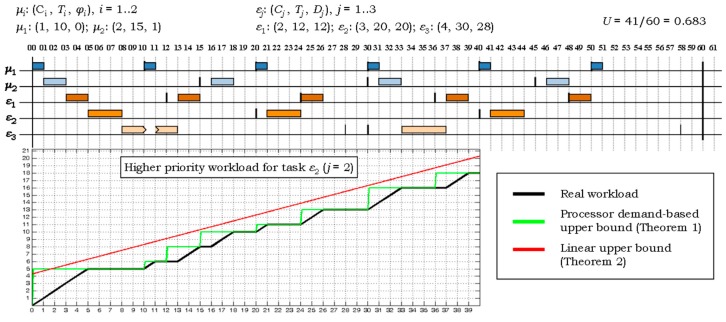
Sensor networks become increasingly a key technology for complex control applications. Their potential use in safety- and time-critical domains has raised the need for task scheduling mechanisms specially adapted to sensor node specific requirements, often materialized in predictable jitter-less execution of tasks characterized by different criticality levels. This paper offers an efficient scheduling solution, named Hybrid Hard Real-Time Scheduling (H²RTS), which combines a static, clock driven method with a dynamic, event driven scheduling technique, in order to provide high execution predictability, while keeping a high node Central Processing Unit (CPU) utilization factor. From the detailed, integrated schedulability analysis of the H²RTS, a set of sufficiency tests are introduced and demonstrated based on the processor demand and linear upper bound metrics. The performance and correct behavior of the proposed hybrid scheduling technique have been extensively evaluated and validated both on a simulator and on a sensor mote equipped with ARM7 microcontroller.
传感器网络日益成为复杂控制应用中的一项关键技术。它们在安全和时间关键领域的潜在应用引发了对任务调度机制的需求,这种机制需特别适应传感器节点的特定要求,这些要求通常体现在以不同关键级别为特征的任务可预测的无抖动执行中。本文提供了一种高效的调度解决方案,名为混合硬实时调度(H²RTS),它将静态的时钟驱动方法与动态的事件驱动调度技术相结合,以提供高执行可预测性,同时保持高节点中央处理器(CPU)利用率。从对H²RTS的详细、综合可调度性分析中,基于处理器需求和线性上限指标引入并展示了一组充分性测试。所提出的混合调度技术的性能和正确行为已在模拟器以及配备ARM7微控制器的传感器节点上进行了广泛评估和验证。