Zhu Jian, Yang Yan, Hu Si-Gan, Zhang Qiu-Bing, Yu Jie, Zhang Yuan-Ming
Department of Cardiovasology, The First Affiliated Hospital of Bengbu Medical College, Bengbu, Anhui 233004, P.R. China.
Department of Medical Oncology, The First Affiliated Hospital of Bengbu Medical College, Bengbu, Anhui 233004, P.R. China.
Exp Ther Med. 2017 Jul;14(1):147-154. doi: 10.3892/etm.2017.4490. Epub 2017 May 22.
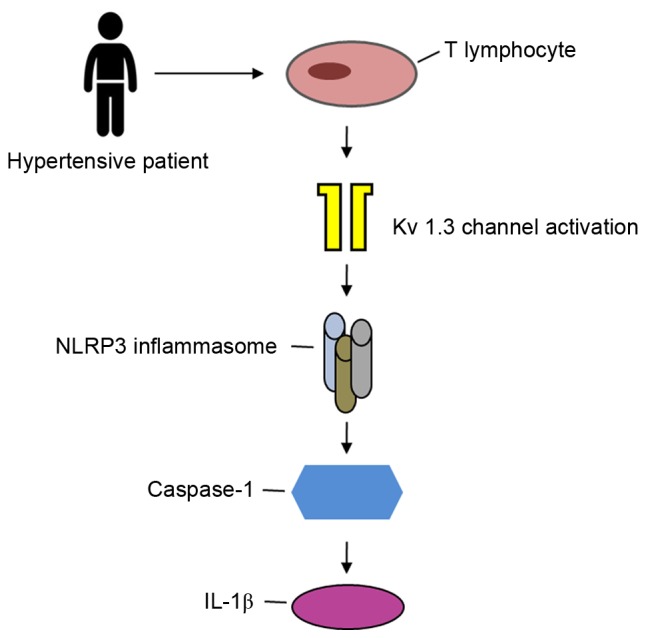
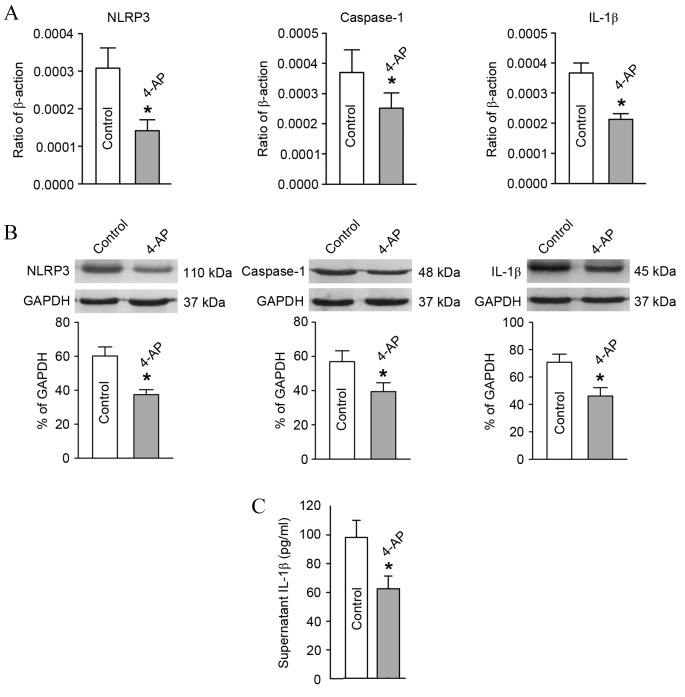
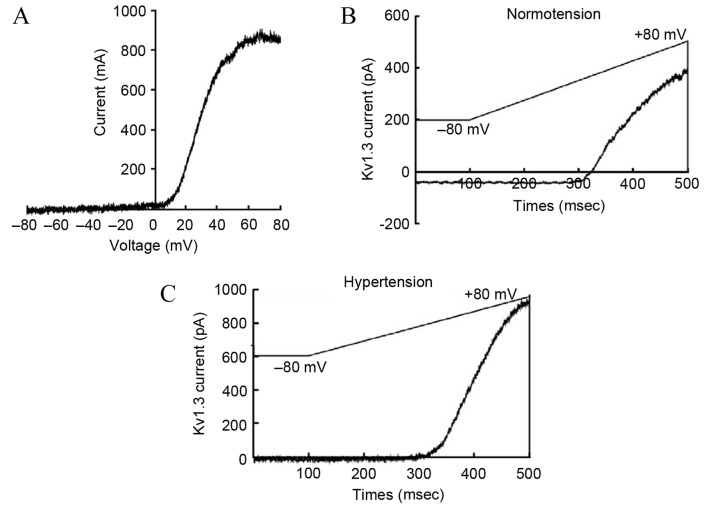
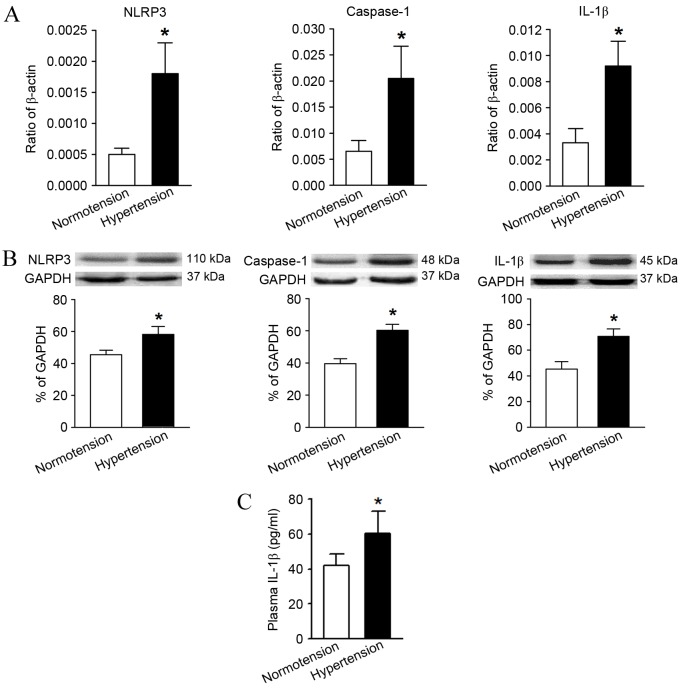
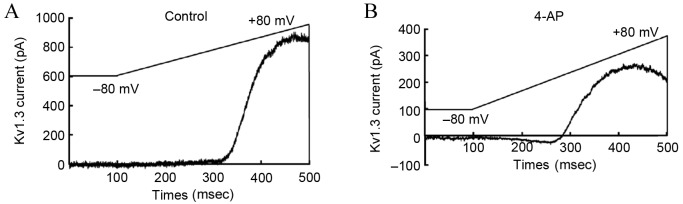
The aim of the current study was to investigate the correlation between voltage-gated potassium 1.3 (Kv1.3) channel of peripheral blood T-lymphocytes and the NLR family pyrin domain containing 3 (NLRP3) inflammasome pathway in hypertensive patients. Peripheral blood samples from the hypertensive Kazakh patients (n=30) and healthy Kazakh subjects (n=30) were collected. The T lymphocytes and serum were separated, and the state of Kv1.3 channels was detected using the patch-clamp technique. Reverse transcription-quantitative polymerase chain reaction and western blot analyses were used to detect the mRNA and protein expression levels of key molecules [NLRP3, caspase-1 and interleuking (IL)-β] in the lymphocyte NLRP3 inflammasome pathway, while serum IL-1β content was measured by ELISA assay. The results demonstrated no statistical difference in the subject baseline data between the two groups. While more significantly activated Kv1.3 channels were identified in the peripheral blood T-lymphocytes of the hypertension group compared to the normotension group, the mRNA and protein expression levels of NLRP3, caspase-1 and IL-1β were elevated and their peripheral serum interleukin-1β levels were significantly increased. After inhibiting the Kv1.3 channels using the classic potassium channel blocker, these indicators were all decreased significantly. The results indicate that the NLRP3 inflammasome pathway of peripheral blood T-lymphocytes in hypertensive Kazakh patients is activated, which may be correlated with the opening of the Kv1.3 channel.
本研究旨在探讨高血压患者外周血T淋巴细胞电压门控钾离子通道1.3(Kv1.3)与含NLR家族pyrin结构域蛋白3(NLRP3)炎性小体通路之间的相关性。收集哈萨克族高血压患者(n = 30)和健康哈萨克族受试者(n = 30)的外周血样本。分离T淋巴细胞和血清,采用膜片钳技术检测Kv1.3通道状态。运用逆转录定量聚合酶链反应和蛋白质免疫印迹分析检测淋巴细胞NLRP3炎性小体通路中关键分子[NLRP3、半胱天冬酶-1和白细胞介素(IL)-β]的mRNA和蛋白表达水平,同时采用酶联免疫吸附测定法检测血清IL-1β含量。结果显示,两组受试者的基线数据无统计学差异。与正常血压组相比,高血压组外周血T淋巴细胞中Kv1.3通道的激活更为显著,NLRP3、半胱天冬酶-1和IL-1β的mRNA和蛋白表达水平升高,外周血清白细胞介素-1β水平显著增加。使用经典钾通道阻滞剂抑制Kv1.3通道后,这些指标均显著下降。结果表明,哈萨克族高血压患者外周血T淋巴细胞的NLRP3炎性小体通路被激活,这可能与Kv1.3通道的开放有关。