Jo Jung Ki, Kim Kyu Shik, Nam Ji Won, Choi Bo Yul, Moon Hong Sang
Department of Urology, Hanyang University College of Medicine, Seoul, Korea.
Department of Preventive Medicine, Hanyang University College of Medicine, Seoul, Korea.
Int Neurourol J. 2017 Jun;21(2):143-151. doi: 10.5213/inj.1732760.380. Epub 2017 Jun 21.
This study estimated the prevalence of lower urinary tract symptoms (LUTS) in Korean men and the conditions for being diagnosed with or treated for LUTS/benign prostatic hyperplasia (BPH).
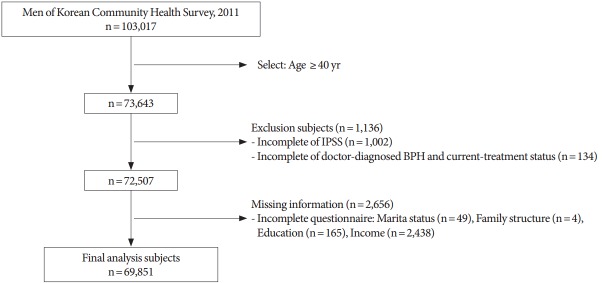
We analyzed cross-sectional data collected from 69,851 Korean men who were 40 years of age or older and had participated in the Korean Community Health Survey performed in 2011. Interviewers performed face-to-face surveys that included sociodemographic questions, the International Prostate Symptom Score (IPSS), and questions regarding whether the subjects had been diagnosed with or treated for LUTS/BPH. We estimated the prevalence of LUTS and assessed whether the subjects had been diagnosed with or treated for LUTS/BPH.
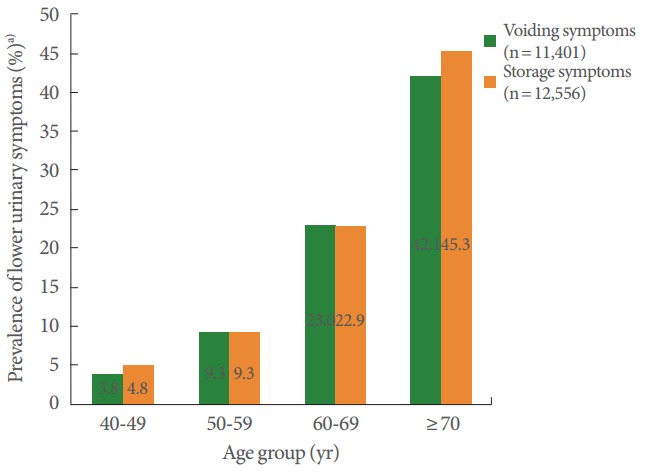
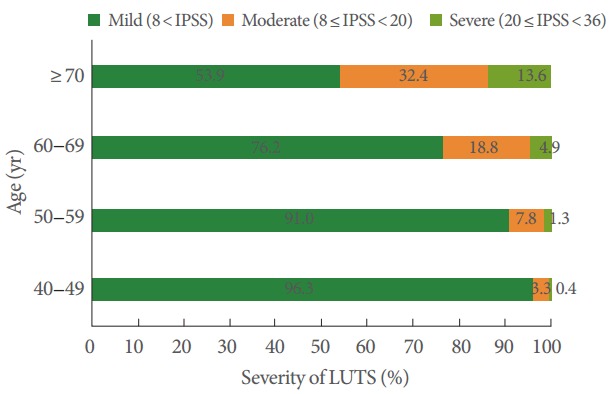
Moderate to severe LUTS, storage symptoms, and voiding symptoms increased with age. The IPSS quality of life score was 1.5±0.004 in the mild LUTS group (n=57,701), 3.3±0.01 in the moderate LUTS group (n=9,203), and 4.3±0.02 in the severe LUTS group (n=2,947) (P<0.0001). The prevalence of moderate to severe LUTS in those who had not been diagnosed with LUTS/BPH was 64.5% (7,847 of 12,150), and the prevalence of moderate to severe LUTS in those who had been diagnosed with LUTS/BPH but had not been treated was 23.5% (2,853 of 12,150).
The severity of LUTS in Korean men increased with age, and the IPSS quality of life score increased with the severity of LUTS. Many Korean men with moderate to severe LUTS had not been diagnosed or treated for LUTS/BPH. Socioeconomic conditions played an important role in health-seeking behavior among patients with LUTS/BPH.
本研究估算了韩国男性下尿路症状(LUTS)的患病率以及被诊断为LUTS/良性前列腺增生(BPH)或接受其治疗的情况。
我们分析了从69851名40岁及以上且参与了2011年韩国社区健康调查的韩国男性中收集的横断面数据。访员进行了面对面调查,内容包括社会人口统计学问题、国际前列腺症状评分(IPSS)以及关于受试者是否被诊断为LUTS/BPH或接受其治疗的问题。我们估算了LUTS的患病率,并评估了受试者是否被诊断为LUTS/BPH或接受其治疗。
中重度LUTS、储尿期症状和排尿期症状随年龄增长而增加。轻度LUTS组(n = 57701)的IPSS生活质量评分为1.5±0.004,中度LUTS组(n = 9203)为3.3±0.01,重度LUTS组(n = 2947)为4.3±0.02(P<0.0001)。未被诊断为LUTS/BPH者中重度LUTS的患病率为64.5%(12150例中的7847例),被诊断为LUTS/BPH但未接受治疗者中重度LUTS的患病率为23.5%(12150例中的2853例)。
韩国男性LUTS的严重程度随年龄增长而增加,IPSS生活质量评分随LUTS严重程度增加而升高。许多有中重度LUTS的韩国男性未被诊断或治疗LUTS/BPH。社会经济状况在LUTS/BPH患者的就医行为中起重要作用。