Henry Jackson Foundation for the Advancement of Military Medicine, 6720-A Rockledge Drive, Suite 100, Bethesda, MD, 20817, USA.
Oak Ridge Institute for Science and Education, 492 Millennium Drive, Suite 101, Belcamp, MD, 21017, USA.
Nutr J. 2017 Jul 3;16(1):41. doi: 10.1186/s12937-017-0262-5.
Special Operations Forces (SOF) Soldiers deploy frequently and require high levels of physical and cognitive performance. Nutritional status is linked to cognitive and physical performance. Studies evaluating dietary intake and nutritional status in deployed environments are lacking. Therefore, this study assessed the effects of combat deployment on diet quality and serum concentrations of nutritional status markers, including iron, vitamin D, parathyroid hormone (PTH), glucose, and lipids, among elite United States (U.S.) Army SOF Soldiers.
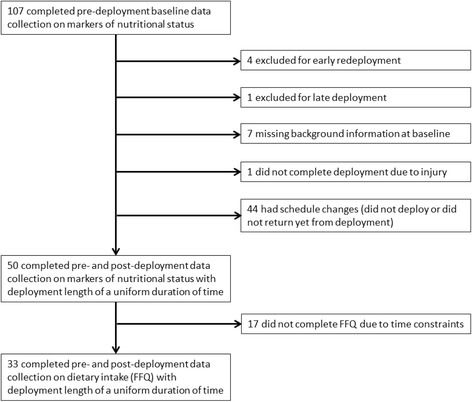
Changes from baseline to post-deployment were determined with a repeated measure within-subjects design for Healthy Eating Index-2010 (HEI-2010) scores, intake of foods, food groups, key nutrients, and serum nutritional status markers. Dietary intake was assessed with a Block Food Frequency Questionnaire. The association between post-deployment serum 25-hydroxy vitamin D (25-OH vitamin D) and PTH was determined. Analyses of serum markers were completed on 50 participants and analyses of dietary intake were completed on 33 participants.
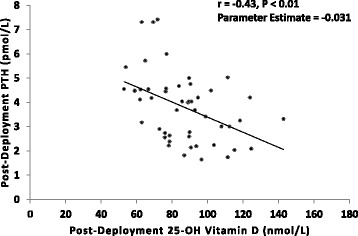
In response to deployment, HEI-2010 scores decreased for total HEI-2010 (70.3 ± 9.1 vs. 62.9 ± 11.1), total fruit (4.4 ± 1.1 vs. 3.7 ± 1.5), whole fruit (4.6 ± 1.0 vs. 4.2 ± 1.4), dairy (6.2 ± 2.7 vs. 4.8 ± 2.4), and empty calories (14.3 ± 3.2 vs. 11.1 ± 4.5) (P ≤ 0.05). Average daily intakes of foods and food groups that decreased included total dairy (P < 0.01), milk (P < 0.01), and non-juice fruit (P = 0.03). Dietary intake of calcium (P = 0.05) and vitamin D (P = 0.03) decreased. PTH increased from baseline (3.4 ± 1.6 vs. 3.8 ± 1.4 pmol/L, P = 0.04), while there was no change in 25-OH vitamin D. Ferritin decreased (385 ± 173 vs. 354 ± 161 pmol/L, P = 0.03) and soluble transferrin receptor increased (16.3 ± 3.7 vs. 17.1 ± 3.5 nmol/L, P = 0.01). There were no changes in glucose or lipids. Post-deployment, serum 25-OH vitamin D was inversely associated with PTH (r = -0.43, P < 0.01).
HEI-2010 scores and dietary intake of milk, calcium, and vitamin D decreased following deployment. Serum PTH increased and iron stores were degraded. No Soldiers were iron deficient. Personnel that deploy frequently should maintain a high diet quality in the U.S. and while deployed by avoiding empty calories and consuming fruits, vegetables, and adequate sources of calcium, vitamin D, and iron. Improving availability and quality of perishable food during deployment may improve diet quality.
特种作战部队(SOF)士兵经常部署,需要高水平的体力和认知表现。营养状况与认知和身体表现有关。缺乏评估部署环境中饮食摄入和营养状况的研究。因此,本研究评估了战斗部署对精英美国(美国)陆军 SOF 士兵饮食质量和血清营养状况标志物浓度的影响,包括铁、维生素 D、甲状旁腺激素(PTH)、葡萄糖和脂质。
采用重复测量的自身设计,对健康饮食指数-2010(HEI-2010)评分、食物、食物组、关键营养素和血清营养状况标志物的摄入量进行了基线到部署后的变化。采用 Block 食物频率问卷评估膳食摄入量。确定了部署后血清 25-羟维生素 D(25-OH 维生素 D)和 PTH 之间的关联。对 50 名参与者进行了血清标志物分析,对 33 名参与者进行了膳食摄入量分析。
为应对部署,HEI-2010 评分总体下降(70.3±9.1 对 62.9±11.1)、总水果(4.4±1.1 对 3.7±1.5)、全水果(4.6±1.0 对 4.2±1.4)、奶制品(6.2±2.7 对 4.8±2.4)和空卡路里(14.3±3.2 对 11.1±4.5)(P≤0.05)。减少的食物和食物组的平均每日摄入量包括总奶制品(P<0.01)、牛奶(P<0.01)和非果汁水果(P=0.03)。钙(P=0.05)和维生素 D(P=0.03)的膳食摄入量减少。PTH 从基线升高(3.4±1.6 对 3.8±1.4 pmol/L,P=0.04),而 25-OH 维生素 D 没有变化。铁蛋白下降(385±173 对 354±161 pmol/L,P=0.03),可溶性转铁蛋白受体增加(16.3±3.7 对 17.1±3.5 nmol/L,P=0.01)。葡萄糖或脂质没有变化。部署后,血清 25-OH 维生素 D 与 PTH 呈负相关(r=-0.43,P<0.01)。
部署后,HEI-2010 评分和牛奶、钙和维生素 D 的膳食摄入量下降。血清 PTH 升高,铁储存减少。没有士兵缺铁。经常部署的人员应通过避免空卡路里和摄入水果、蔬菜以及足够的钙、维生素 D 和铁来源,在美国和部署期间保持高饮食质量。改善部署期间易腐食物的供应和质量可能会改善饮食质量。