Uchida Nao, Kushida Yoshihiro, Kitada Masaaki, Wakao Shohei, Kumagai Naonori, Kuroda Yasumasa, Kondo Yoshiaki, Hirohara Yukari, Kure Shigeo, Chazenbalk Gregorio, Dezawa Mari
Departments of Stem Cell Biology and Histology and.
Pediatrics, Tohoku University Graduate School of Medicine, Sendai, Japan.
J Am Soc Nephrol. 2017 Oct;28(10):2946-2960. doi: 10.1681/ASN.2016070775. Epub 2017 Jul 3.
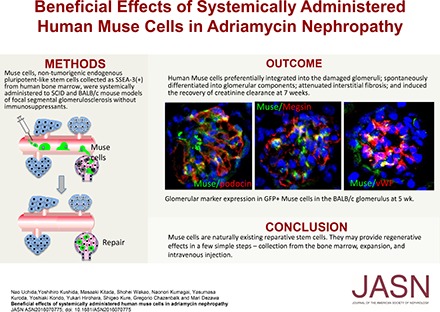
Multilineage-differentiating stress-enduring (Muse) cells are nontumorigenic endogenous pluripotent-like stem cells that can be collected from various organs. Intravenously administered Muse cells have been shown to spontaneously migrate to damaged tissue and replenish lost cells, but the effect in FSGS is unknown. We systemically administered human bone marrow-derived Muse cells without concurrent administration of immunosuppressants to severe combined immune-deficient (SCID) and BALB/c mouse models with adriamycin-induced FSGS (FSGS-SCID and FSGS-BALB/c, respectively). In FSGS-SCID mice, human Muse cells preferentially integrated into the damaged glomeruli and spontaneously differentiated into cells expressing markers of podocytes (podocin; 31%), mesangial cells (megsin; 13%), and endothelial cells (CD31; 41%) without fusing to the host cells; attenuated glomerular sclerosis and interstitial fibrosis; and induced the recovery of creatinine clearance at 7 weeks. Human Muse cells induced similar effects in FSGS-BALB/c mice at 5 weeks, despite xenotransplant without concurrent immunosuppressant administration, and led to improvement in urine protein, creatinine clearance, and plasma creatinine levels more impressive than that in the FSGS-SCID mice at 5 weeks. However, functional recovery in FSGS-BALB/c mice was impaired at 7 weeks due to immunorejection, suggesting the importance of Muse cell survival as glomerular cells in the FSGS kidney for tissue repair and functional recovery. In conclusion, Muse cells are unique reparative stem cells that preferentially home to damaged glomeruli and spontaneously differentiate into glomerular cells after systemic administration. Introduction of genes to induce differentiation is not required before Muse cell administration; thus, Muse cells may be a feasible therapeutic strategy in FSGS.
多谱系分化应激耐受(Muse)细胞是可从各种器官收集的非致瘤性内源性多能样干细胞。静脉注射的Muse细胞已被证明可自发迁移至受损组织并补充丢失的细胞,但在局灶节段性肾小球硬化症(FSGS)中的作用尚不清楚。我们在无免疫抑制剂同时给药的情况下,将人骨髓来源的Muse细胞系统地给予阿霉素诱导的FSGS的重症联合免疫缺陷(SCID)和BALB/c小鼠模型(分别为FSGS-SCID和FSGS-BALB/c)。在FSGS-SCID小鼠中,人Muse细胞优先整合到受损的肾小球中,并自发分化为表达足细胞标志物(足突蛋白;31%)、系膜细胞标志物(megsin;13%)和内皮细胞标志物(CD31;41%)的细胞,且不与宿主细胞融合;减轻肾小球硬化和间质纤维化;并在7周时诱导肌酐清除率恢复。尽管在无免疫抑制剂同时给药的情况下进行异种移植,人Muse细胞在5周时在FSGS-BALB/c小鼠中诱导了类似的效果,并导致尿蛋白、肌酐清除率和血浆肌酐水平的改善比5周时的FSGS-SCID小鼠更显著。然而,由于免疫排斥,FSGS-BALB/c小鼠在7周时的功能恢复受损,这表明Muse细胞作为FSGS肾脏中的肾小球细胞存活对于组织修复和功能恢复的重要性。总之,Muse细胞是独特的修复性干细胞,全身给药后优先归巢至受损的肾小球并自发分化为肾小球细胞。在给予Muse细胞之前不需要引入诱导分化的基因;因此,Muse细胞可能是FSGS中一种可行的治疗策略。