Risso Fabrice G, Jalilvand Farzad, Orjalo Ashley J, Moreno Matthew R, Davis Deshaun L, Birmingham-Babauta Samantha A, Stokes John J, Stage Alyssa A, Liu Tricia M, Giuliano Dominic V, Lazar Adrina, Lockie Robert G
Department of Kinesiology, California State University, Northridge, Northridge, CA, USA.
Department of Kinesiology, California State University, Fullerton, Fullerton, CA, USA.
Int J Exerc Sci. 2017 Jul 1;10(4):568-579. doi: 10.70252/ZOUT6574. eCollection 2017.
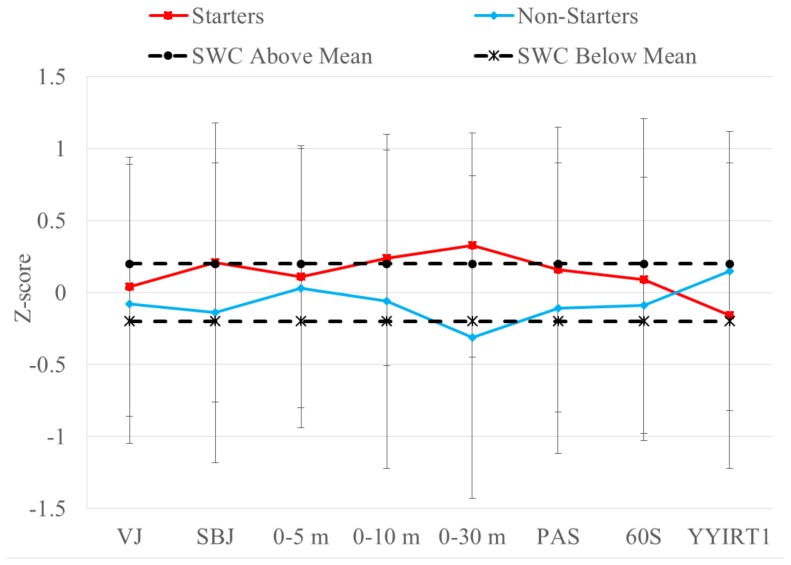
NCAA soccer features different substitution rules compared to FIFA-sanctioned matches, with a greater availability of players who can enter the game. This could influence the physiological characteristics of the field position starters (ST) and non-starters (NST) within a collegiate women's team, which has not been previously analyzed. Thus, 22 field players from the same Division I women's soccer squad completed: vertical and standing broad jumps; 30-meter (m) sprint (0-5, 0-10, 0-30 m intervals); pro-agility and 60-yard shuttle; and the Yo-Yo Intermittent Recovery Test Level 1. Players were defined into ST (n=10) and NST (n=12) by the coaching staff. A one-way ANOVA derived any significant (≤0.05) between-group differences, and effect sizes were used for a magnitude-based inference analysis. Z-scores were also calculated to document worthwhile differences above or below the squad mean for the groups. The results showed no significant between-group differences for any of the performance tests. ST did have a worthwhile difference above the squad mean in the 0-10 and 0-30 m sprint intervals, while NST had a worthwhile difference below the squad mean in the 0-30 m interval. Physiological characteristics between ST and NST from the analyzed Division I squad were similar, although ST were generally faster. The similarities between ST and NST may be a function of the team's training, in that all players may complete the same workouts. Nonetheless, if all players exhibit similar physiological capacities, with appropriate substitutions by the coach a collegiate team should be able to maintain a high work-rate throughout a match.
与国际足联批准的比赛相比,美国全国大学体育协会(NCAA)的足球比赛有不同的换人规则,更多球员可以进入比赛。这可能会影响大学女子足球队中首发球员(ST)和非首发球员(NST)的生理特征,而此前尚未对此进行过分析。因此,来自同一一级女子足球队的22名场上球员完成了:垂直纵跳和立定跳远;30米短跑(0至5米、0至10米、0至30米区间);敏捷性测试和60码穿梭跑;以及Yo-Yo间歇恢复测试一级。教练组将球员分为首发球员(n = 10)和非首发球员(n = 12)。单因素方差分析得出组间的任何显著差异(≤0.05),效应量用于基于量级的推断分析。还计算了Z分数,以记录各小组高于或低于球队平均水平的有价值差异。结果显示,任何一项性能测试的组间差异均不显著。首发球员在0至10米和0至30米短跑区间确实有高于球队平均水平的有价值差异,而非首发球员在0至30米区间有低于球队平均水平的有价值差异。尽管首发球员通常更快,但分析的一级球队中首发球员和非首发球员的生理特征相似。首发球员和非首发球员之间的相似性可能是球队训练的结果,因为所有球员可能都完成相同的训练。尽管如此,如果所有球员都表现出相似的生理能力,教练进行适当换人,大学球队应该能够在整场比赛中保持较高的工作强度。