Delil Selman, Çelik Rahmi Nurhan, San Sayın, Dundar Murat
Informatics Institute, Istanbul Technical University, Istanbul, Turkey.
Department of Financial Econometrics, Sakarya University, Sakarya, Turkey.
BMC Health Serv Res. 2017 Jul 4;17(1):458. doi: 10.1186/s12913-017-2381-2.
Analysis of patient mobility in a country not only gives an idea of how the health-care system works, but also can be a guideline to determine the quality of health care and health disparity among regions. Even though determination of patient movement is important, it is not often realized that patient mobility could have a unique pattern beyond health-related endowments (e.g., facilities, medical staff). This study therefore addresses the following research question: Is there a way to identify regions with similar patterns using spatio-temporal distribution of patient mobility? The aim of the paper is to answer this question and improve a classification method that is useful for populous countries like Turkey that have many administrative areas.
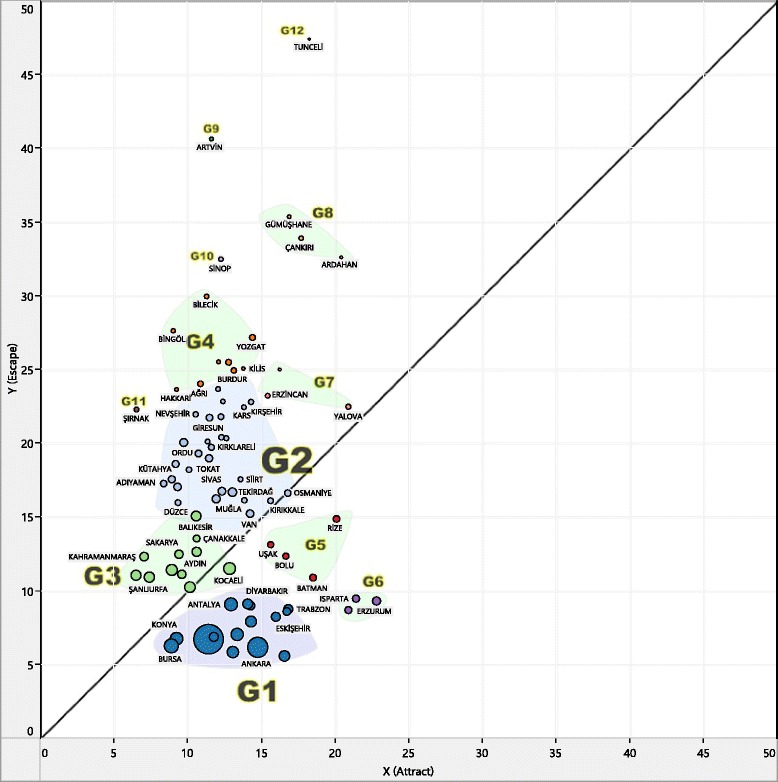
The data used in the study consist of spatio-temporal information on patient mobility for the period between 2009 and 2013. Patient mobility patterns based on the number of patients attracted/escaping across 81 provinces of Turkey are illustrated graphically. The hierarchical clustering method is used to group provinces in terms of the mobility characteristics revealed by the patterns. Clustered groups of provinces are analyzed using non-parametric statistical tests to identify potential correlations between clustered groups and the selected basic health indicators.
Ineffective health-care delivery in certain regions of Turkey was determined through identifying patient mobility patterns. High escape values obtained for a large number of provinces suggest poor health-care accessibility. On the other hand, over the period of time studied, visualization of temporal mobility revealed a considerable decrease in the escape ratio for inadequately equipped provinces. Among four of twelve clusters created using the hierarchical clustering method, which include 64 of 81 Turkish provinces, there was a statistically significant relationship between the patterns and the selected basic health indicators of the clusters. The remaining eight clusters included 17 provinces and showed anomalies.
The most important contribution of this study is the development of a way to identify patient mobility patterns by analyzing patient movements across the clusters. These results are strong evidence that patient mobility patterns provide a useful tool for decisions concerning the distribution of health-care services and the provision of health care equipment to the provinces.
对一个国家患者流动情况的分析不仅能让人了解医疗保健系统的运作方式,还可为确定医疗质量以及地区间的健康差异提供指导。尽管确定患者流动情况很重要,但人们往往没有意识到患者流动可能具有超越与健康相关禀赋(如设施、医务人员)的独特模式。因此,本研究提出以下研究问题:能否利用患者流动的时空分布来识别具有相似模式的地区?本文旨在回答这个问题,并改进一种对像土耳其这样拥有众多行政区的人口大国有用的分类方法。
本研究使用的数据包括2009年至2013年期间患者流动的时空信息。基于土耳其81个省份吸引/流出患者数量的患者流动模式以图形方式展示。采用层次聚类方法根据模式所揭示的流动特征对省份进行分组。使用非参数统计检验对聚类的省份组进行分析,以确定聚类组与选定的基本健康指标之间的潜在相关性。
通过识别患者流动模式确定了土耳其某些地区医疗保健服务的低效。大量省份获得的高流出值表明医疗保健可及性差。另一方面,在所研究的时间段内,时间流动的可视化显示设备不足省份的流出率有相当大的下降。在使用层次聚类方法创建的十二个聚类中的四个聚类中(包括81个土耳其省份中的64个),模式与聚类的选定基本健康指标之间存在统计学上的显著关系。其余八个聚类包括17个省份,显示出异常情况。
本研究最重要的贡献是开发了一种通过分析跨聚类的患者流动来识别患者流动模式的方法。这些结果有力地证明,患者流动模式为有关医疗保健服务分配和向各省提供医疗保健设备的决策提供了有用工具。