Tillmann Ana Cristina, Andrade Alexandro, Swarowsky Alessandra, Guimarães Adriana Coutinho De Azevedo
Health Sciences Centre (CEFID), Research Laboratory in Leisure and Physical Activity (LAPLAF), University of Santa Catarina State, Florianópolis, Brazil.
Health Sciences Centre (CEFID), University of Santa Catarina State, Florianopolis, Brazil.
JMIR Res Protoc. 2017 Jul 4;6(7):e129. doi: 10.2196/resprot.6489.
In the 10 most populated countries in the world, Parkinson's disease (PD) affects more than 5 million individuals. Despite optimal treatment options already developed for the disease, concomitant involvement of other areas of health care plays an important role in complementing the treatment. From this perspective, dancing can be viewed as a non-drug alternative that can reduce falls by improving some motor skills, such as mobility, balance, gait, and posture, and can also improve the overall quality of life. Brazilian samba promotes improvement in motor and non-motor symptoms in individuals with PD, providing a new treatment option for this population.
The main objective of this quasi-experimental study is to provide a 12-week samba protocol (2x/week) for individuals with PD and to compare its effects with the group without intervention. The hypothesis is that the Brazilian samba protocol will promote improvement in primary (motor) and secondary (non-motor) outcomes in individuals with PD.
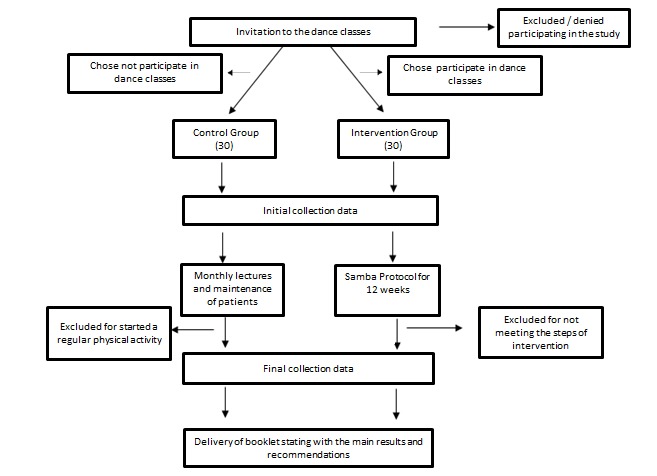
The sample will be selected at random from individuals diagnosed with PD in the city of Florianopolis (SC, Brazil). Sample size calculation was performed with the G*Power 3.1.9.2 software, with 0.447 effect size, at 5% significance level, power of 0.9, and test and sample loss of 20%. This yielded 60 individuals divided between the intervention and control groups. The questionnaires will be filled out before and after the dance intervention. The data collection for the control group will be held simultaneously to the intervention group. The classes will last for 1 hour, twice a week in the evening for 12 weeks, and all classes will be divided into warm-up, main part, and relaxation. Two-way analysis of variance with repeated measures and Sidak post-hoc comparison test will be used for a comparative analysis of the final results of the control group with the experimental group and of the within-group changes between pre- and postintervention period.
We expect to complete follow-up in September 2017.
The major inspiration for this study was to encourage the creation of new rehabilitation programs that do not emphasize doctor involvement. This is a unique protocol for PD and we believe it can be an important tool to alleviate the motor and non-motor symptoms of individuals with PD. Dance is a simple activity depending on little equipment and few financial resources, facilitating its implementation and improving the cost-benefit relationship. In addition, activities that have a cultural aspect for the population in question, and which are pleasant, enable the participants to commit long term. This can enhance patient's compliance with the therapy, which is often a problem for many rehabilitation programs.
在世界人口最多的10个国家中,帕金森病(PD)影响着超过500万人。尽管已经为该疾病开发了最佳治疗方案,但其他医疗保健领域的协同参与在补充治疗方面发挥着重要作用。从这个角度来看,舞蹈可被视为一种非药物替代方法,它可以通过改善一些运动技能,如活动能力、平衡、步态和姿势,来减少跌倒,还可以提高整体生活质量。巴西桑巴舞可促进帕金森病患者运动和非运动症状的改善,为这一人群提供了一种新的治疗选择。
这项准实验研究的主要目的是为帕金森病患者提供一个为期12周的桑巴舞方案(每周两次),并将其效果与未干预组进行比较。假设是巴西桑巴舞方案将促进帕金森病患者主要(运动)和次要(非运动)结局的改善。
样本将从巴西圣卡塔琳娜州弗洛里亚诺波利斯市被诊断为帕金森病的个体中随机选取。使用G*Power 3.1.9.2软件进行样本量计算,效应大小为0.447,显著性水平为5%,检验效能为0.9,检验和样本损失率为20%。这产生了60名个体,分为干预组和对照组。问卷将在舞蹈干预前后填写。对照组的数据收集将与干预组同时进行。课程将持续1小时,每周两次,晚上进行,为期12周,所有课程将分为热身、主要部分和放松。采用重复测量的双向方差分析和Sidak事后比较检验,对对照组与实验组的最终结果以及干预前后组内变化进行比较分析。
我们预计在2017年9月完成随访。
本研究的主要灵感是鼓励创建不强调医生参与的新康复项目。这是一个针对帕金森病的独特方案,我们相信它可以成为缓解帕金森病患者运动和非运动症状的重要工具。舞蹈是一种简单的活动,所需设备少,资金投入少,便于实施并改善成本效益关系。此外,对于相关人群具有文化层面且令人愉悦的活动能够使参与者长期坚持。这可以提高患者对治疗的依从性,而这往往是许多康复项目面临的一个问题。
