Department of Psychological Sciences, University of Liverpool, Liverpool, UK.
UK Centre for Tobacco and Alcohol Studies, UK.
Int J Obes (Lond). 2017 Nov;41(11):1710-1717. doi: 10.1038/ijo.2017.158. Epub 2017 Jul 5.
Overeating and obesity are frequently attributed to an addiction to food. However, there is currently a lack of evidence to support the idea that certain foods contain any specific addictive substance. An alternative approach is to focus on dimensions of observable behaviour, which may underpin a behavioural addiction to eating. To facilitate this, it is necessary to develop a tool to quantify addiction-like eating behaviour, which is not based on the clinical criteria for substance dependence. The current study provides initial validation of the Addiction-like Eating Behaviour Scale (AEBS).
English speaking male and female participants (N=511) from a community sample completed the AEBS, alongside a range of other health- and eating-related questionnaires including the Yale Food Addiction Scale (YFAS) and Binge Eating Scale (BES). Participants also provided their height and weight to enable calculation of body mass index (BMI). Finally, to assess test-retest reliability, an additional 70 participants completed the AEBS twice, 2 weeks apart.
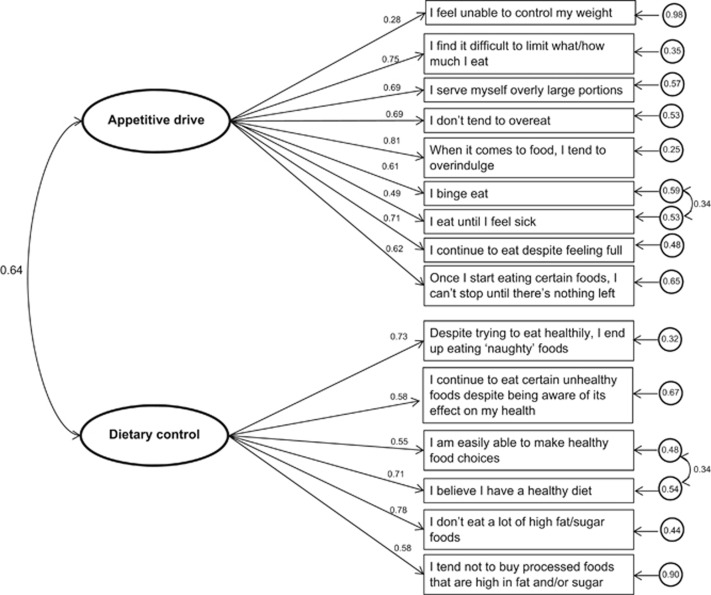
Principle components analysis revealed that a two-factor structure best accounted for the data. Factor 1 consisted of items that referred to appetitive drive, whereas factor two consisted of items that referred to dietary control practices. Both subscales demonstrated good internal reliability and test-retest reliability, and a confirmatory factor analysis confirmed the two-factor scale structure. AEBS scores correlated positively with body mass index (BMI) (P<0.001) and other self-report measures of overeating. Importantly, the AEBS significantly predicted variance in BMI above that accounted for by both the YFAS and BES (P=0.027).
The AEBS provides a valid and reliable tool to quantify the behavioural features of a potential 'eating addiction'. In doing so, the AEBS overcomes many limitations associated with applying substance-dependence criteria to eating.
暴饮暴食和肥胖通常归因于对食物的成瘾。然而,目前缺乏证据支持某些食物含有任何特定成瘾物质的观点。另一种方法是关注可观察行为的维度,这些维度可能是对食物产生行为成瘾的基础。为了促进这一点,有必要开发一种工具来量化类似成瘾的进食行为,这种行为不是基于物质依赖的临床标准。本研究初步验证了类似成瘾的进食行为量表(AEBS)。
来自社区样本的英语男女性参与者(N=511)完成了 AEBS,以及一系列其他与健康和饮食相关的问卷,包括耶鲁食物成瘾量表(YFAS)和暴食量表(BES)。参与者还提供了他们的身高和体重,以计算体重指数(BMI)。最后,为了评估测试-重测信度,另外 70 名参与者在两周内两次完成了 AEBS。
主成分分析显示,双因素结构最能解释数据。因素 1 由与食欲驱动有关的项目组成,而因素 2 由与饮食控制实践有关的项目组成。两个分量表都表现出良好的内部信度和测试-重测信度,验证性因素分析也证实了双因素量表结构。AEBS 评分与体重指数(BMI)呈正相关(P<0.001),与其他自我报告的暴食测量结果也呈正相关。重要的是,AEBS 显著预测了 BMI 的方差,超过了 YFAS 和 BES 所能解释的方差(P=0.027)。
AEBS 提供了一种有效且可靠的工具,用于量化潜在的“饮食成瘾”的行为特征。这样做,AEBS 克服了将物质依赖标准应用于饮食所带来的许多限制。