Rutledge Robb B, Moutoussis Michael, Smittenaar Peter, Zeidman Peter, Taylor Tanja, Hrynkiewicz Louise, Lam Jordan, Skandali Nikolina, Siegel Jenifer Z, Ousdal Olga T, Prabhu Gita, Dayan Peter, Fonagy Peter, Dolan Raymond J
Max Planck University College London Centre for Computational Psychiatry and Ageing Research, London, England2Wellcome Trust Centre for Neuroimaging, University College London, London, England.
Wellcome Trust Centre for Neuroimaging, University College London, London, England.
JAMA Psychiatry. 2017 Aug 1;74(8):790-797. doi: 10.1001/jamapsychiatry.2017.1713.
Major depressive disorder (MDD) is associated with deficits in representing reward prediction errors (RPEs), which are the difference between experienced and predicted reward. Reward prediction errors underlie learning of values in reinforcement learning models, are represented by phasic dopamine release, and are known to affect momentary mood.
To combine functional neuroimaging, computational modeling, and smartphone-based large-scale data collection to test, in the absence of learning-related concerns, the hypothesis that depression attenuates the impact of RPEs.
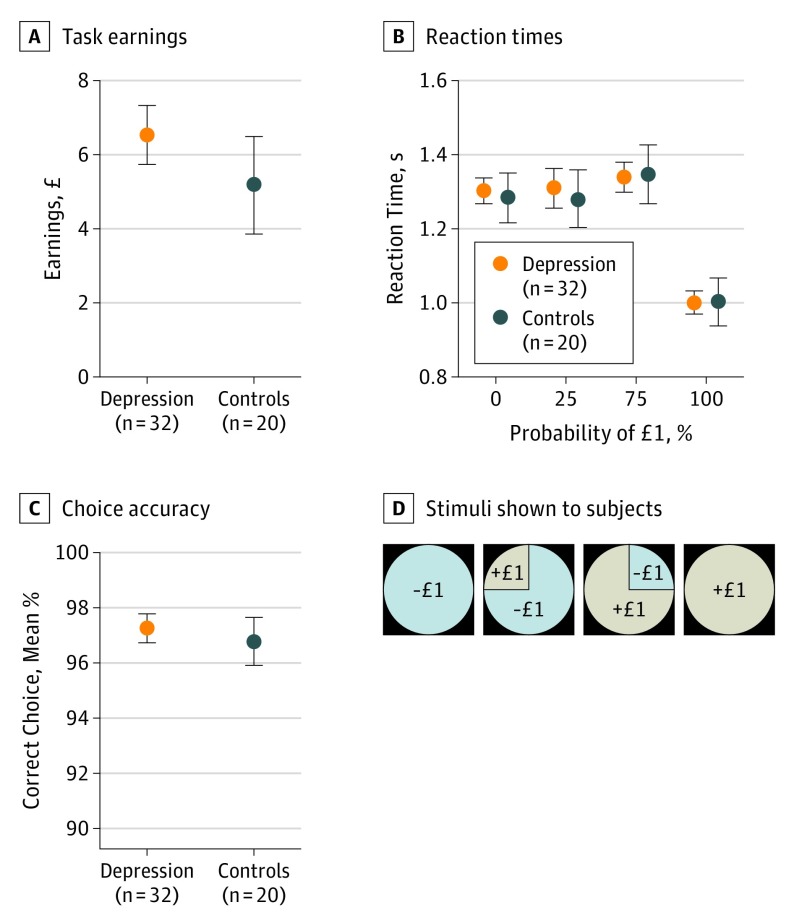
DESIGN, SETTING, AND PARTICIPANTS: Functional magnetic resonance imaging (fMRI) data were collected on 32 individuals with moderate MDD and 20 control participants who performed a probabilistic reward task. A risky decision task with repeated happiness ratings as a measure of momentary mood was also tested in the laboratory in 74 participants and with a smartphone-based platform in 1833 participants. The study was conducted from November 20, 2012, to February 17, 2015.
Blood oxygen level-dependent activity was measured in ventral striatum, a dopamine target area known to represent RPEs. Momentary mood was measured during risky decision making.
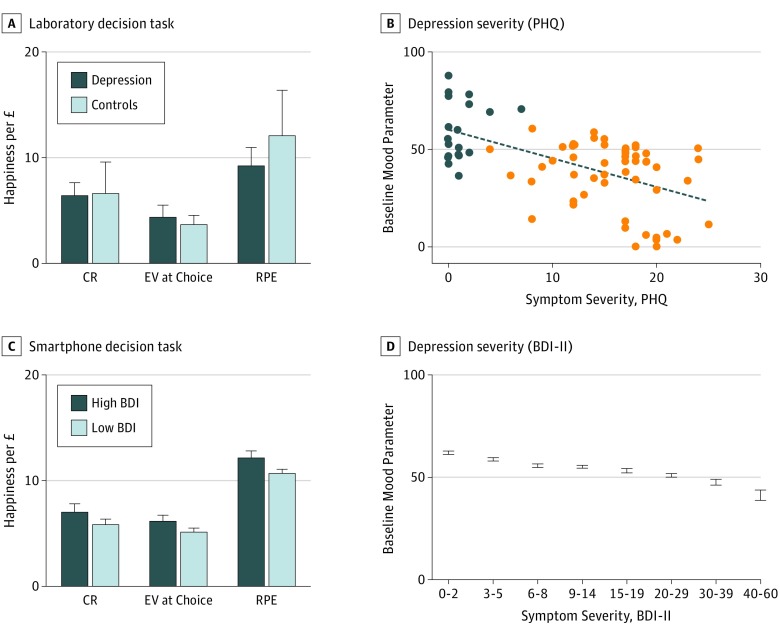
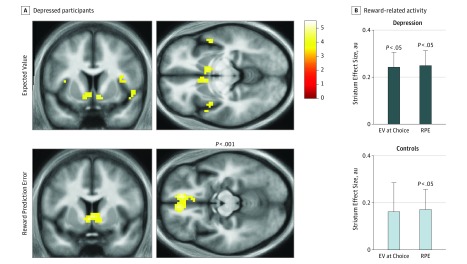
Of the 52 fMRI participants (mean [SD] age, 34.0 [9.1] years), 30 (58%) were women and 32 had MDD. Of the 74 participants in the laboratory risky decision task (mean age, 34.2 [10.3] years), 44 (59%) were women and 54 had MDD. Of the smartphone group, 543 (30%) had a depression history and 1290 (70%) had no depression history; 918 (50%) were women, and 593 (32%) were younger than 30 years. Contrary to previous results in reinforcement learning tasks, individuals with moderate depression showed intact RPE signals in ventral striatum (z = 3.16; P = .002) that did not differ significantly from controls (z = 0.91; P = .36). Symptom severity correlated with baseline mood parameters in laboratory (ρ = -0.54; P < 1 × 10⁻⁶) and smartphone (ρ = -0.30; P < 1 × 10-39) data. However, participants with depression showed an intact association between RPEs and happiness in a computational model of momentary mood dynamics (z = 4.55; P < .001) that was not attenuated compared with controls (z = -0.42; P = .67).
The neural and emotional impact of RPEs is intact in major depression. These results suggest that depression does not affect the expression of dopaminergic RPEs and that attenuated RPEs in previous reports may reflect downstream effects more closely related to aberrant behavior. The correlation between symptom severity and baseline mood parameters supports an association between depression and momentary mood fluctuations during cognitive tasks. These results demonstrate a potential for smartphones in large-scale computational phenotyping, which is a goal for computational psychiatry.
重度抑郁症(MDD)与奖励预测误差(RPE)表征缺陷有关,奖励预测误差是指实际获得的奖励与预期奖励之间的差异。奖励预测误差是强化学习模型中价值学习的基础,由阶段性多巴胺释放来表征,并且已知会影响瞬时情绪。
结合功能神经影像学、计算建模和基于智能手机的大规模数据收集,在不存在与学习相关问题的情况下,检验抑郁症会减弱奖励预测误差影响这一假设。
设计、背景和参与者:对32名中度MDD患者和20名对照参与者进行功能性磁共振成像(fMRI)数据收集,他们执行了一项概率奖励任务。在实验室中,对74名参与者以及在基于智能手机的平台上对1833名参与者进行了一项风险决策任务测试,该任务以重复的幸福度评分作为瞬时情绪的衡量指标。该研究于2012年11月20日至2015年2月17日进行。
在腹侧纹状体测量血氧水平依赖活动,腹侧纹状体是已知表征奖励预测误差的多巴胺靶区。在风险决策过程中测量瞬时情绪。
在52名fMRI参与者(平均[标准差]年龄,34.0[9.1]岁)中,30名(58%)为女性,32名患有MDD。在74名参与实验室风险决策任务的参与者(平均年龄,34.2[10.3]岁)中,44名(59%)为女性,54名患有MDD。在智能手机组中,543名(30%)有抑郁症病史,1290名(70%)无抑郁症病史;918名(50%)为女性,593名(32%)年龄小于30岁。与强化学习任务中先前的结果相反,中度抑郁症患者在腹侧纹状体中显示出完整的奖励预测误差信号(z = 3.16;P = 0.002),与对照组无显著差异(z = 0.91;P = 0.36)。症状严重程度与实验室(ρ = -0.54;P < 1×10 - 6)和智能手机(ρ = -0.30;P < 1×10 - 39)数据中的基线情绪参数相关。然而,在瞬时情绪动态的计算模型中,抑郁症患者的奖励预测误差与幸福感之间存在完整的关联(z = 4.55;P < 0.001),与对照组相比未减弱(z = -0.42;P = 0.67)。
在重度抑郁症中,奖励预测误差的神经和情绪影响是完整的。这些结果表明,抑郁症不会影响多巴胺能奖励预测误差的表达,先前报告中减弱的奖励预测误差可能更紧密地反映了与异常行为相关的下游效应。症状严重程度与基线情绪参数之间的相关性支持抑郁症与认知任务期间瞬时情绪波动之间的关联。这些结果证明了智能手机在大规模计算表型分析中的潜力,这是计算精神病学追求的目标。