Quillfeldt Petra, Moodley Yoshan, Weimerskirch Henri, Cherel Yves, Delord Karine, Phillips Richard A, Navarro Joan, Calderón Luciano, Masello Juan F
Department of Animal Ecology and Systematics, Justus Liebig University Giessen, Heinrich-Buff-Ring 38, 35392, Giessen, Germany.
Department of Zoology, University of Venda, Private Bag X5050, Thohoyandou, 0950, Republic of South Africa.
BMC Evol Biol. 2017 Jul 5;17(1):160. doi: 10.1186/s12862-017-1008-x.
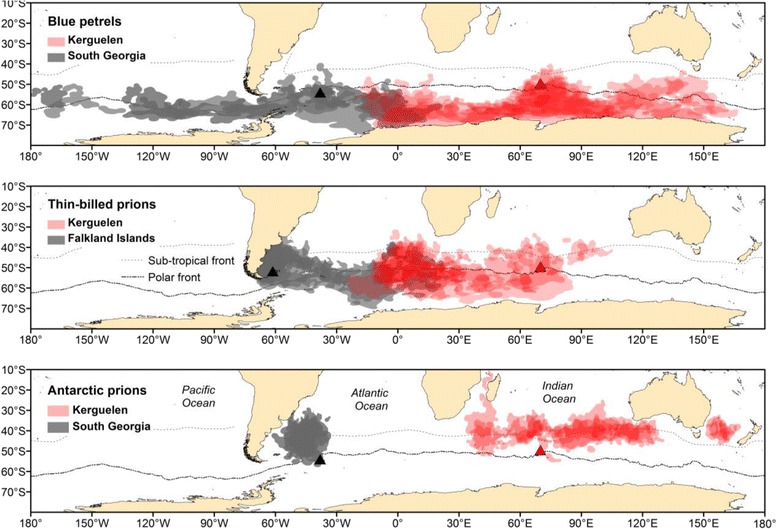
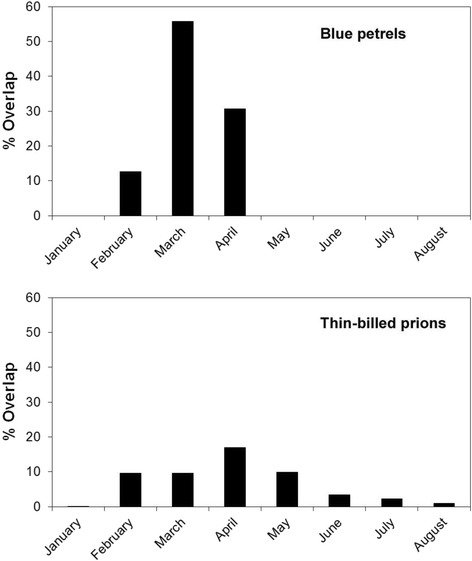
In seabirds, the extent of population genetic and phylogeographic structure varies extensively among species. Genetic structure is lacking in some species, but present in others despite the absence of obvious physical barriers (landmarks), suggesting that other mechanisms restrict gene flow. It has been proposed that the extent of genetic structure in seabirds is best explained by relative overlap in non-breeding distributions of birds from different populations. We used results from the analysis of microsatellite DNA variation and geolocation (tracking) data to test this hypothesis. We studied three small (130-200 g), very abundant, zooplanktivorous petrels (Procellariiformes, Aves), each sampled at two breeding populations that were widely separated (Atlantic and Indian Ocean sectors of the Southern Ocean) but differed in the degree of overlap in non-breeding distributions; the wintering areas of the two Antarctic prion (Pachyptila desolata) populations are separated by over 5000 km, whereas those of the blue petrels (Halobaena caerulea) and thin-billed prions (P. belcheri) show considerable overlap. Therefore, we expected the breeding populations of blue petrels and thin-billed prions to show high connectivity despite their geographical distance, and those of Antarctic prions to be genetically differentiated.
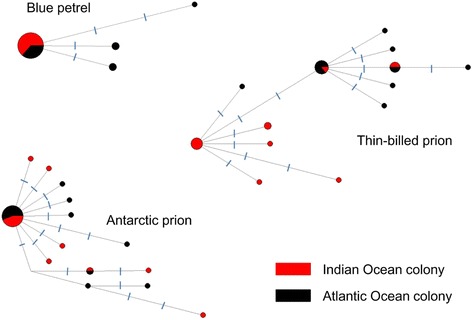
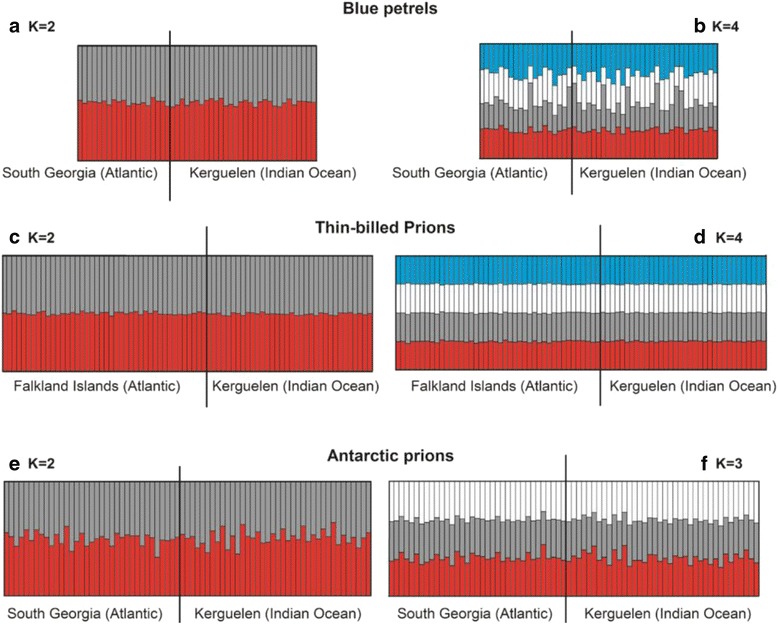
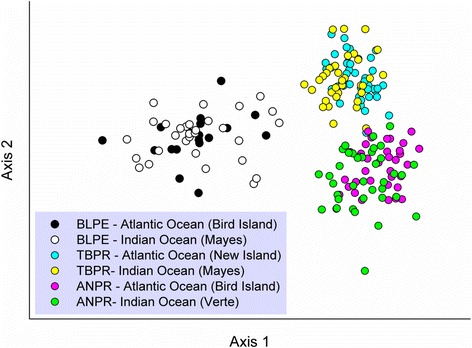
Microsatellite (at 18 loci) and cytochrome b sequence data suggested a lack of genetic structure in all three species. We thus found no relationship between genetic and spatial structure (relative overlap in non-breeding distributions) in these pelagic seabirds.
In line with other Southern Ocean taxa, geographic distance did not lead to genetic differences between widely spaced populations of Southern Ocean petrel species.
在海鸟中,种群遗传和系统地理学结构的程度在不同物种间差异很大。一些物种缺乏遗传结构,而另一些物种尽管没有明显的物理屏障(地标)却存在遗传结构,这表明其他机制限制了基因流动。有人提出,海鸟遗传结构的程度最好用不同种群鸟类非繁殖分布的相对重叠来解释。我们利用微卫星DNA变异分析结果和地理定位(追踪)数据来检验这一假设。我们研究了三种小型(130 - 200克)、数量非常丰富的浮游性海燕(鹱形目,鸟类),每种在两个繁殖种群中取样,这两个种群相距甚远(南大洋的大西洋和印度洋区域),但非繁殖分布的重叠程度不同;两种南极普里恩海燕(Pachyptila desolata)种群的越冬区域相隔超过5000公里,而蓝海燕(Halobaena caerulea)和细纹嘴普里恩海燕(P. belcheri)的越冬区域有相当大的重叠。因此,我们预计蓝海燕和细纹嘴普里恩海燕的繁殖种群尽管地理距离较远,但仍表现出高连通性,而南极普里恩海燕的繁殖种群在遗传上会有分化。
微卫星(18个位点)和细胞色素b序列数据表明这三种物种都缺乏遗传结构。因此,我们发现在这些远洋海鸟中,遗传结构与空间结构(非繁殖分布的相对重叠)之间没有关系。
与其他南大洋分类群一致,地理距离并未导致南大洋海燕物种相距遥远的种群之间产生遗传差异。