Division of Nephrology, Department of Medicine and.
Department of Transplantation and Surgery, Semmelweis University, Budapest, Hungary.
Clin J Am Soc Nephrol. 2017 Sep 7;12(9):1428-1437. doi: 10.2215/CJN.00570117. Epub 2017 Jul 5.
Depression in patients with nondialysis-dependent CKD is often undiagnosed, empirically overlooked, and associated with higher risk of death, progression to ESRD, and hospitalization. However, there is a paucity of evidence on the association between the presence of depression in patients with advanced nondialysis-dependent CKD and post-ESRD mortality, particularly among those in the transition period from late-stage nondialysis-dependent CKD to maintenance dialysis.
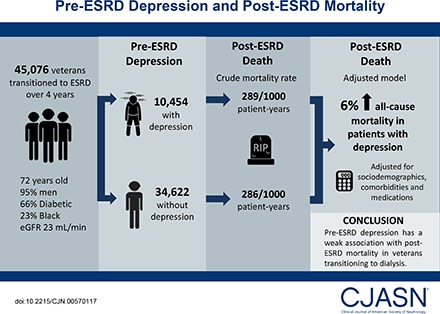
DESIGN, SETTING, PARTICIPANTS, & MEASUREMENTS: From a nation-wide cohort of 45,076 United States veterans who transitioned to ESRD over 4 contemporary years (November of 2007 to September of 2011), we identified 10,454 (23%) patients with a depression diagnosis during the predialysis period. We examined the association of pre-ESRD depression with all-cause mortality after transition to dialysis using Cox proportional hazards models adjusted for sociodemographics, comorbidities, and medications.
Patients were 72±11 years old (mean±SD) and included 95% men, 66% patients with diabetes, and 23% blacks. The crude mortality rate was similar in patients with depression (289/1000 patient-years; 95% confidence interval, 282 to 297) versus patients without depression (286/1000 patient-years; 95% confidence interval, 282 to 290). Compared with patients without depression, patients with depression had a 6% higher all-cause mortality risk in the adjusted model (hazard ratio, 1.06; 95% confidence interval, 1.03 to 1.09). Similar results were found across all selected subgroups as well as in sensitivity analyses using alternate definitions of depression.
Pre-ESRD depression has a weak association with post-ESRD mortality in veterans transitioning to dialysis.
非透析依赖性慢性肾脏病(CKD)患者的抑郁常常未被诊断,被经验性忽视,与更高的死亡风险、向终末期肾病(ESRD)进展以及住院相关。然而,关于非透析依赖性 CKD 晚期患者中抑郁的存在与 ESRD 后死亡率之间的关联,尤其是在从晚期非透析依赖性 CKD 向维持性透析过渡的时期,相关证据很少。
设计、设置、参与者和测量方法:从一个全国性队列中,我们纳入了 45076 名在 4 年期间(2007 年 11 月至 2011 年 9 月)向 ESRD 过渡的美国退伍军人,其中有 10454 名(23%)患者在透析前被诊断为抑郁症。我们使用 Cox 比例风险模型,在校正了社会人口统计学、合并症和药物使用情况后,检验了 ESRD 前抑郁与过渡到透析后的全因死亡率之间的关联。
患者的年龄为 72±11 岁(均值±标准差),其中 95%为男性,66%患有糖尿病,23%为黑人。抑郁组的粗死亡率与无抑郁组相似(289/1000 患者年;95%置信区间,282 至 297)。与无抑郁的患者相比,在调整后的模型中,抑郁患者的全因死亡率风险高 6%(风险比,1.06;95%置信区间,1.03 至 1.09)。在所有选定的亚组以及使用抑郁的替代定义进行的敏感性分析中,均得到了类似的结果。
在向透析过渡的退伍军人中,ESRD 前的抑郁与 ESRD 后死亡率之间存在微弱的关联。