Clark James W, Donoghue Philip C J
School of Earth Sciences, University of Bristol, Life Sciences Building, Tyndall Avenue, Bristol BS8 1TQ, UK
Proc Biol Sci. 2017 Jul 12;284(1858). doi: 10.1098/rspb.2017.0912.
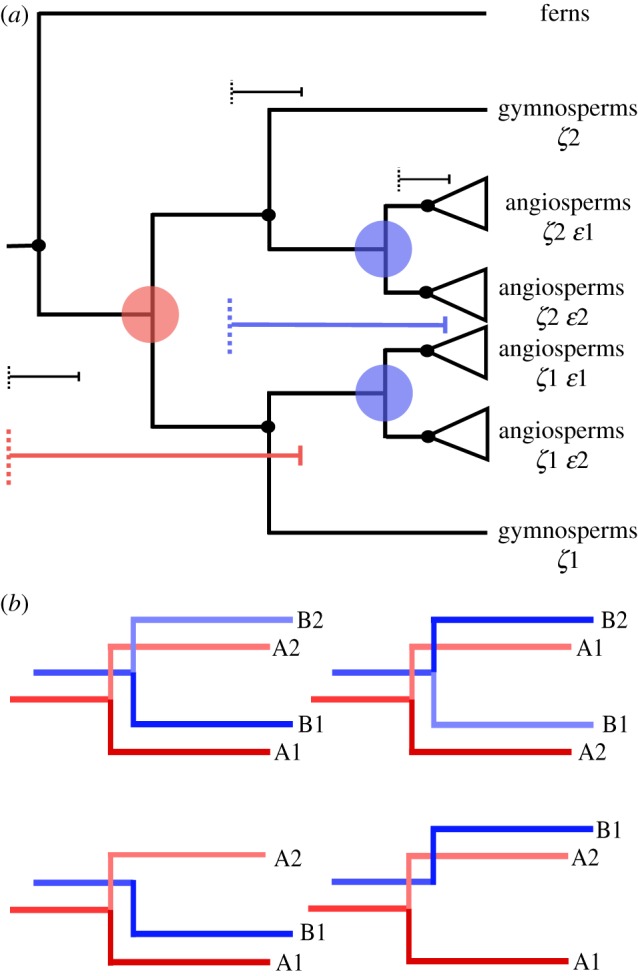
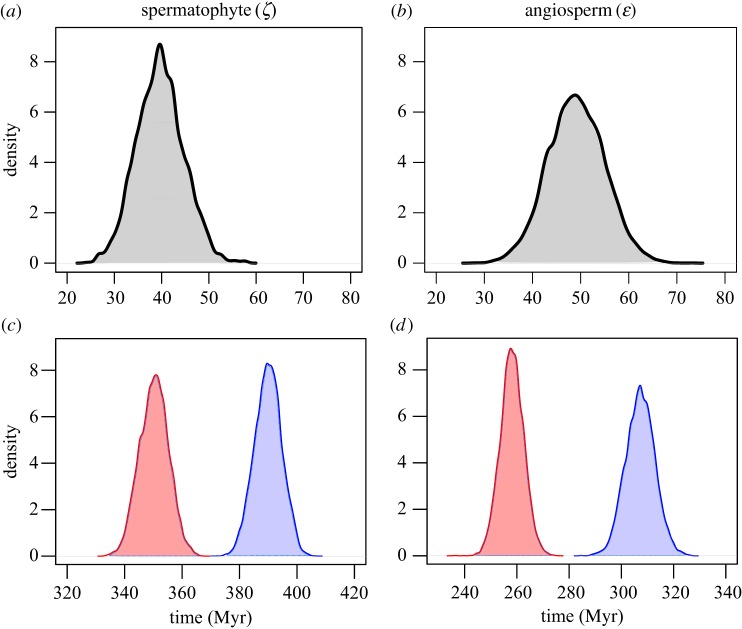
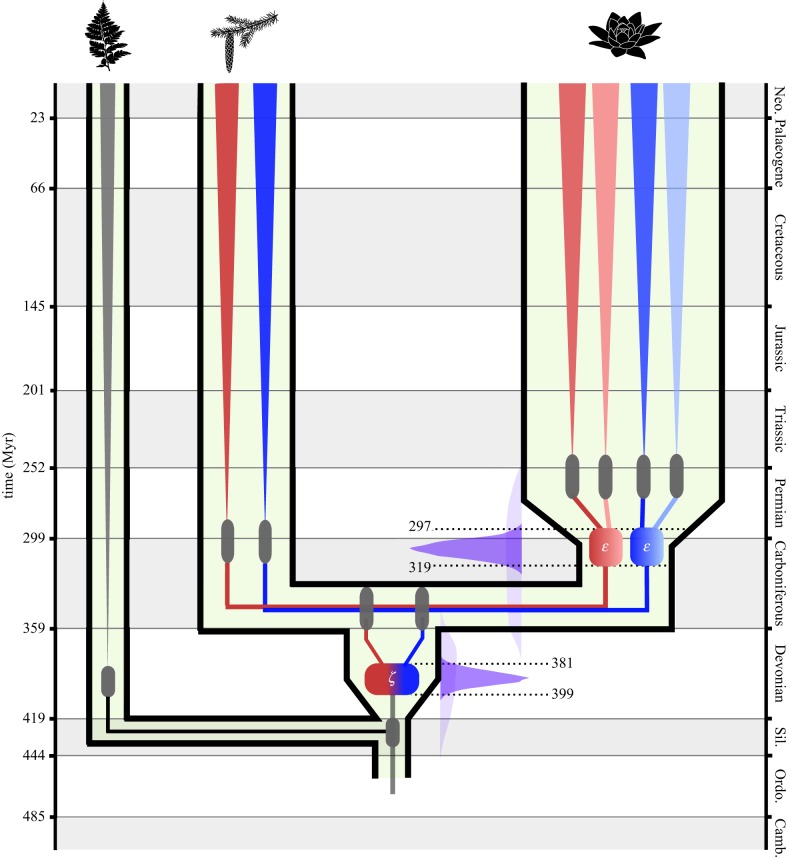
Whole genome duplication (WGD) has occurred in many lineages within the tree of life and is invariably invoked as causal to evolutionary innovation, increased diversity, and extinction resistance. Testing such hypotheses is problematic, not least since the timing of WGD events has proven hard to constrain. Here we show that WGD events can be dated through molecular clock analysis of concatenated gene families, calibrated using fossil evidence for the ages of species divergences that bracket WGD events. We apply this approach to dating the two major genome duplication events shared by all seed plants () and flowering plants (), estimating the seed plant WGD event at 399-381 Ma, and the angiosperm WGD event at 319-297 Ma. These events thus took place early in the stem of both lineages, precluding hypotheses of WGD conferring extinction resistance, driving dramatic increases in innovation and diversity, but corroborating and qualifying the more permissive hypothesis of a 'lag-time' in realizing the effects of WGD in plant evolution.
全基因组复制(WGD)在生命之树的许多谱系中都有发生,并且总是被认为是进化创新、多样性增加和抗灭绝能力增强的原因。检验此类假设存在问题,尤其是因为WGD事件的发生时间已被证明难以确定。在这里,我们表明,可以通过对串联基因家族进行分子钟分析来确定WGD事件的时间,并利用夹在WGD事件之间的物种分化年龄的化石证据进行校准。我们应用这种方法来确定所有种子植物()和开花植物()共有的两次主要基因组复制事件的时间,估计种子植物WGD事件发生在3.99 - 3.81亿年前,被子植物WGD事件发生在3.19 - 2.97亿年前。因此,这些事件发生在这两个谱系主干的早期,排除了WGD赋予抗灭绝能力、推动创新和多样性急剧增加的假设,但证实并限定了在植物进化中实现WGD效应存在“滞后时间”这一更为宽泛的假设。