Gundlach Jan, Herzberg Christina, Hertel Dietrich, Thürmer Andrea, Daniel Rolf, Link Hannes, Stülke Jörg
Department of General Microbiology, Georg-August University Göttingen, Göttingen, Germany.
Department of Plant Ecology and Ecosystems Research, Georg-August University, Albrecht-von-Haller-Institute, Göttingen, Germany.
mBio. 2017 Jul 5;8(4):e00861-17. doi: 10.1128/mBio.00861-17.
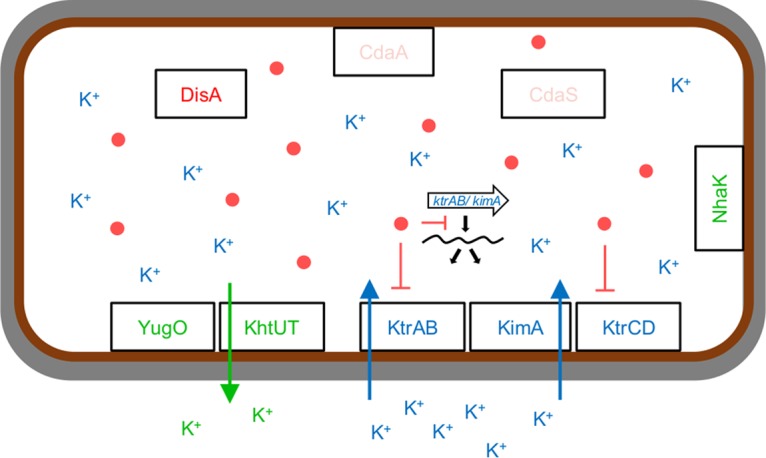
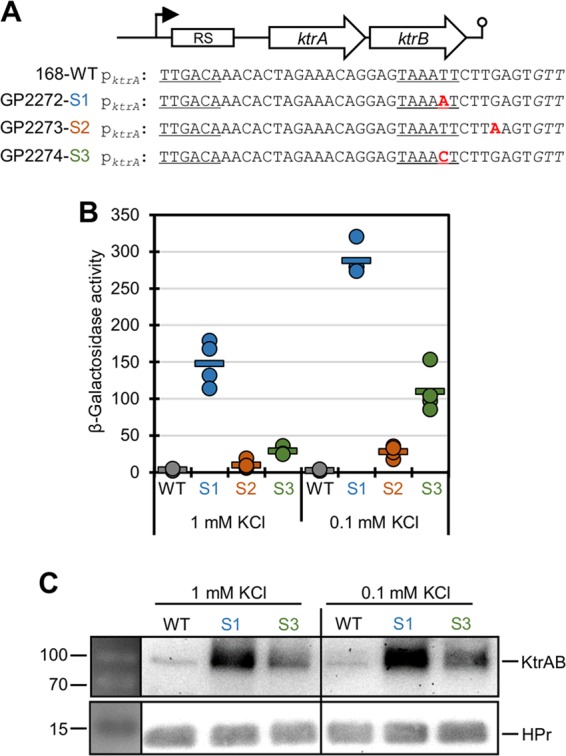
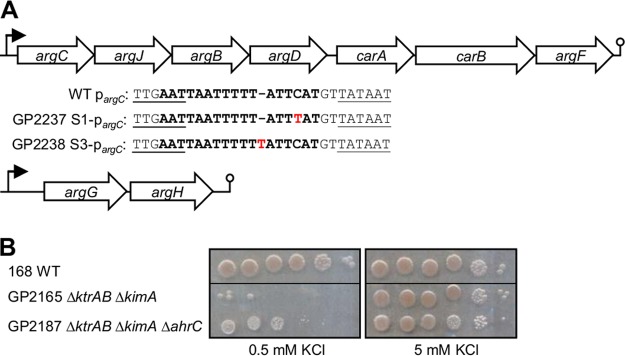
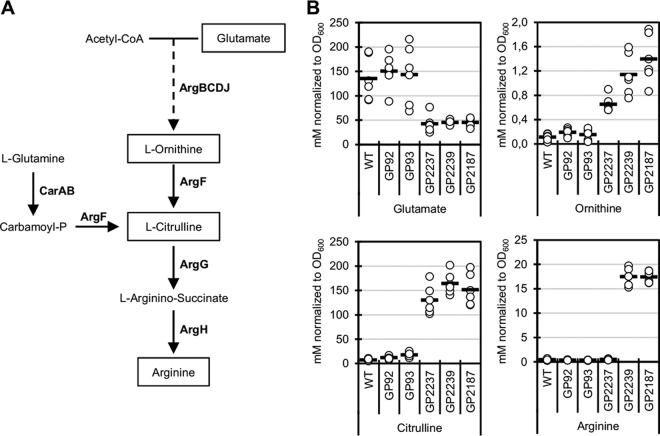
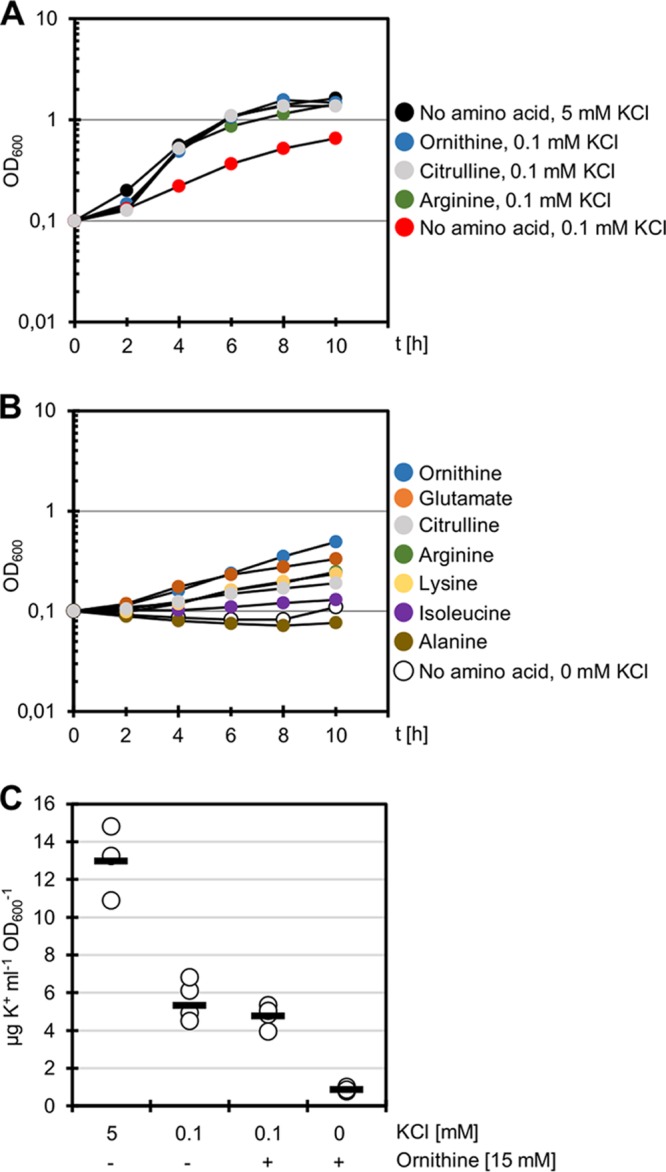
Potassium is the most abundant metal ion in every living cell. This ion is essential due to its requirement for the activity of the ribosome and many enzymes but also because of its role in buffering the negative charge of nucleic acids. As the external concentrations of potassium are usually low, efficient uptake and intracellular enrichment of the ion is necessary. The Gram-positive bacterium possesses three transporters for potassium, KtrAB, KtrCD, and the recently discovered KimA. In the absence of the high-affinity transporters KtrAB and KimA, the bacteria were unable to grow at low potassium concentrations. However, we observed the appearance of suppressor mutants that were able to overcome the potassium limitation. All these suppressor mutations affected amino acid metabolism, particularly arginine biosynthesis. In the mutants, the intracellular levels of ornithine, citrulline, and arginine were strongly increased, suggesting that these amino acids can partially substitute for potassium. This was confirmed by the observation that the supplementation with positively charged amino acids allows growth of even at the extreme potassium limitation that the bacteria experience if no potassium is added to the medium. In addition, a second class of suppressor mutations allowed growth at extreme potassium limitation. These mutations result in increased expression of KtrAB, the potassium transporter with the highest affinity and therefore allow the acquisition and accumulation of the smallest amounts of potassium ions from the environment. Potassium is essential for every living cell as it is required for the activity for many enzymes and for maintaining the intracellular pH by buffering the negative charge of the nucleic acids. We have studied the adaptation of the soil bacterium to life at low potassium concentrations. If the major high-affinity transporters are missing, the bacteria are unable to grow unless they acquire mutations that result in the accumulation of positively charged amino acids such as ornithine, citrulline, and arginine. Supplementation of the medium with these amino acids rescued growth even in the absence of externally added potassium. Moreover, these growth conditions, which the bacteria experience as an extreme potassium limitation, can be overcome by the acquisition of mutations that result in increased expression of the high-affinity potassium transporter KtrAB. Our results indicate that positively charged amino acids can partially take over the function of potassium.
钾是每个活细胞中含量最丰富的金属离子。这种离子至关重要,这是因为核糖体和许多酶的活性都需要它,而且它在缓冲核酸的负电荷方面也发挥着作用。由于细胞外钾的浓度通常较低,因此高效摄取并在细胞内富集这种离子是必要的。革兰氏阳性菌拥有三种钾转运蛋白,即KtrAB、KtrCD以及最近发现的KimA。在缺乏高亲和力转运蛋白KtrAB和KimA的情况下,细菌无法在低钾浓度下生长。然而,我们观察到出现了能够克服钾限制的抑制突变体。所有这些抑制突变都影响氨基酸代谢,尤其是精氨酸的生物合成。在这些突变体中,鸟氨酸、瓜氨酸和精氨酸的细胞内水平大幅升高,这表明这些氨基酸可以部分替代钾。这一点通过以下观察结果得到了证实:补充带正电荷的氨基酸甚至能使细菌在不向培养基中添加钾时所经历的极端钾限制条件下生长。此外,第二类抑制突变使细菌能够在极端钾限制条件下生长。这些突变导致具有最高亲和力的钾转运蛋白KtrAB的表达增加,因此能够从环境中获取并积累最少量的钾离子。钾对每个活细胞都至关重要,因为许多酶的活性以及通过缓冲核酸的负电荷来维持细胞内pH都需要它。我们研究了土壤细菌在低钾浓度环境下的适应性。如果主要的高亲和力转运蛋白缺失,细菌就无法生长,除非它们获得导致带正电荷的氨基酸(如鸟氨酸、瓜氨酸和精氨酸)积累的突变。即使在没有外部添加钾的情况下,向培养基中补充这些氨基酸也能挽救细菌的生长。此外,细菌所经历的这些极端钾限制生长条件,可以通过获得导致高亲和力钾转运蛋白KtrAB表达增加的突变来克服。我们的结果表明,带正电荷的氨基酸可以部分替代钾的功能。