Choi Jung-Yoo, Sim Jae-Hyuk, Yeo In-Sung Luke
Dental Research Institute, Seoul National University School of Dentistry, Seoul, Korea.
Department of Prosthodontics, Seoul National University School of Dentistry, Seoul, Korea.
J Periodontal Implant Sci. 2017 Jun;47(3):182-192. doi: 10.5051/jpis.2017.47.3.182. Epub 2017 Jun 28.
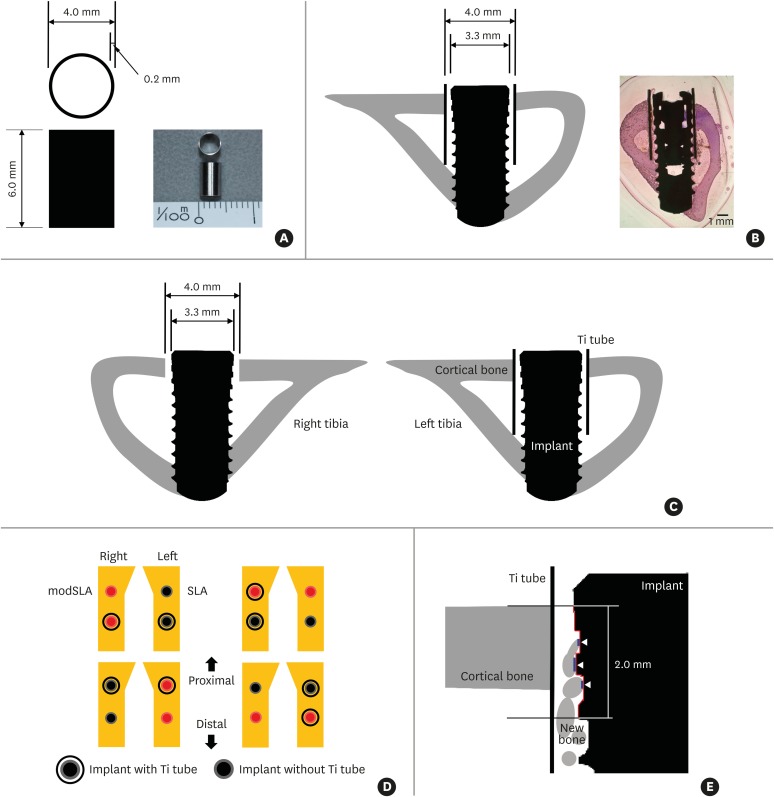
Contact and distance osteogenesis occur around all endosseous dental implants. However, the mechanisms underlying these processes have not been fully elucidated. We hypothesized that these processes occur independently of each other. To test this, we used titanium (Ti) tubes to physically separate contact and distance osteogenesis, thus allowing contact osteogenesis to be measured in the absence of possible triggers from distance osteogenesis.
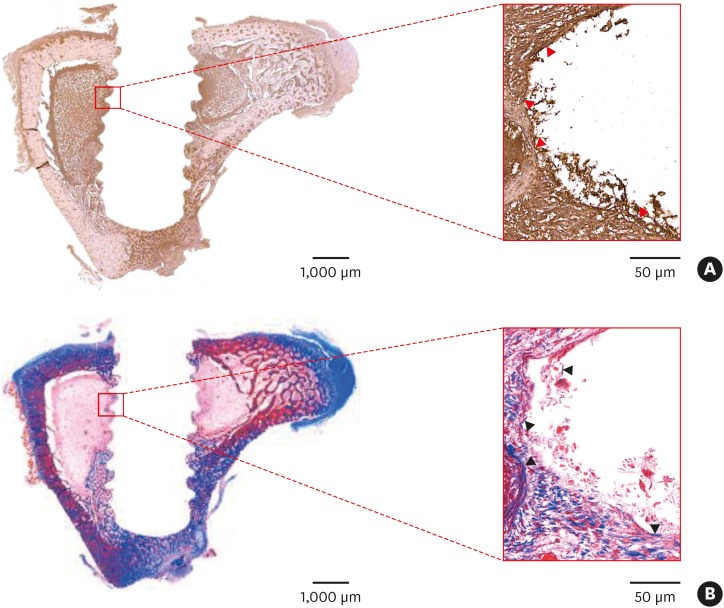
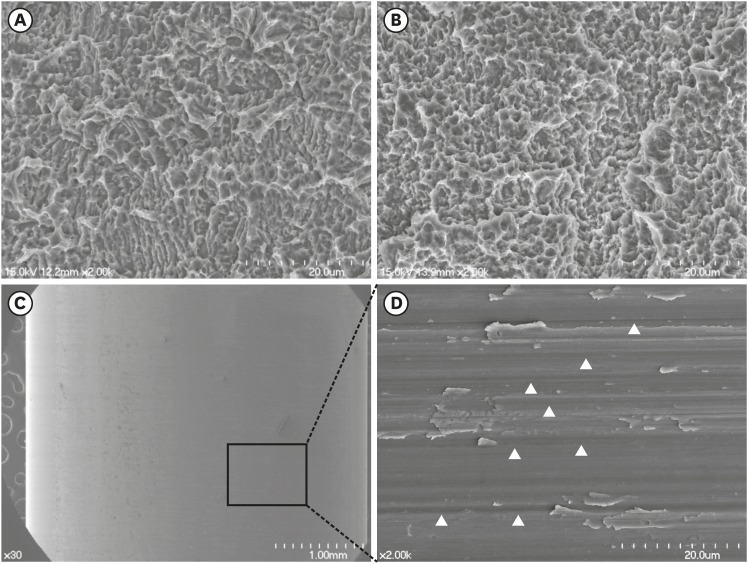
Sandblasted and acid-etched (SLA) and modified SLA (modSLA) implants were used. Both types had been sandblasted with large grit and then etched with acid. The modSLA implants then underwent additional treatment to increase hydrophilicity. The implants were implanted into rabbit tibiae, and half were implanted within Ti tubes. The bone-to-implant contact (BIC) ratio was calculated for each implant. Immunohistochemical analyses of bone morphogenetic protein (BMP)-2 expression and new bone formation (Masson trichrome stain) were performed.
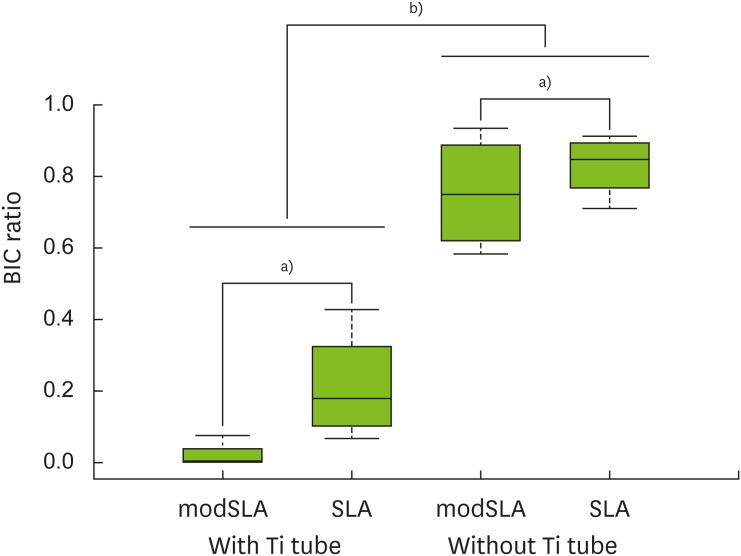
The implants outside of Ti tubes were associated with good bone formation along the implant surface. Implantation within a Ti tube significantly reduced the BIC ratio (<0.001). Compared with the modSLA implants, the SLA implants were associated with significantly higher BIC ratios, regardless of the presence or absence of Ti tubes (=0.043). In the absence of Ti tubes, the bone adjacent to the implant had areas of new bone formation that expressed BMP-2 at high levels.
This study disproved the null hypothesis and suggested that contact osteogenesis is initiated by signals from the old bone that undergoes distance osteogenesis after drilling. This signal may be BMP-2.
接触性成骨和距离性成骨发生于所有骨内牙种植体周围。然而,这些过程背后的机制尚未完全阐明。我们假设这些过程相互独立发生。为了验证这一点,我们使用钛(Ti)管在物理上分隔接触性成骨和距离性成骨,从而能够在不存在距离性成骨可能引发因素的情况下测量接触性成骨。
使用喷砂和酸蚀(SLA)种植体以及改良型SLA(modSLA)种植体。两种类型的种植体均先用大颗粒喷砂,然后进行酸蚀。modSLA种植体随后接受额外处理以增加亲水性。将种植体植入兔胫骨,其中一半植入Ti管内。计算每个种植体的骨-种植体接触(BIC)率。进行骨形态发生蛋白(BMP)-2表达的免疫组织化学分析以及新骨形成(Masson三色染色)分析。
Ti管外的种植体沿种植体表面有良好的骨形成。植入Ti管内显著降低了BIC率(<0.001)。与modSLA种植体相比,无论有无Ti管,SLA种植体的BIC率均显著更高(=0.043)。在没有Ti管的情况下,种植体相邻的骨有新骨形成区域,且高水平表达BMP-2。
本研究否定了原假设,并表明接触性成骨是由钻孔后发生距离性成骨的旧骨发出的信号启动的。该信号可能是BMP-2。