Bielen Kenny, 's Jongers Bart, Boddaert Jan, Raju Tom K, Lammens Christine, Malhotra-Kumar Surbhi, Jorens Philippe G, Goossens Herman, Kumar-Singh Samir
Molecular Pathology Group, Laboratory of Cell Biology and Histology, Faculty of Medicine and Health Sciences, University of AntwerpWilrijk, Belgium.
Laboratory of Medical Microbiology-Vaccine and Infectious Disease Institute, University of AntwerpWilrijk, Belgium.
Front Cell Infect Microbiol. 2017 Jun 21;7:274. doi: 10.3389/fcimb.2017.00274. eCollection 2017.
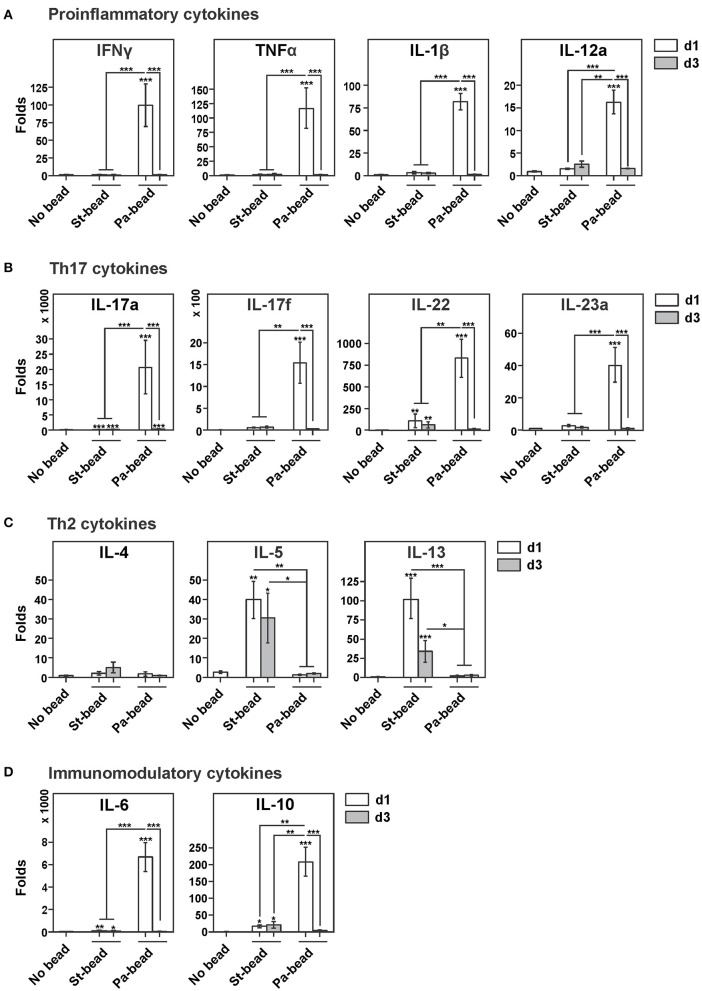
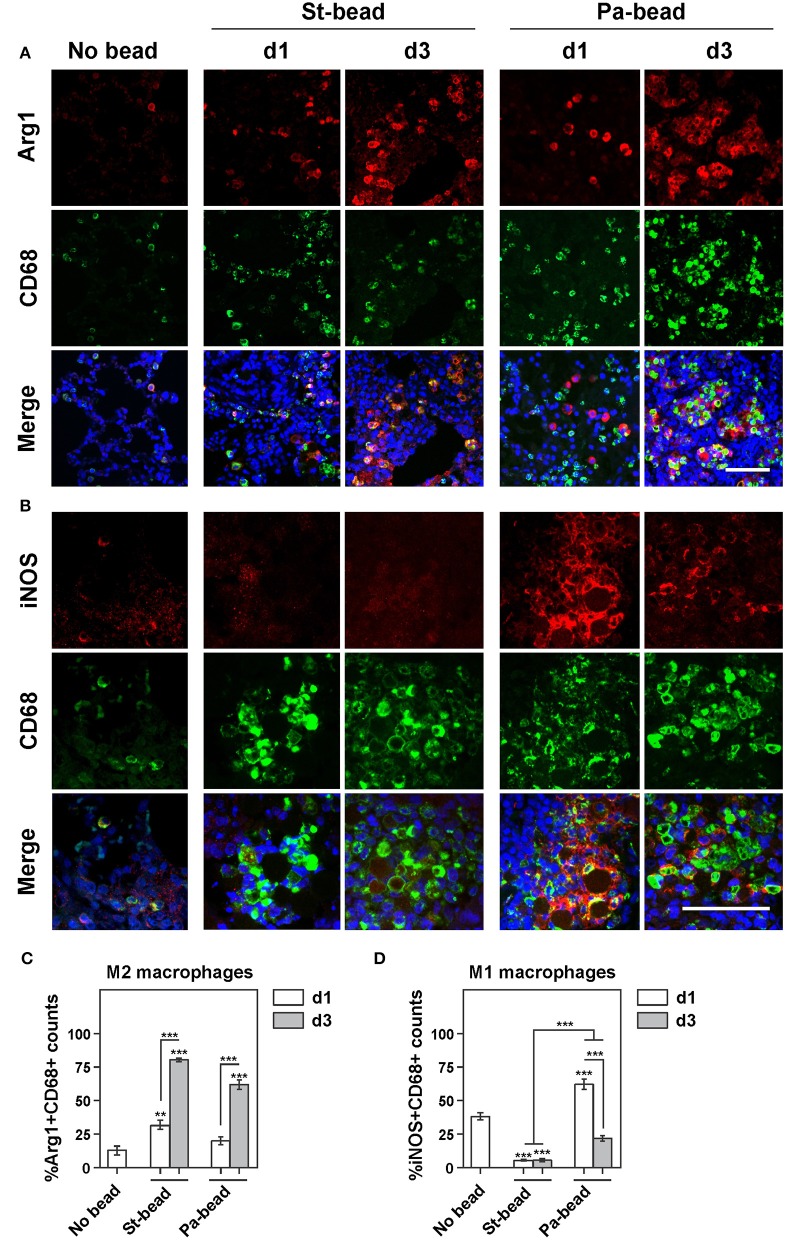
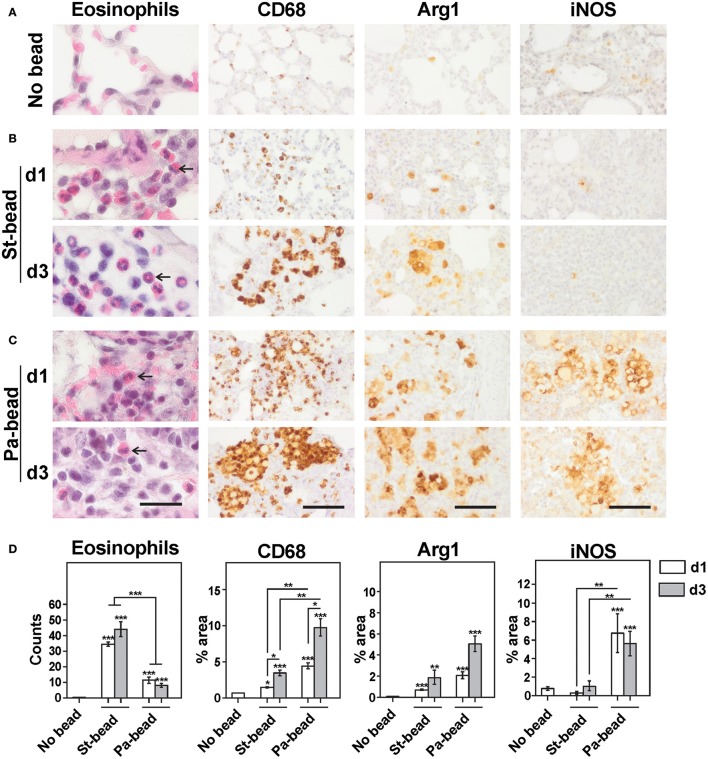
Biofilm-producing strains of are a major cause of morbidity and mortality in cystic fibrosis (CF) patients. In these patients, increased levels of IL-17 as well as of IL-5 and IL-13 along with arginase (Arg)-positive macrophages have been observed in bronchoalveolar lavage fluid. While IL-17 is a strong proinflammatory cytokine associated with host defense against bacterial and fungal infections and is also elevated in several autoimmune diseases, IL-5/IL-13 and Arg1-positive M2 macrophages are part of the anti-inflammatory type 2 (Th2) immunity. To study whether increased IL-5 and IL-13 levels are related to biofilm formation, which is frequently observed in CF patients colonized by , we utilized an agarose bead-embedded rat model commonly employed in biofilm studies. We showed that "sterile" agarose bead instillation in rat notably increased lung transcript levels of IL-5 and IL-13 at two post-instillation study-points, day 1 and day 3. Concurrently, increased infiltration of type 2 innate cells such as eosinophils and Arg1 positive M2 activated macrophages (Arg1+CD68+) was also observed both at day 1 and day 3 while the proportion of M1 activated macrophages (iNOS+CD68+) at these time-points decreased. In contrast, -loaded beads caused a drastic elevation of proinflammatory Th1 (IFNγ, TNFα, IL-12a) and antibacterial Th17 (IL-17a, IL-17f, IL-22, IL-23a) cytokines along with a high influx of neutrophils and M1 macrophages, while Th2 cytokines (IL-5 and IL-13) drastically declined at day 1 post-infection. Interestingly, at day 3 post-infection, both Th1 and Th17 cytokines sharply declined and corroborated with decreased M1 and increased M2 macrophages. These data suggest that while IL-17 is linked to episodes of acute exacerbations of infection in CF patients, the increased Th2 cytokines and M2 macrophages observed in these patients are largely due to the biofilm matrix. The data presented here has important implications for clinical management of CF patients.
产生生物膜的菌株是囊性纤维化(CF)患者发病和死亡的主要原因。在这些患者的支气管肺泡灌洗液中,已观察到白细胞介素-17(IL-17)以及IL-5和IL-13水平升高,同时还有精氨酸酶(Arg)阳性巨噬细胞。虽然IL-17是一种强大的促炎细胞因子,与宿主抵抗细菌和真菌感染有关,并且在几种自身免疫性疾病中也会升高,但IL-5/IL-13和Arg1阳性M2巨噬细胞是抗炎2型(Th2)免疫的一部分。为了研究IL-5和IL-13水平升高是否与生物膜形成有关(生物膜形成在被该菌株定植的CF患者中经常观察到),我们利用了一种常用于该菌株生物膜研究的琼脂糖珠包埋大鼠模型。我们发现,在大鼠中滴注“无菌”琼脂糖珠后,在滴注后的两个研究时间点,即第1天和第3天,肺组织中IL-5和IL-13的转录水平显著升高。同时,在第1天和第3天也观察到2型固有细胞如嗜酸性粒细胞和Arg1阳性M2活化巨噬细胞(Arg1+CD68+)的浸润增加,而此时M1活化巨噬细胞(iNOS+CD68+)的比例下降。相比之下,负载该菌株的珠子导致促炎Th1(干扰素γ、肿瘤坏死因子α、IL-12a)和抗菌Th17(IL-17a、IL-17f、IL-22、IL-23a)细胞因子急剧升高,同时中性粒细胞和M1巨噬细胞大量涌入,而Th2细胞因子(IL-5和IL-13)在感染后第1天急剧下降。有趣的是,在感染后第3天,Th1和Th17细胞因子均急剧下降,同时M1巨噬细胞减少,M2巨噬细胞增加。这些数据表明,虽然IL-17与CF患者感染急性加重发作有关,但在这些患者中观察到的Th2细胞因子和M2巨噬细胞增加主要归因于生物膜基质。本文所呈现的数据对CF患者的临床管理具有重要意义。