Booiman Thijs, Wit Ferdinand W, Maurer Irma, De Francesco Davide, Sabin Caroline A, Harskamp Agnes M, Prins Maria, Garagnani Paolo, Pirazzini Chiara, Franceschi Claudio, Fuchs Dietmar, Gisslén Magnus, Winston Alan, Reiss Peter, Kootstra Neeltje A
Department of Experimental Immunology and.
Amsterdam Institute for Global Health and Development, Netherlands.
Open Forum Infect Dis. 2017 May 25;4(3):ofx108. doi: 10.1093/ofid/ofx108. eCollection 2017 Summer.
Increased monocyte activation and intestinal damage have been shown to be predictive for the increased morbidity and mortality observed in treated people living with human immunodeficiency virus (PLHIV).
A cross-sectional analysis of cellular and soluble markers of monocyte activation, coagulation, intestinal damage, and inflammation in plasma and cerebrospinal fluid (CSF) of PLHIV with suppressed plasma viremia on combination antiretroviral therapy and age and demographically comparable HIV-negative individuals participating in the Comorbidity in Relation to AIDS (COBRA) cohort and, where appropriate, age-matched blood bank donors (BBD).
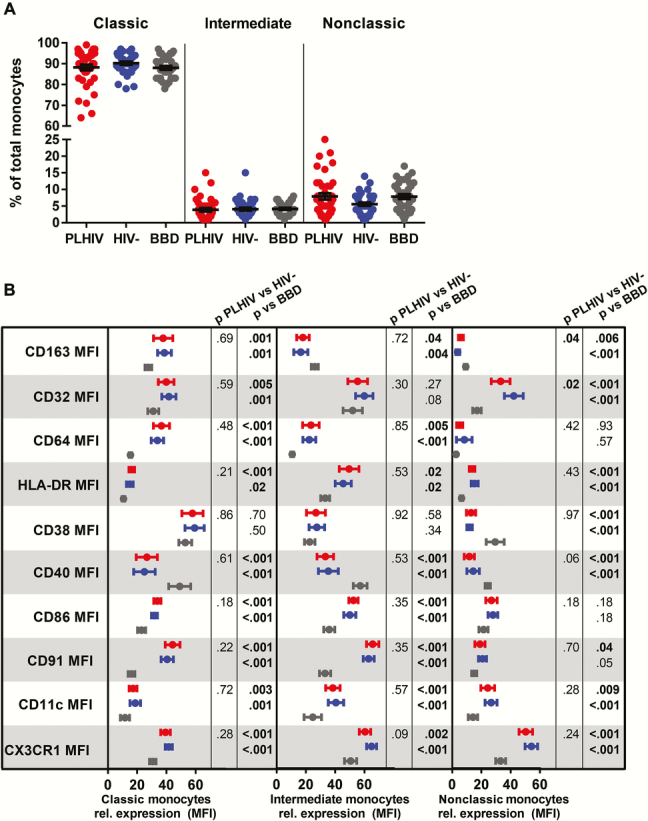
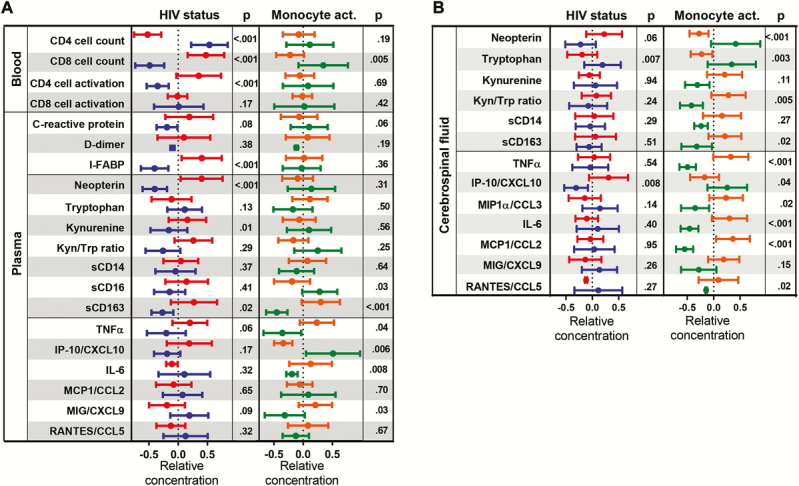
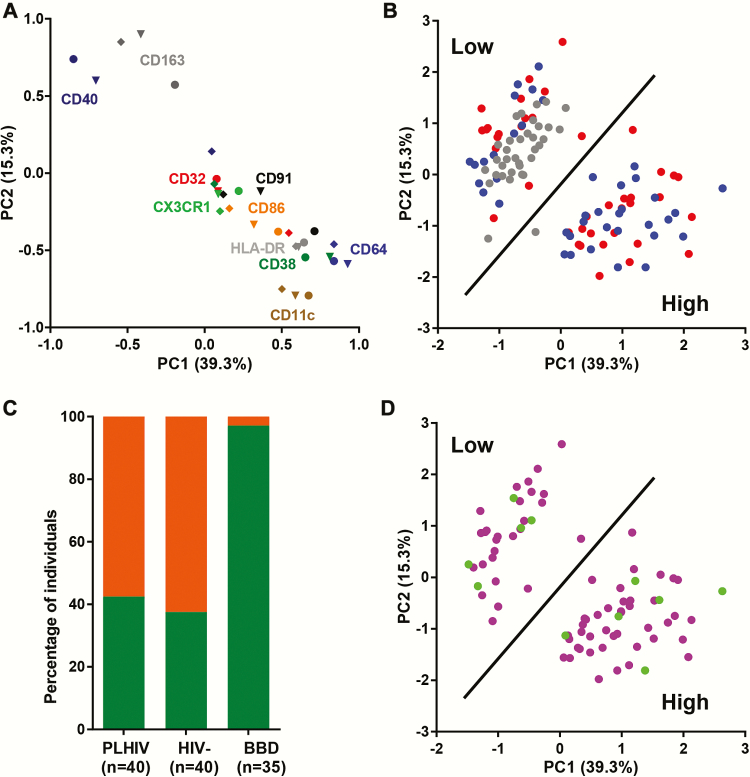
People living with HIV, HIV-negative individuals, and BBD had comparable percentages of classical, intermediate, and nonclassical monocytes. Expression of CD163, CD32, CD64, HLA-DR, CD38, CD40, CD86, CD91, CD11c, and CX3CR1 on monocytes did not differ between PLHIV and HIV-negative individuals, but it differed significantly from BBD. Principal component analysis revealed that 57.5% of PLHIV and 62.5% of HIV-negative individuals had a high monocyte activation profile compared with 2.9% of BBD. Cellular monocyte activation in the COBRA cohort was strongly associated with soluble markers of monocyte activation and inflammation in the CSF.
People living with HIV and HIV-negative COBRA participants had high levels of cellular monocyte activation compared with age-matched BBD. High monocyte activation was predictive for inflammation in the CSF.
单核细胞激活增加和肠道损伤已被证明可预测接受治疗的人类免疫缺陷病毒(HIV)感染者的发病率和死亡率上升。
对接受联合抗逆转录病毒治疗且血浆病毒血症得到抑制的HIV感染者以及年龄和人口统计学特征匹配的HIV阴性个体(参与艾滋病合并症[COBRA]队列研究),以及在适当情况下年龄匹配的血库捐献者(BBD)的血浆和脑脊液(CSF)中的单核细胞激活、凝血、肠道损伤和炎症的细胞及可溶性标志物进行横断面分析。
HIV感染者、HIV阴性个体和BBD的经典、中间和非经典单核细胞百分比相当。单核细胞上CD163、CD32、CD64、HLA-DR、CD38、CD40、CD86、CD91、CD11c和CX3CR1的表达在HIV感染者和HIV阴性个体之间没有差异,但与BBD有显著差异。主成分分析显示,与2.9%的BBD相比,57.5%的HIV感染者和62.5%的HIV阴性个体具有高单核细胞激活特征。COBRA队列中的细胞单核细胞激活与CSF中单核细胞激活和炎症的可溶性标志物密切相关。
与年龄匹配的BBD相比,HIV感染者和HIV阴性的COBRA参与者具有高水平的细胞单核细胞激活。高单核细胞激活可预测CSF中的炎症。