Khodavaisy S, Hedayati M T, Alialy M, Habibi M R, Badali H
Department of Medical Mycology and Parasitology, Kurdistan University of Medical Sciences, Sanandaj, Iran.
Department of Medical Mycology and Parasitology, School of Public Health and National Institute of Health Research, Tehran University of Medical Sciences, Tehran, Iran.
Curr Med Mycol. 2015 Mar;1(1):12-17. doi: 10.18869/acadpub.cmm.1.1.12.
Invasive aspergillosis (IA) is one of the most common life-threatening fungal infections among the critically ill patients including intensive care unit (ICU) patients. Delayed diagnosis and therapy may lead to poor outcomes. Diagnosis may be facilitated by a test for molecular biomarkers, i.e. detection of galactomannan (GM) antigen based on enzyme immunoassay, which is of increasing interest in the clinical settings for the diagnosis of IA. In the present study, we assessed GM testing of bronchoalveolar lavage (BAL) fluid as a tool for early diagnosis of IA among ICU patients who were at risk for developing IA.
A prospective study was performed in ICU patients with underlying predisposing conditions for IA between August 2010 and September 2011. BAL samples for direct microscopic examination, culture, and GM detection were obtained once or twice weekly. GM in BAL levels was measured using the Platellia Aspergillus EIA test kit. According to modified European Organization for the Research and Treatment of Cancer/ Mycoses Study Group (EORTC/MSG) criteria, patients were classified as having probable or possible IA.
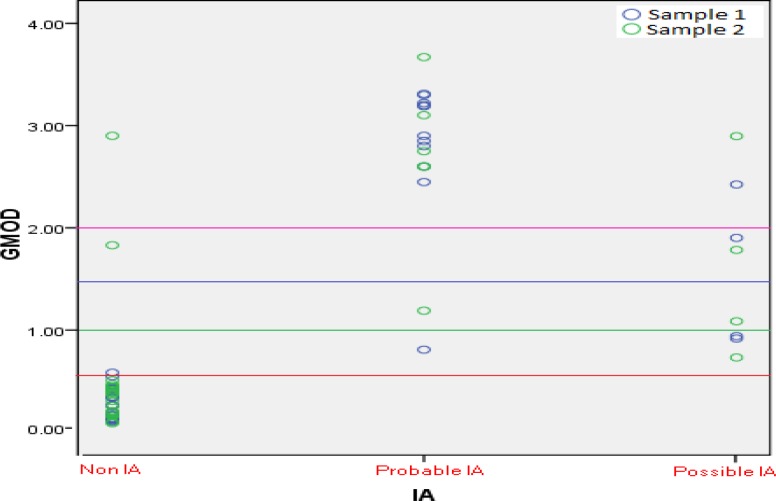
Out of 43 suspected patients to IA, 13 (30.2%) cases showed IA. According to the criteria presented by EORTC/MSG, they were categorized as: 4 cases (30.8%) of possible IA and 9 (69.2%) of probable IA. Out of 21 BAL samples from patients with IA, 11 (52.4%) had at least one positive BAL GM index. Using a cutoff index of 0.5, the sensitivity and specificity, positive and negative predictive values of GM detection in BAL fluid were 100%, 85.7%, 65.7% and 96%, respectively. The sensitivity and specificity was 73% and 92.7% at cutoff ≥1.0, respectively. In 6 of 13 IA cases, BAL culture or direct microscopic examination remained negative, whereas GM in BAL was positive.
Our data have revealed that the sensitivity of GM detection in BAL was better than that of conventional tests. It seems that GM detection in BAL is beneficial to establish or exclude the early diagnosis of IA in ICU patients.
侵袭性曲霉病(IA)是重症患者(包括重症监护病房[ICU]患者)中最常见的危及生命的真菌感染之一。诊断和治疗延迟可能导致不良后果。分子生物标志物检测,即基于酶免疫测定法检测半乳甘露聚糖(GM)抗原,可能有助于诊断,在IA诊断的临床环境中,这种方法越来越受到关注。在本研究中,我们评估了支气管肺泡灌洗(BAL)液的GM检测作为早期诊断有IA发生风险的ICU患者IA的一种工具。
2010年8月至2011年9月期间,对有IA潜在易患因素的ICU患者进行了一项前瞻性研究。每周获取一次或两次BAL样本用于直接显微镜检查、培养和GM检测。使用Platellia Aspergillus EIA检测试剂盒测量BAL液中的GM水平。根据修订后的欧洲癌症研究与治疗组织/真菌病研究组(EORTC/MSG)标准,将患者分类为可能患有或疑似患有IA。
在43例疑似IA患者中,13例(30.2%)确诊为IA。根据EORTC/MSG提出的标准,它们被分类为:4例(30.8%)疑似IA和9例(69.2%)很可能患有IA。在来自IA患者的21份BAL样本中,11份(52.4%)至少有一个阳性BAL GM指数。使用截断指数0.5时,BAL液中GM检测的敏感性和特异性、阳性和阴性预测值分别为100%、85.7%、65.7%和96%。截断值≥1.0时,敏感性和特异性分别为73%和92.7%。在13例IA病例中的6例中,BAL培养或直接显微镜检查仍为阴性,而BAL中的GM为阳性。
我们的数据表明,BAL中GM检测的敏感性优于传统检测。似乎BAL中GM检测有利于确立或排除ICU患者IA的早期诊断。