Stein Elizabeth, Elbadawi Lina I, Kazmierczak James, Davis Jeffrey P
MMWR Morb Mortal Wkly Rep. 2017 Jul 7;66(26):687-691. doi: 10.15585/mmwr.mm6626a2.
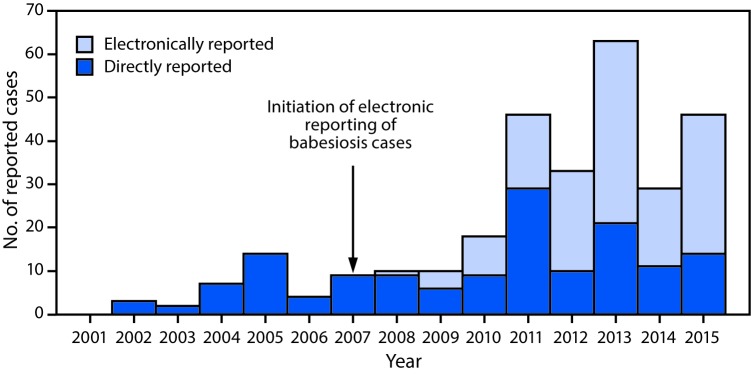
Babesiosis is an emerging zoonotic disease caused primarily by Babesia microti, an intraerythocytic protozoan. Babesia microti, like the causal agents for Lyme disease and anaplasmosis, is endemic to the northeastern and upper midwestern United States where it is usually transmitted by the blacklegged tick, Ixodes scapularis. Although babesiosis is usually a mild to moderate illness, older or immunocompromised persons can develop a serious malaria-like illness that can be fatal without prompt treatment. The most common initial clinical signs and symptoms of babesiosis (fever, fatigue, chills, and diaphoresis) are nonspecific and present diagnostic challenges that can contribute to delays in diagnosis and effective treatment with atovaquone and azithromycin (1). Results of one study revealed a mean delay of 12-14 days from symptom onset to treatment (2). Knowledge of the incidence and geographic distribution of babesiosis can raise the index of clinical suspicion and facilitate more prompt diagnosis and lifesaving treatment (1). The first known case of babesiosis in Wisconsin was detected in 1985 (3), and babesiosis became officially reportable in the state in 2001. Wisconsin babesiosis surveillance data for 2001-2015 were analyzed in 3-year intervals to compare demographic, epidemiologic, and laboratory features among patients with cases of reported babesiosis. To determine possible reasons for an increase in reported Babesia infection, trends in electronic laboratory reporting and diagnosis by polymerase chain reaction testing (PCR) were examined. Between the first and last 3-year analysis intervals, there was a 26-fold increase in the incidence of confirmed babesiosis, in addition to geographic expansion. These trends might be generalizable to other states with endemic disease, similar suburbanization and forest fragmentation patterns, and warming average temperatures (4). Accurate surveillance in states where babesiosis is endemic is necessary to estimate the increasing burden of babesiosis and other tickborne diseases and to develop appropriate public health interventions for prevention and practice.
巴贝斯虫病是一种新出现的人畜共患疾病,主要由微小巴贝斯虫引起,它是一种红细胞内的原生动物。微小巴贝斯虫与莱姆病和无形体病的病原体一样,在美国东北部和中西部上游地区呈地方性流行,通常由黑腿蜱——肩突硬蜱传播。虽然巴贝斯虫病通常是一种轻度至中度疾病,但老年人或免疫功能低下者可能会患上严重的类似疟疾的疾病,如不及时治疗可能会致命。巴贝斯虫病最常见的初始临床体征和症状(发热、疲劳、寒战和出汗)是非特异性的,带来了诊断挑战,可能导致诊断延迟以及使用阿托伐醌和阿奇霉素进行有效治疗的延迟(1)。一项研究结果显示,从症状出现到治疗的平均延迟时间为12 - 14天(2)。了解巴贝斯虫病的发病率和地理分布情况可提高临床怀疑指数,并有助于更及时地诊断和进行挽救生命的治疗(1)。威斯康星州首例已知的巴贝斯虫病病例于1985年被检测到(3),2001年该州正式开始报告巴贝斯虫病病例。对2001 - 2015年威斯康星州巴贝斯虫病监测数据按3年间隔进行分析,以比较报告的巴贝斯虫病病例患者的人口统计学、流行病学和实验室特征。为了确定报告的巴贝斯虫感染增加的可能原因,研究了电子实验室报告趋势以及聚合酶链反应检测(PCR)诊断情况。在第一个和最后一个3年分析间隔期间,除了地理范围扩大外,确诊的巴贝斯虫病发病率增加了26倍。这些趋势可能适用于其他有地方性疾病、类似郊区化和森林碎片化模式以及平均气温上升的州(4)。在巴贝斯虫病流行的州进行准确监测对于估计巴贝斯虫病和其他蜱传疾病日益增加的负担以及制定适当的预防和实践公共卫生干预措施是必要的。