Gehrman Philip, Gooneratne Nalaka S, Brewster Glenna S, Richards Kathy C, Karlawish Jason
Department of Psychiatry, University of Pennsylvania School of Medicine, USA; Center for Sleep and Respiratory Neurobiology, University of Pennsylvania School of Medicine, USA.
Center for Sleep and Respiratory Neurobiology, University of Pennsylvania School of Medicine, USA; Division of Geriatric Medicine, University of Pennsylvania School of Medicine, USA.
Geriatr Nurs. 2018 Jan-Feb;39(1):60-65. doi: 10.1016/j.gerinurse.2017.06.003. Epub 2017 Jul 3.
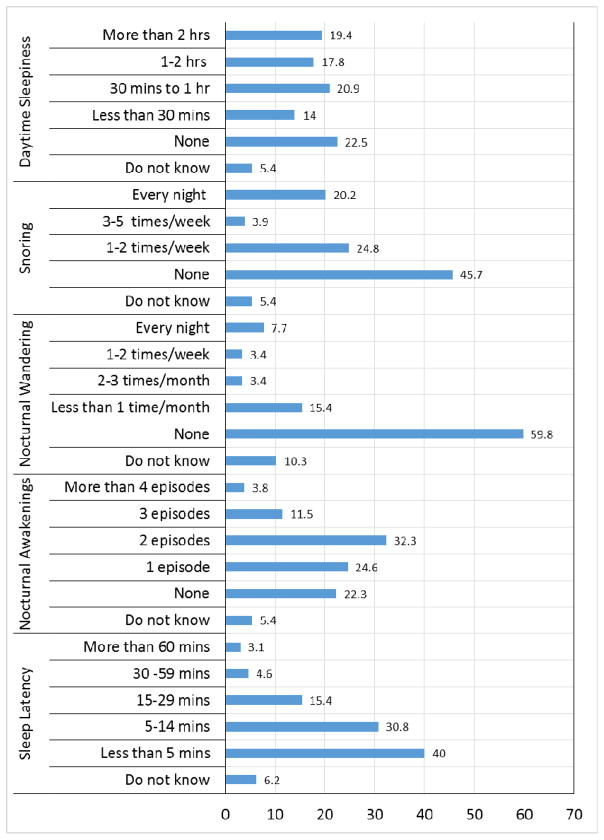
Sleep disturbance symptoms are common in persons living with Alzheimer disease (AD). However little is known about the impact of sleep disturbance symptoms in patients living with AD on caregiver burden and quality of life (QOL). The aims of this study were to determine the prevalence of symptoms of disturbed sleep in patients with AD, identify the care-recipient sleep disturbance symptoms that predict caregiver burden and QoL, and determine how care-recipient sleep disturbance symptoms compare to other caregiver and patient characteristics when predicting caregiver QoL. Caregiver burden was assessed using the Screen for Caregiver Burden. Sixty percent of the care-recipients had at least one sleep symptom. In 130 caregiver/patient dyads, nocturnal awakenings, nocturnal wandering, and snoring predicted caregiver burden. Multivariate modeling demonstrated that caregiver burden, caregiver physical and mental health, and caregiver depression were predictors of overall caregiver QoL. Treating disturbed sleep in care-recipients and caregiver mental health symptoms could have important public health impact by improving the lives of the caregiving dyad.
睡眠障碍症状在阿尔茨海默病(AD)患者中很常见。然而,对于AD患者的睡眠障碍症状对照顾者负担和生活质量(QOL)的影响知之甚少。本研究的目的是确定AD患者睡眠障碍症状的患病率,识别可预测照顾者负担和生活质量的受照顾者睡眠障碍症状,并确定在预测照顾者生活质量时,受照顾者睡眠障碍症状与其他照顾者和患者特征相比情况如何。使用照顾者负担筛查量表评估照顾者负担。60%的受照顾者至少有一种睡眠症状。在130对照顾者/患者二元组中,夜间觉醒、夜间徘徊和打鼾可预测照顾者负担。多变量模型表明,照顾者负担、照顾者身心健康和照顾者抑郁是照顾者总体生活质量的预测因素。治疗受照顾者的睡眠障碍和照顾者的心理健康症状可能会通过改善照顾二元组的生活而产生重要的公共卫生影响。