Palacios Òscar, Jiménez-Martí Elena, Niederwanger Michael, Gil-Moreno Selene, Zerbe Oliver, Atrian Sílvia, Dallinger Reinhard, Capdevila Mercè
Departament de Química, Facultat de Ciències, Universitat Autònoma de Barcelona, E-08193 Cerdanyola del Vallès, Spain.
Departament de Genètica, Facultat de Biologia, Universitat de Barcelona, Av. Diagonal 643, E-08028 Barcelona, Spain.
Int J Mol Sci. 2017 Jul 6;18(7):1452. doi: 10.3390/ijms18071452.
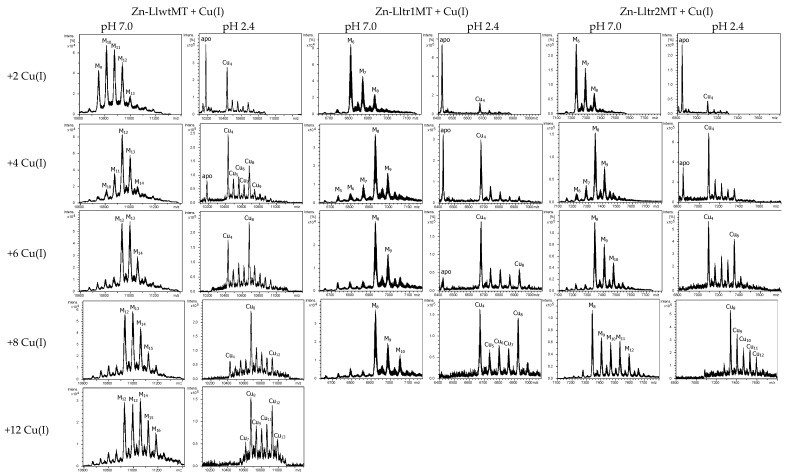
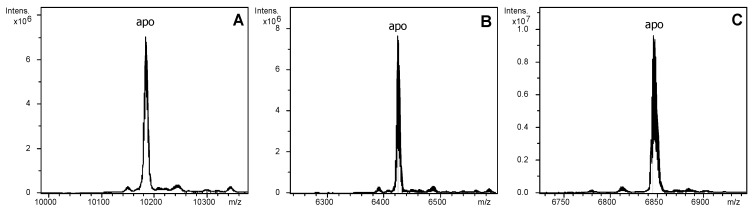
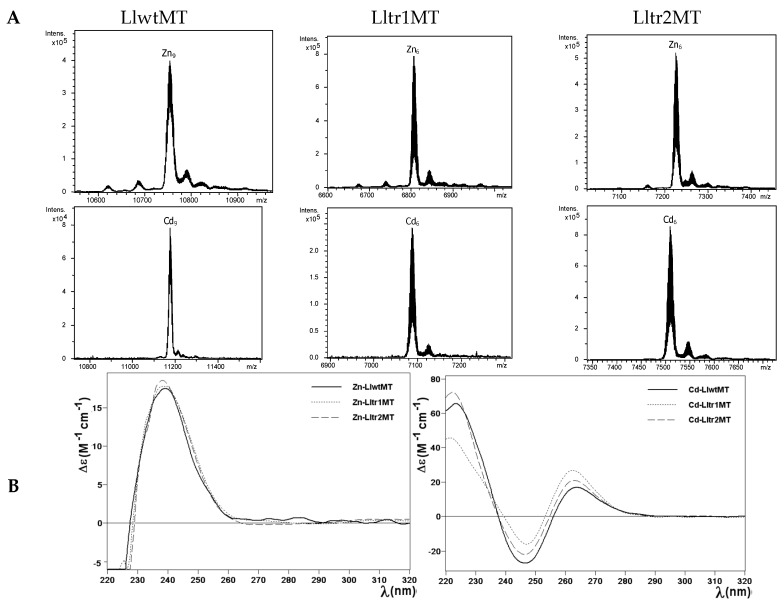
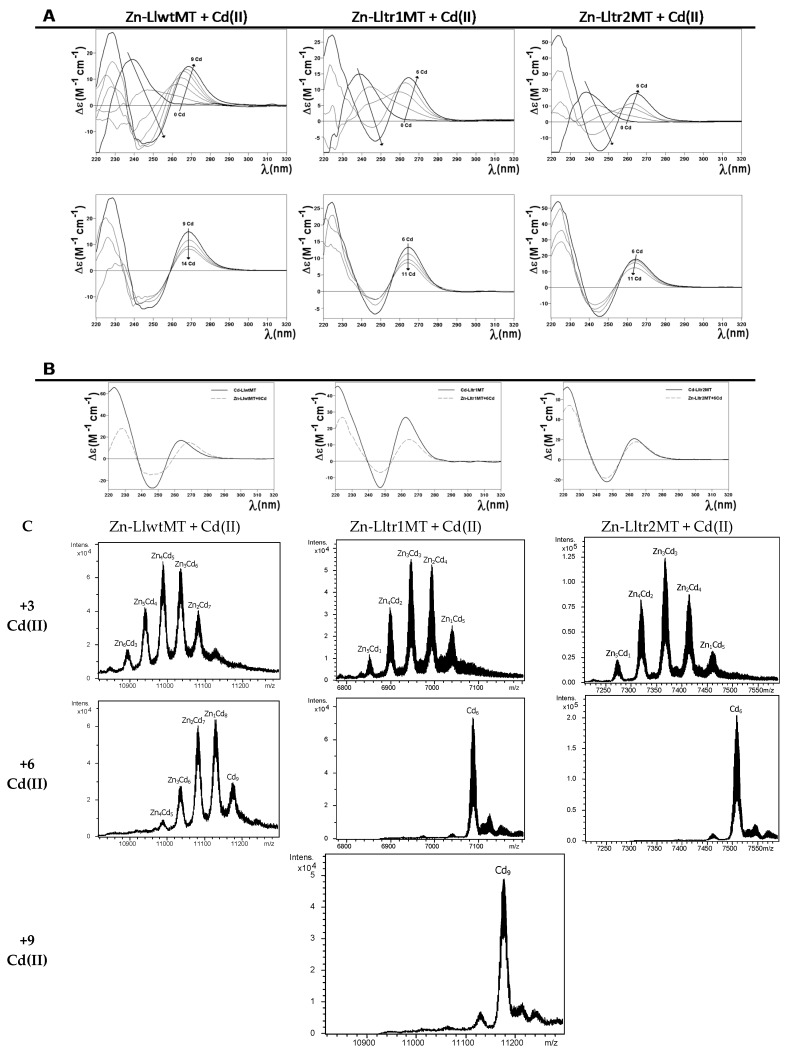
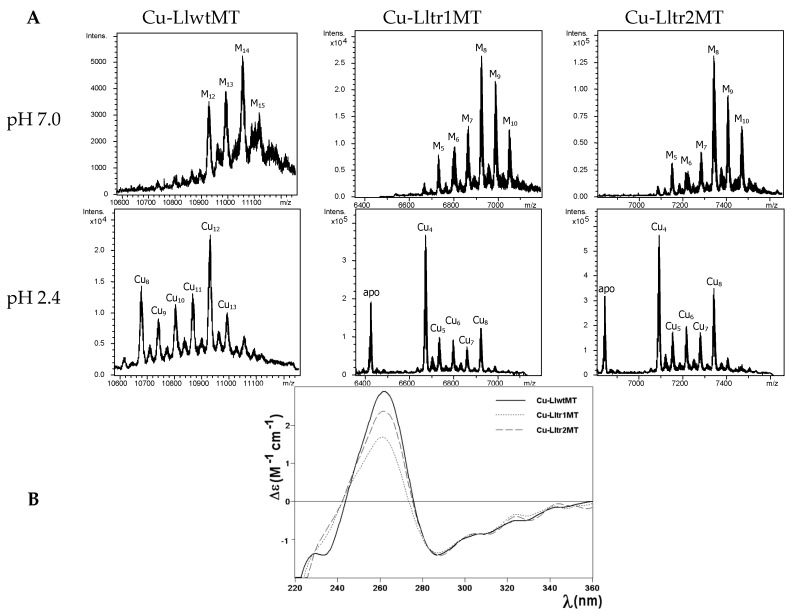
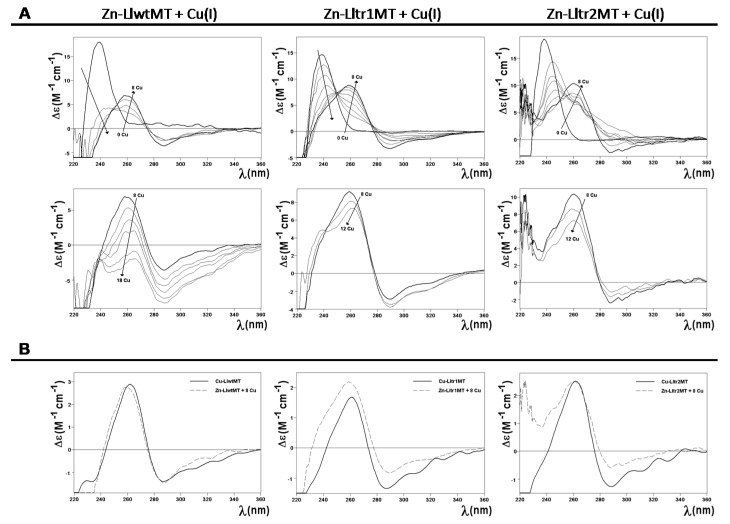
After the resolution of the 3D structure of the Cd₉-aggregate of the metallothionein (MT), we report here a detailed analysis of the metal binding capabilities of the wild type MT, LlwtMT, and of two truncated mutants lacking either the N-terminal domain, Lltr2MT, or both the N-terminal domain, plus four extra flanking residues (SSVF), Lltr1MT. The recombinant synthesis and in vitro studies of these three proteins revealed that LlwtMT forms unique M₉-LlwtMT complexes with Zn(II) and Cd(II), while yielding a complex mixture of heteronuclear Zn,Cu-LlwtMT species with Cu(I). As expected, the truncated mutants gave rise to unique M₆-LltrMT complexes and Zn,Cu-LltrMT mixtures of lower stoichiometry with respect to LlwtMT, with the SSVF fragment having an influence on their metal binding performance. Our results also revealed a major specificity, and therefore a better metal-coordinating performance of the three proteins for Cd(II) than for Zn(II), although the analysis of the Zn(II)/Cd(II) displacement reaction clearly demonstrates a lack of any type of cooperativity in Cd(II) binding. Contrarily, the analysis of their Cu(I) binding abilities revealed that every LlMT domain is prone to build Cu₄-aggregates, the whole MT working by modules analogously to, as previously described, certain fungal MTs, like those of and . It is concluded that the MT is a Cd-specific protein that (beyond its extended binding capacity through an additional Cd-binding domain) confers to a particular adaptive advantage in its changeable marine habitat.
在解析了金属硫蛋白(MT)的Cd₉聚集体的三维结构后,我们在此报告对野生型MT(LlwtMT)以及两个截短突变体的金属结合能力的详细分析,这两个截短突变体分别缺失N端结构域(Lltr2MT),或同时缺失N端结构域以及四个额外的侧翼残基(SSVF,Lltr1MT)。对这三种蛋白质的重组合成及体外研究表明,LlwtMT与Zn(II)和Cd(II)形成独特的M₉-LlwtMT复合物,而与Cu(I)形成异核Zn,Cu-LlwtMT物种的复杂混合物。正如预期的那样,截短突变体产生了独特的M₆-LltrMT复合物以及相对于LlwtMT化学计量较低的Zn,Cu-LltrMT混合物,SSVF片段对它们的金属结合性能有影响。我们的结果还揭示了这三种蛋白质对Cd(II)的主要特异性,因此对Cd(II)的金属配位性能优于对Zn(II),尽管对Zn(II)/Cd(II)置换反应的分析清楚地表明Cd(II)结合中缺乏任何类型的协同作用。相反,对它们结合Cu(I)能力的分析表明,每个LlMT结构域都易于形成Cu₄聚集体,整个MT通过模块工作,类似于先前描述的某些真菌MT,如 和 的MT。得出的结论是,MT是一种Cd特异性蛋白质,它(除了通过额外的Cd结合结构域具有扩展的结合能力之外)赋予 在其多变的海洋栖息地中特定的适应性优势。