Centre for Research in Psychology, Behaviour and Achievement, Coventry University, Coventry, UK.
School of Psychology, University of Birmingham, Birmingham, UK.
Autism Res. 2017 Nov;10(11):1891-1904. doi: 10.1002/aur.1828. Epub 2017 Jul 7.
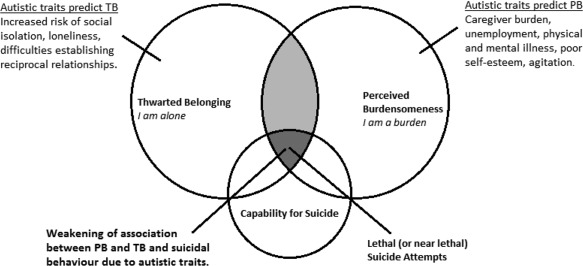
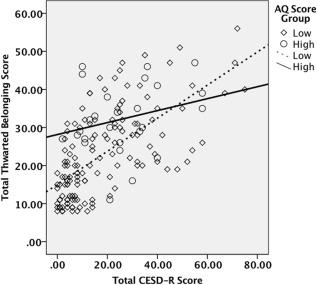
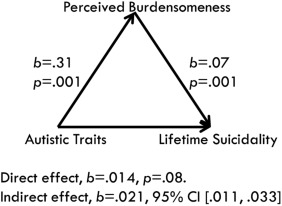
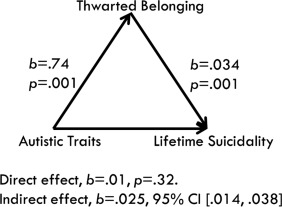
Autism spectrum conditions (ASC) has recently been associated with increased risk of suicidality. However, no studies have explored how autistic traits may interact with current models of suicidal behavior in a non-clinical population. The current study therefore explored how self-reported autistic traits interact with perceived burdensomeness and thwarted belongingness in predicting suicidal behavior, in the context of the Interpersonal-Psychological Theory of Suicide (IPTS). 163 young adults (aged 18-30 years) completed an online survey including measures of thwarted belonging and perceived burdensomeness (Interpersonal Needs Questionnaire), self-reported autistic traits (Autism Spectrum Quotient), current depression (Centre for Epidemiological Studies Depression Scale), and lifetime suicidality (Suicide Behavior Questionnaire-Revised). Results showed that burdensomeness and thwarted belonging significantly mediated the relationship between autistic traits and suicidal behavior. Both depression and autistic traits significantly predicted thwarted belonging and perceived burdensomeness. Autistic traits did not significantly moderate the relationship between suicidal behavior and thwarted belonging or perceived burdensomeness. Results suggest that the IPTS provides a useful framework for understanding the influence of autistic traits on suicidal behavior. However, the psychometric properties of these measures need be explored in those with clinically confirmed diagnosis of ASC. Autism Res 2017, 10: 1891-1904. © 2017 The Authors Autism Research published by International Society for Autism Research and Wiley Periodicals, Inc.
Recent research has shown that people with high autistic traits are more likely to attempt suicide. However, no studies have explored why. We found that people with high autistic traits were more likely to experience feelings that they do not belong in the world, are a burden on others, and depression, which may increase their likelihood of attempting suicide. These results suggest that promoting inclusion and independence in those with high autistic traits could help prevent people attempting suicide.
自闭症谱系障碍(ASC)最近与自杀风险增加有关。然而,尚无研究探讨自闭症特征如何与非临床人群中当前的自杀行为模型相互作用。因此,本研究探讨了在自杀的人际关系-心理理论(IPTS)背景下,自我报告的自闭症特征如何与感知的负担和归属感受挫相互作用,从而预测自杀行为。163 名年轻成年人(年龄在 18-30 岁之间)完成了一项在线调查,其中包括挫败感和归属感的测量(人际关系需求问卷),自我报告的自闭症特征(自闭症谱系商数),当前的抑郁(流行病学研究抑郁量表)和终生自杀(自杀行为问卷修订版)。结果表明,负担和归属感受挫显着介导了自闭症特征与自杀行为之间的关系。抑郁和自闭症特征均显着预测了归属感受挫和感知负担。自闭症特征与自杀行为和归属感受挫或感知负担之间的关系没有显着调节作用。结果表明,IPTS 为理解自闭症特征对自杀行为的影响提供了有用的框架。但是,需要在经临床确诊为 ASC 的人群中探索这些措施的心理计量特性。自闭症研究 2017 年,10:1891-1904。©2017 年自闭症研究国际协会和 Wiley 期刊出版公司自闭症研究出版。
最近的研究表明,具有较高自闭症特征的人更有可能尝试自杀。但是,尚无研究探讨原因。我们发现,具有较高自闭症特征的人更有可能感到自己不属于这个世界,是他人的负担,并且感到沮丧,这可能会增加他们尝试自杀的可能性。这些结果表明,促进自闭症特征较高的人的包容和独立感可能有助于防止人们尝试自杀。