Hanlon Colleen A, Dowdle Logan T, Correia Brittany, Mithoefer Oliver, Kearney-Ramos Tonisha, Lench Daniel, Griffin Millie, Anton Raymond F, George Mark S
Department of Psychiatry and Behavioral Sciences, Medical University of South Carolina, United States; Department of Neurosciences, Medical University of South Carolina, United States; Center for Biomedical Imaging, Medical University of South Carolina, United States.
Department of Psychiatry and Behavioral Sciences, Medical University of South Carolina, United States; Department of Neurosciences, Medical University of South Carolina, United States.
Drug Alcohol Depend. 2017 Sep 1;178:310-317. doi: 10.1016/j.drugalcdep.2017.03.039. Epub 2017 May 30.
Preclinical research has demonstrated a causal relationship between medial prefrontal cortex activity and cocaine self-administration. As a step towards translating those data to a neural circuit-based intervention for patients, this study sought to determine if continuous theta burst stimulation (cTBS) to the left frontal pole (FP), would attenuate frontal-striatal activity in two substance-dependent populations.
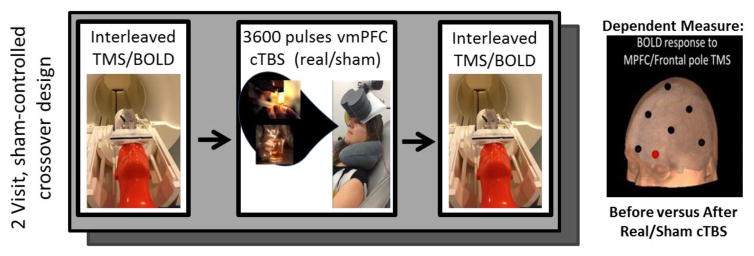
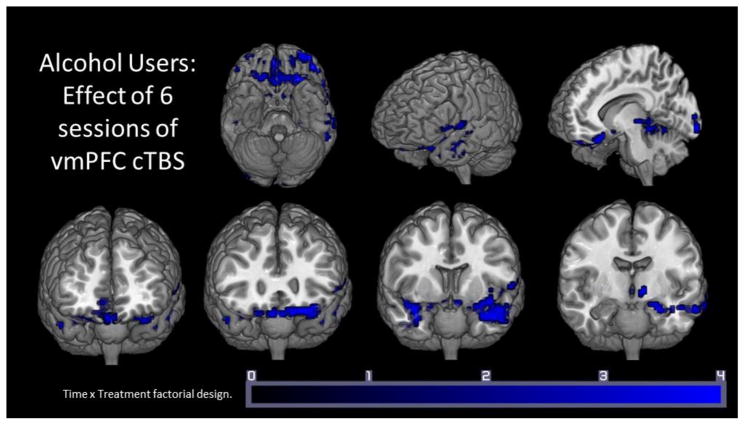
Forty-nine substance dependent individuals (25 cocaine, 24 alcohol) completed a single-blind, sham-controlled, crossover study wherein they received 6 trains of real or sham cTBS (110% resting motor threshold, FP1) each visit. Baseline evoked BOLD signal was measured immediately before and after real and sham cTBS (interleaved TMS/BOLD imaging: single pulses to left FP; scalp-to-cortex distance covariate, FWE correction p<0.05) RESULTS: Among cocaine users, real cTBS significantly decreased evoked BOLD signal in the caudate, accumbens, anterior cingulate, orbitofrontal (OFC) and parietal cortex relative to sham cTBS. Among alcohol users, real cTBS significantly decreased evoked BOLD signal in left OFC, insula, and lateral sensorimotor cortex. There was no significant difference between the groups.
These data suggest that 6 trains of left FP cTBS delivered in a single day decreases TMS-evoked BOLD signal in the OFC and several cortical nodes which regulate salience and are typically activated by drug cues. The reliability of this pattern across cocaine- and alcohol-dependent individuals suggests that cTBS may be an effective tool to dampen neural circuits typically engaged by salient drug cues. Multiday studies are required to determine it this has a sustainable effect on the brain or drug use behavior.
临床前研究已证明内侧前额叶皮质活动与可卡因自我给药之间存在因果关系。作为将这些数据转化为基于神经回路的患者干预措施的第一步,本研究旨在确定对左侧额极(FP)进行连续theta爆发刺激(cTBS)是否会减弱两个物质依赖人群的额叶 - 纹状体活动。
49名物质依赖个体(25名可卡因使用者,24名酒精使用者)完成了一项单盲、假对照、交叉研究,他们每次就诊时接受6组真实或假的cTBS(110%静息运动阈值,FP1)。在真实和假cTBS前后立即测量基线诱发的BOLD信号(交错TMS/BOLD成像:向左FP施加单脉冲;头皮到皮质距离协变量,FWE校正p<0.05)结果:在可卡因使用者中,相对于假cTBS,真实cTBS显著降低了尾状核、伏隔核、前扣带回、眶额叶(OFC)和顶叶皮质中诱发的BOLD信号。在酒精使用者中,真实cTBS显著降低了左侧OFC、岛叶和外侧感觉运动皮质中诱发的BOLD信号。两组之间没有显著差异。
这些数据表明,一天内进行6组左侧FP cTBS可降低OFC和几个调节显著性且通常由药物线索激活的皮质节点中的TMS诱发BOLD信号。这种模式在可卡因和酒精依赖个体中的可靠性表明,cTBS可能是一种有效工具,可抑制通常由显著药物线索激活的神经回路。需要进行多日研究以确定这是否对大脑或药物使用行为有可持续影响。