Xia Zhi, Cholewa Jason, Zhao Yan, Shang Hua-Yu, Yang Yue-Qin, Araújo Pessôa Kassiana, Su Quan-Sheng, Lima-Soares Fernanda, Zanchi Nelo Eidy
Exercise Physiology and Biochemistry Laboratory, College of Physical Education, Jinggangshan UniversityJi'an, China.
Department of Sports Medicine, Chengdu Sport UniversityChengdu, China.
Front Physiol. 2017 Jun 22;8:434. doi: 10.3389/fphys.2017.00434. eCollection 2017.
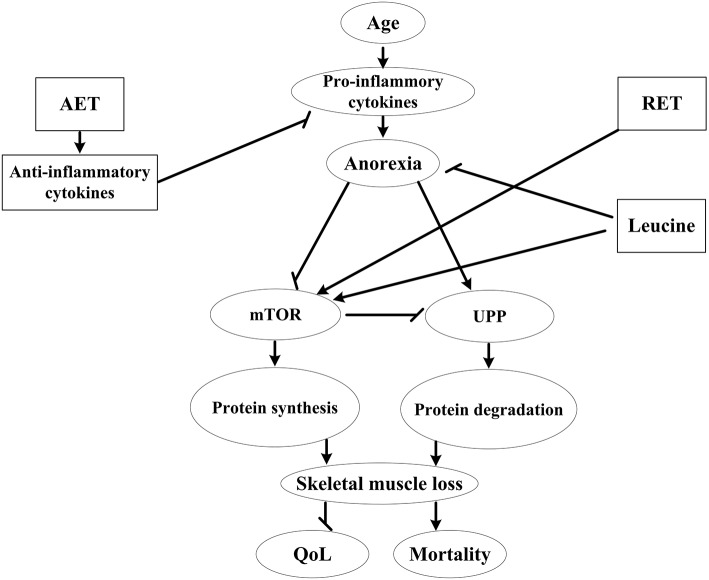
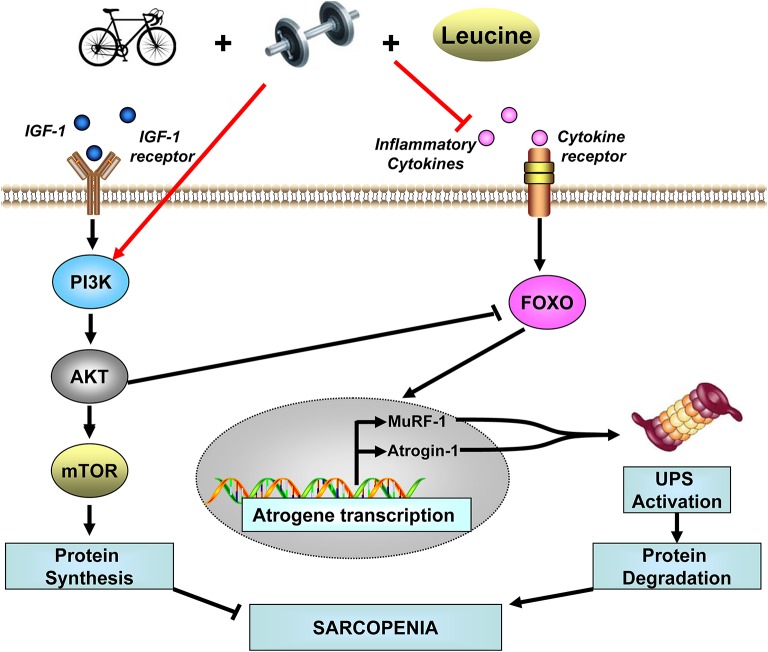
Sarcopenia is defined as the progressive loss of muscle mass with age, and poses a serious threat to the physiological and psychological health of the elderly population with consequential economic and social burdens. Chronic low-grade inflammation plays a central role in the development of sarcopenia such that it alters cellular protein metabolism to favor proteolysis over synthesis, and thereby accelerates muscular atrophy. The purpose of this review is to highlight how exercise and nutrition intervention strategies can attenuate or treat sarcopenia. Resistance exercise increases not only muscle mass but also muscle strength, while aerobic exercise is able to ameliorate the age-related metabolic disorders. Concurrent exercise training integrates the advantages of both aerobic and resistance exercise, and may exert a significant synergistic effect in the aging organism. Higher protein intakes rich in the amino acid leucine appear to restore skeletal muscle protein metabolism balance by rescuing protein synthesis in older adults. There is good reason to believe that a multimodal treatment, a combination of exercise and increased leucine consumption in the diet, can combat some of the muscle loss associated with aging. Future research is needed to consolidate these findings to humans, and to further clarify to what extent and by which mechanisms protein metabolism might be directly involved in sarcopenia pathogenesis and the multimodal treatment responses.
肌肉减少症被定义为随着年龄增长肌肉质量的逐渐丧失,对老年人群的生理和心理健康构成严重威胁,并带来相应的经济和社会负担。慢性低度炎症在肌肉减少症的发展中起核心作用,它改变细胞蛋白质代谢,使蛋白水解优于合成,从而加速肌肉萎缩。本综述的目的是强调运动和营养干预策略如何减轻或治疗肌肉减少症。抗阻运动不仅能增加肌肉质量,还能增强肌肉力量,而有氧运动能够改善与年龄相关的代谢紊乱。同时进行运动训练整合了有氧运动和抗阻运动的优势,可能在衰老机体中发挥显著的协同作用。富含亮氨酸的较高蛋白质摄入量似乎通过挽救老年人的蛋白质合成来恢复骨骼肌蛋白质代谢平衡。有充分的理由相信,运动和饮食中增加亮氨酸摄入相结合的多模式治疗可以对抗一些与衰老相关的肌肉流失。未来需要进行研究,将这些发现应用于人类,并进一步阐明蛋白质代谢在多大程度上以及通过何种机制可能直接参与肌肉减少症的发病机制和多模式治疗反应。