Feng Ying, Yin Yanhai, Fei Shuizhang
Interdepartmental Graduate Major in Genetics and Genomics, Iowa State University, AmesIA, United States.
Department of Genetics, Development, and Cell Biology, Iowa State University, AmesIA, United States.
Front Plant Sci. 2017 Jun 22;8:1107. doi: 10.3389/fpls.2017.01107. eCollection 2017.
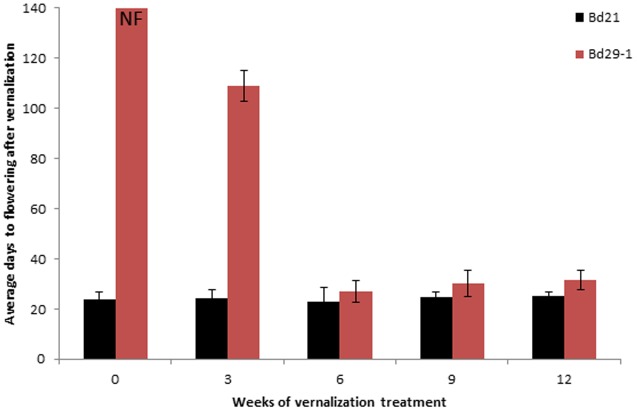
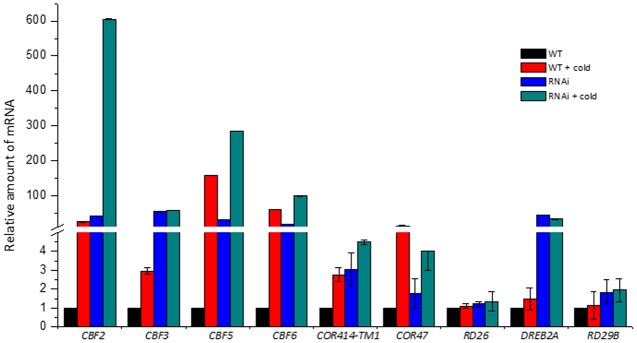
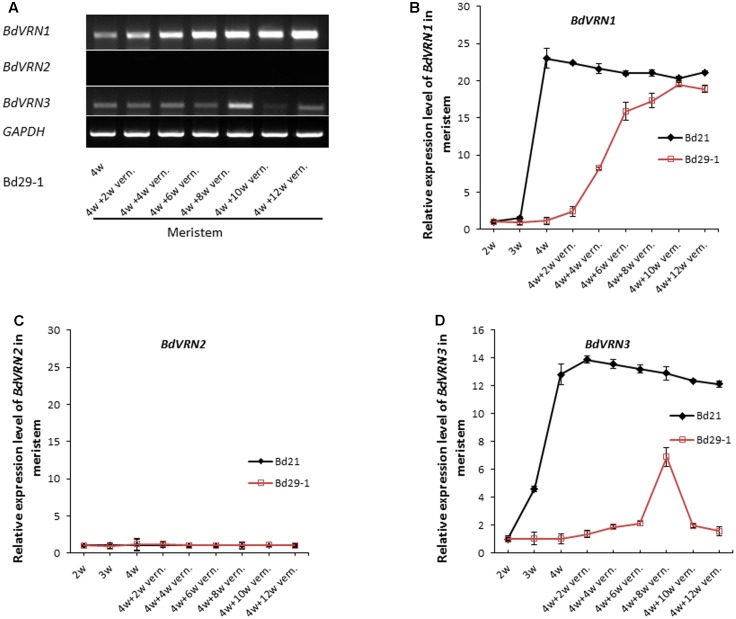
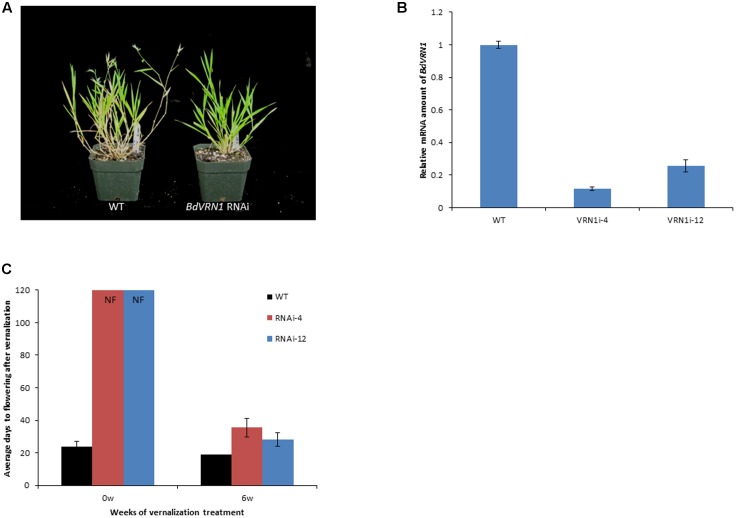
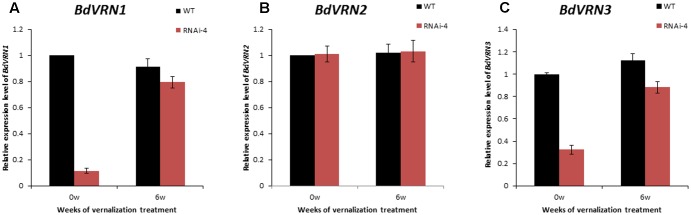
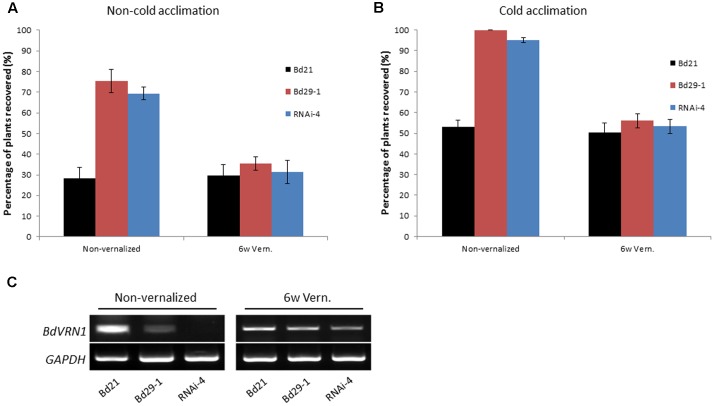
Vernalization is an essential process by which many temperate plant species acquire competence for flowering. is a model plant for temperate grasses including many cool-season forage and turfgrasses and cereals. Grasses with spring growth habit do not require vernalization for flowering and are typically less winter hardy. Yet the connection between vernalization and freezing tolerance remain unclear. The diverse requirement of vernalization for flowering makes it an ideal choice for studying the relationship between vernalization and freezing tolerance. Here, we isolated and analyzed the spatial and temporal expression patterns of two vernalization related homologous genes, and in Bd21, a non-vernalization-requiring accession, and Bd29-1, an accession shown to be vernalization-requiring. We showed that expression of and is independent of vernalization in Bd21, but is vernalization dependent in Bd29-1. Moreover, vernalization-induced expression of appears to precede that of in Bd29-1. Bd21 RNAi knockdown mutants for conferred vernalization requirement for flowering, and reduced the expression of Both Bd29-1 and the RNAi mutants of Bd21 exhibited reduced freezing tolerance upon vernalization treatment. Cold-responsive genes , , , , and were all constitutively expressed at a high level in the RNAi mutants of Bd21. Taken together, our results suggest that expression of promotes flowering by upregulating , and gaining the competency for flowering reduces freezing tolerance in .
春化作用是许多温带植物物种获得开花能力的一个重要过程。[植物名称]是温带禾本科植物的模式植物,包括许多冷季型牧草、草坪草和谷类作物。具有春季生长习性的禾本科植物开花不需要春化作用,通常抗寒性较差。然而,春化作用与抗冻性之间的联系仍不清楚。春化作用对开花的不同要求使其成为研究春化作用与抗冻性之间关系的理想选择。在这里,我们分离并分析了两个与春化作用相关的同源基因[基因名称1]和[基因名称2]在Bd21(一个不需要春化作用的种质)和Bd29 - 1(一个显示需要春化作用的种质)中的时空表达模式。我们发现,[基因名称1]和[基因名称2]在Bd21中的表达与春化作用无关,但在Bd29 - 1中则依赖于春化作用。此外,在Bd29 - 1中,春化作用诱导的[基因名称1]表达似乎先于[基因名称2]。Bd21的[基因名称1]RNA干扰敲除突变体赋予了开花对春化作用的需求,并降低了[基因名称2]的表达。Bd29 - 1和Bd21的[基因名称1]RNA干扰突变体在春化处理后均表现出抗冻性降低。冷响应基因[基因名称3]、[基因名称4]、[基因名称5]、[基因名称6]和[基因名称7]在Bd21的[基因名称1]RNA干扰突变体中均持续高水平表达。综上所述,我们的结果表明,[基因名称1]的表达通过上调[基因名称2]来促进开花,并且获得开花能力会降低[植物名称]的抗冻性。