Perez Elizabeth Solis, Medina Mario Alberto González, Lomeli Manuel Lopez-Cabanillas, González Verónica Tijerina, Pérez Jesús Zacarías Villarreal, Lavalle González Fernando J, Imrhan Victorine, Juma Shanil, Vijayagopal Parakat, Boonme Kittipong, Prasad Chandan
TWU-UANL Consortium to Promote Research in Obesity and Obesity-related Diseases, Monterrey, Mexico.
School of Public Health and Nutrition of Universidad Autónoma de Nuevo León, Monterrey, Mexico.
BMC Obes. 2017 Jul 3;4:25. doi: 10.1186/s40608-017-0160-6. eCollection 2017.
Metabolic syndrome (MetS) is a major risk factor for cardiovascular disease and diabetes. Previous studies in obese children demonstrating a positive association between serum uric acid (sUA) and components of MetS are confounded by lack of uniformity in age and pubertal status of children. Therefore, we have examined the role of sUA in MetS and its components in pre-pubertal children (Tanner Stage I, age ≤ 9 years).
Pre-pubertal obese children (32 boys, 27 girls, age 6-9 years) were recruited from Nuevo Leon, Mexico. For comparison, an equal number of children with normal body mass index (BMI) in the same age range (22 Boys, 39 girls, age 6-9 years) were also recruited from the same community. Presence of MetS and its components was defined according to the criteria of International Diabetes Federation. Fasting blood was analyzed for lipids, glucose, insulin, and uric acid.
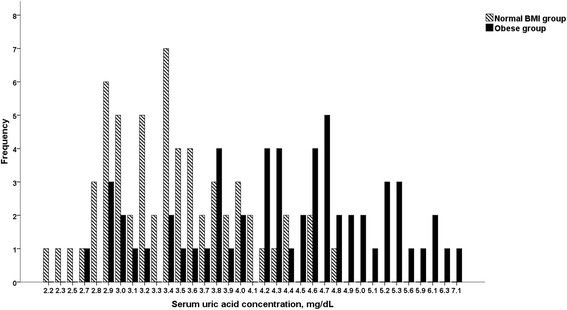
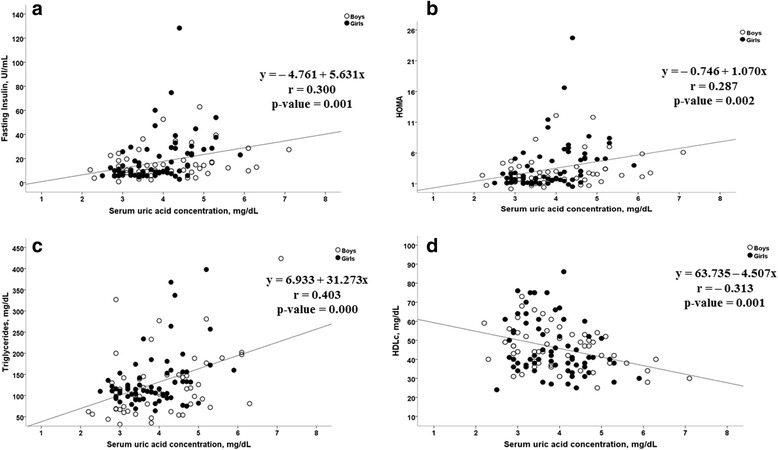
Among the obese children, sUA was positively associated with insulin resistance and hypertriglyceridemia and negatively associated with high density lipoprotein-cholesterol (HDLc). Subjects were three times more likely to have a MetS diagnosis per one unit (md/dL) difference in sUA. Of the 59 obese pre-pubertal children, 20 were classified as having MetS defined by the presence of abdominal obesity and two or more of other components described under methods. Of these, 57.1% (20/61) had sUA between 5.1 and 7.1 mg/dl.
The findings of this study clearly indicate a positive relationship between uric acid and MetS and its components in pre-pubertal obese children with Tanner stage I and ≤9 years of age.
代谢综合征(MetS)是心血管疾病和糖尿病的主要危险因素。先前针对肥胖儿童的研究表明血清尿酸(sUA)与MetS各组分之间存在正相关,但这些研究因儿童年龄和青春期状态缺乏一致性而受到干扰。因此,我们研究了sUA在青春期前儿童(坦纳I期,年龄≤9岁)的MetS及其组分中的作用。
从墨西哥新莱昂招募青春期前肥胖儿童(32名男孩,27名女孩,年龄6 - 9岁)。为作比较,还从同一社区招募了相同年龄范围(22名男孩,39名女孩,年龄6 - 9岁)且体重指数(BMI)正常的同等数量儿童。根据国际糖尿病联盟的标准定义MetS及其组分的存在情况。对空腹血样进行血脂、血糖、胰岛素和尿酸分析。
在肥胖儿童中,sUA与胰岛素抵抗和高甘油三酯血症呈正相关,与高密度脂蛋白胆固醇(HDLc)呈负相关。sUA每相差一个单位(md/dL),受试者被诊断为MetS的可能性高出三倍。在59名青春期前肥胖儿童中,20名被归类为患有由腹部肥胖以及方法中所述的其他两种或更多组分定义的MetS。其中,57.1%(20/61)的儿童sUA在5.1至7.1mg/dl之间。
本研究结果清楚地表明,尿酸与坦纳I期且年龄≤9岁的青春期前肥胖儿童的MetS及其组分之间存在正相关。